
Global Power Index 2026 – Military, Economy, Technology, Diplomacy & Influence
In 2026, the definition of power has shifted dramatically. Nations are no longer judged only by military strength or economic size. Today’s global power is shaped by AI capability, technological innovation, cybersecurity dominance, soft power, digital infrastructure, trade alliances, and global political influence.
This year’s ranking reflects a world shaped by artificial intelligence, climate challenges, geopolitical tension, expanding digital economies, and a restructuring of global alliances. The global power balance is fundamentally changing — some nations are rising faster than ever, while others are struggling to maintain influence.
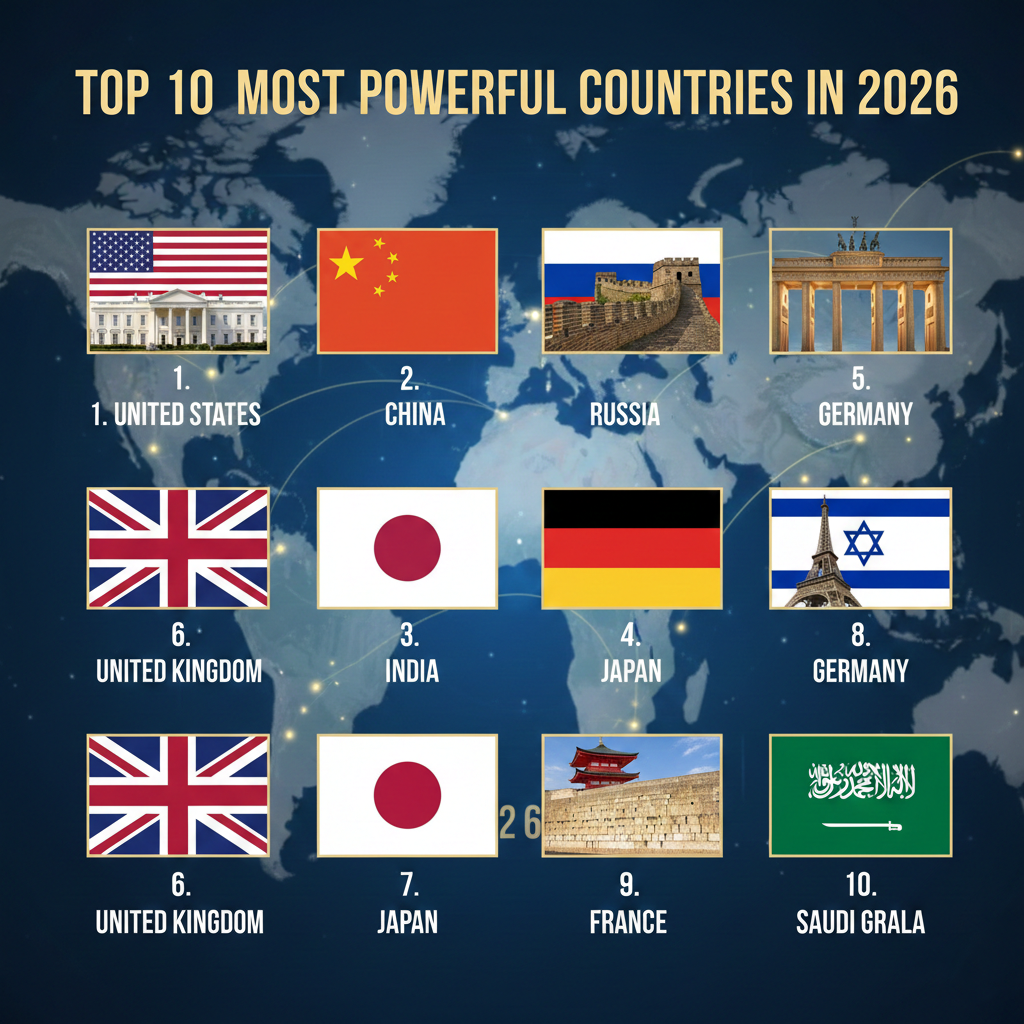
Here is the Top 10 list of the most powerful countries in 2026, based on combined strength across:
- Economy & GDP ranking
- Military power
- AI & technology leadership
- Global diplomacy
- Manufacturing & trade dominance
- Population advantage
- Cultural influence
- Energy & natural resources
- Cybersecurity strength
- Space technology progress
Let’s explore how each nation holds power in the new era.
1. United States – Still the World’s Most Influential Power
Despite internal political divides and external challenges, the U.S. continues to dominate globally.
Why the USA Is #1 in 2026
- World’s strongest military and nuclear capability
- Home to the most advanced AI companies (OpenAI, Nvidia, Google, Meta, Microsoft)
- Dominates global entertainment, media, and culture
- Leading space power via NASA & private companies (SpaceX, Blue Origin)
- Strong alliances: NATO, Japan, South Korea, India partnerships
- Largest consumer market in the world
- Most influential currency (USD remains the global reserve currency)
2026 Strength Points
American AI leadership is unmatched. Silicon Valley remains the innovation heart of the world, shaping trends in robotics, biotech, cybersecurity, and semiconductors.
The U.S. continues to set global standards in technology, defense modernization, cyber warfare capability, and international diplomacy.
2. China – The Rising Superpower Reshaping Global Order
China remains the world’s second-most powerful nation, though its economic growth has moderated.
Why China Is #2
- The world’s second-largest economy
- Massive manufacturing dominance
- Strong military expansion
- Leading in AI surveillance, smart cities, quantum computing
- Strategic Belt and Road Initiative (BRI) influence across 70+ countries
- Advanced space missions including lunar base plans
2026 Dynamics
China’s AI-driven economy alongside strong domestic innovation keeps it a formidable force. Its influence extends across Asia, Africa, and Latin America.
Though geopolitical tensions with the U.S. continue, China is now a global pillar of technology, trade, and military reach.
3. India – The Fastest-Growing Major Power of 2026
India’s transformation is one of the biggest global stories of the decade.
Why India Ranks #3
- The world’s fastest-growing large economy
- Strong digital infrastructure (UPI, ONDC, Aadhaar)
- Global IT hub, dominant in AI adoption
- Defense modernization and rising military capability
- Global manufacturing shift from China → India
- Largest population and young workforce
- Strong diplomatic influence (G20 presidency impact continues)
2026 Highlights
India is becoming the center of global outsourcing, AI innovation, chip manufacturing, fintech, electric mobility, and space exploration. The country is also emerging as a key geopolitical partner for the U.S., EU, Japan, and Middle Eastern nations.
4. Russia – Military Superpower With Strategic Energy Influence
Despite economic sanctions and geopolitical isolation in earlier years, Russia remains a military and energy powerhouse.
Why Russia Is #4
- One of the world’s strongest nuclear arsenals
- Large conventional military force
- Massive energy resources (oil, natural gas, minerals)
- Cyber warfare dominance
- Strong global influence through defense exports
2026 Dynamics
Russia’s power stems from military strength, strategic alliances, and control over key global energy supplies. It also maintains strong ties with China, Middle Eastern partners, and parts of Africa.
5. Japan – Technology, Innovation & Soft Power Titan
Japan remains one of the most advanced and stable global powers.
Why Japan Is #5
- World leader in robotics, semiconductors, and automotive engineering
- Strong economy and high-tech export industry
- Key U.S. ally in the Indo-Pacific
- Respected global soft power (culture, anime, gaming, entertainment)
- Advanced military modernization with new defense policies
2026 Picture
Japan’s strength lies in its innovation ecosystem and technological sophistication. Its commitment to AI, clean energy, and advanced manufacturing keeps it a top-tier global player.
6. Germany – Europe’s Powerhouse
Germany remains the strongest economy in Europe despite political and energy challenges.
Why Germany Ranks #6
- Europe’s largest economy
- High-tech engineering, machine tools, automotive industry
- Key EU decision-maker
- Strong military modernization
- Global export powerhouse
2026 Snapshot
Germany’s influence across European Union policy, trade agreements, and technological manufacturing makes it a central pillar of global power.
7. United Kingdom – Diplomatic & Financial Power Center
Post-Brexit, the UK has reinvented its global influence.
Why the UK Is #7
- Strongest financial hub after New York (London)
- Cultural and media influence worldwide
- Advanced military and intelligence networks (MI6, GCHQ)
- Space & defense investments
- Close ties with USA, EU, Commonwealth nations
2026 Insights
The UK’s soft power, global diplomacy, cybersecurity strength, and finance leadership ensure it remains in the top 10.
8. France – Military & Diplomatic Leader of Europe
France combines military strength with cultural and diplomatic influence.
Why France Ranks #8
- Strong military with nuclear capability
- One of the world’s biggest arms exporters
- Global diplomatic reach (UN, NATO, EU, Africa presence)
- Strong cultural appeal (fashion, films, arts, luxury goods)
2026 Overview
France’s strategic presence across Europe, Africa, and the Indo-Pacific ensures its position as a major world player.
9. South Korea – The Technology & Semiconductor Powerhouse
South Korea’s rise is driven by innovation and high-tech exports.
Why South Korea Is #9
- Global semiconductor leader (Samsung, SK Hynix)
- Strong AI development and robotics advancement
- Powerful economy with global brands
- Advanced military capability
- Strategic influence in East Asia
2026 Outlook
South Korea’s tech dominance, especially in chips and electronics, makes it a globally critical nation in the AI-driven era.
10. Saudi Arabia – The Rising Middle Eastern Superpower
Saudi Arabia’s transformation is accelerating under Vision 2030.
Why Saudi Arabia Is #10
- Control of major global oil supply
- Massive sovereign wealth fund (PIF) reshaping global investments
- Advanced defense spending
- Rapid growth in tourism, finance, and smart cities (NEOM)
- Strong influence in Middle East geopolitics
2026 Projection
Saudi Arabia is evolving from an oil-based economy to a diversified global force with influence in energy, geopolitics, sports, and investment.
Honorable Mentions (Countries Rising Fast)
🇦🇪 United Arab Emirates
A tech, finance, tourism, and AI powerhouse of the Middle East.
🇨🇦 Canada
Stable economy, strong diplomacy, high immigration influence.
🇦🇺 Australia
Key Asia-Pacific power with strong military and natural resources.
🇮🇱 Israel
Cybersecurity and defense technology global leader.
How Global Power Is Changing in 2026
Major global trends reshaping the power index:
1. AI Dominance = Strategic Power
Nations leading in AI (USA, China, India, Japan, South Korea) now dominate global influence.
2. Manufacturing Shifts
Companies are moving production from China → India → Vietnam → Mexico.
3. Geopolitical Alliances Are Realigning
U.S.–India partnership, China–Russia alignment, and Middle-East rising influence.
4. Cybersecurity Is Now National Defense
Countries investing in cyber offense/defense gain massive advantage.
5. Population = Workforce Power
India and ASEAN nations hold demographic advantages.
Conclusion
The global power landscape in 2026 is dynamic, competitive, and evolving faster than any time in modern history. Traditional military and economic strength remain important, but AI, technology leadership, digital infrastructure, cyber power, and innovation ecosystems now define global influence.
The Top 10 Most Powerful Countries in 2026 reflect a blend of old superpowers and fast-rising new giants.
The next decade will reshape global power further as AI accelerates geopolitical, economic, and military changes.
