

When Power Stops Obeying the Law
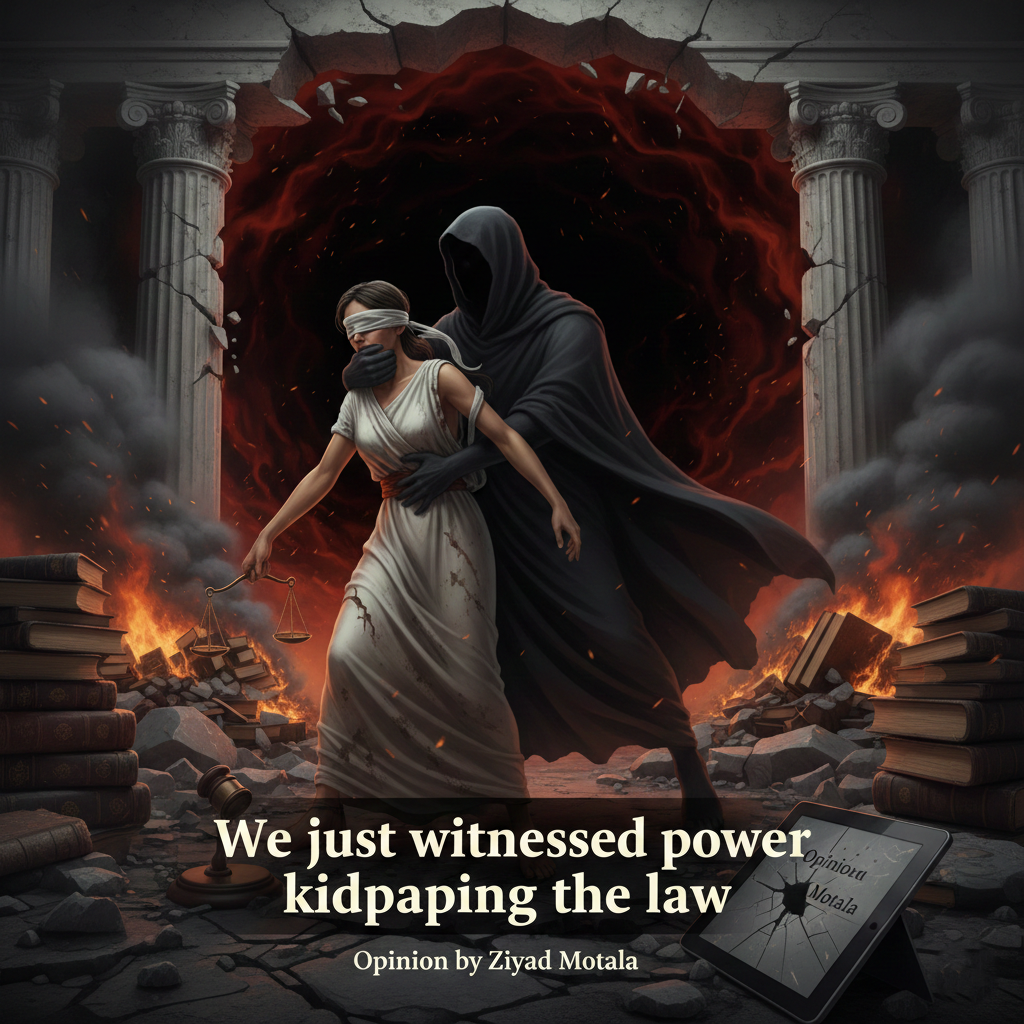
We just witnessed power kidnapping the law—not quietly, not subtly, but in full public view.
This is not a metaphor meant for dramatic effect. It is a precise description of a political moment where authority no longer submits to legal restraint, but instead bends, rewrites, or ignores it. When this happens, democracy does not collapse overnight. It erodes—slowly, deliberately, and often legally on paper.
Across democracies, especially those already under strain, we are seeing a troubling pattern: law is no longer the referee; it is becoming the hostage.
This opinion examines how power captures the legal system, why it is happening now, and what it means for constitutional democracy, accountability, and ordinary citizens.
The Meaning of “Power Kidnapping the Law”
At its core, law exists to restrain power.
When power kidnaps the law, the relationship reverses.
What This Looks Like in Practice
Instead of power being accountable to law, we see:
- Laws rewritten to protect those in power
- Courts pressured, bypassed, or selectively respected
- Investigative agencies weaponised against critics
- Legal procedures followed in form but violated in spirit
This is not outright dictatorship. It is legal authoritarianism—a system where injustice is delivered through seemingly lawful means.
How Democracies Slide Without Tanks or Coups
Modern democratic backsliding rarely involves military takeovers. It happens through institutions.
The Step-by-Step Erosion
- Delegitimising independent institutions
Courts, media, and watchdogs are branded as biased or “anti-national”. - Changing the rules mid-game
Laws are amended to favour incumbents, often rushed through legislatures. - Selective enforcement of law
Allies are protected. Opponents are prosecuted. - Normalising exceptional power
Emergency measures become permanent governance tools.
By the time citizens realise what is happening, the legal framework has already been reshaped.
When Law Becomes a Tool Instead of a Shield
The most dangerous moment for any democracy is when legality is used to justify injustice.
Law as an Instrument of Control
History shows us that:
- Apartheid was legal
- Segregation was legal
- Emergency rule has often been legal
Legality does not equal legitimacy.
When laws are crafted or interpreted solely to entrench power, the legal system stops protecting citizens and starts managing obedience.
Courts Under Pressure: The Last Line of Defence
An independent judiciary is the final barrier between power and impunity.
What Happens When Courts Are Cornered
Power kidnaps the law most effectively when:
- Judges are intimidated or publicly attacked
- Judicial appointments become politicised
- Court orders are ignored without consequence
- Delays are used as a strategic weapon
A court that cannot enforce its decisions is reduced to symbolism.
According to global assessments by organisations like the International Commission of Jurists, judicial independence is declining in multiple democracies worldwide
(Outbound reference: https://www.icj.org)
The Illusion of Due Process
One of the most deceptive aspects of modern authoritarianism is how procedures are followed while justice is denied.
Due Process in Name Only
We often hear:
- “The court will decide”
- “Let the investigation continue”
- “The law will take its course”
But when investigations are endless, bail is delayed without reason, or laws are applied unevenly, due process becomes punishment itself.
This tactic avoids public outrage while achieving political objectives.
Media, Silence, and Manufactured Consent
No kidnapping succeeds without silence—or distraction.
How Public Attention Is Managed
- Complex legal language hides simple abuses
- Sensational news replaces institutional analysis
- Critics are labelled rather than debated
When media ecosystems fail to explain legal overreach clearly, citizens stop recognising danger until it directly affects them.
Independent journalism platforms like thenews.zone play a crucial role in breaking down these issues for the public before it is too late.
(Internal link: thenews.zone)
Why This Moment Matters More Than Ever
This is not just about one case, one country, or one leader.
It is about precedent.
The Precedent Problem
Once power successfully kidnaps the law:
- Future governments inherit expanded authority
- Citizens lose faith in justice
- Institutions become reversible tools
Democracy becomes conditional—available only to those aligned with power.
Comparative Snapshot: Rule of Law vs Power Rule
| Principle | Rule of Law | Rule by Power |
|---|---|---|
| Accountability | Everyone equal | Selective |
| Courts | Independent | Pressured |
| Laws | Stable & fair | Flexible for power |
| Citizens | Rights holders | Subjects |
| Opposition | Protected | Criminalised |
This shift rarely announces itself. It normalises quietly.
Constitutionalism Under Threat
A constitution is meant to be a living restraint on authority.
When Constitutions Are Hollowed Out
Power kidnaps constitutionalism by:
- Amending core protections casually
- Ignoring constitutional morality
- Treating the document as a political inconvenience
As constitutional scholar warnings repeatedly note, a constitution survives only if those in power respect its spirit, not just its text
(Outbound reference: https://www.constitution.org)
The Citizen’s Role: Complicity or Resistance
Silence is not neutral.
How Ordinary People Become Unwilling Participants
- Accepting injustice as “normal politics”
- Believing it won’t affect them
- Distrusting institutions without defending them
Democracy does not die only because of powerful actors. It dies when citizens stop expecting better.
Frequently Asked Questions (FAQs)
What does “power kidnapping the law” actually mean?
It refers to situations where political power controls, manipulates, or overrides the legal system to protect itself rather than serve justice.
Can this happen in democracies?
Yes. In fact, it happens most effectively in democracies because it uses legal procedures to appear legitimate.
Is this the same as dictatorship?
No. It is more subtle. Elections may still occur, but fairness, accountability, and equality before law erode.
Why is judicial independence so important?
Because courts are the last institution capable of stopping unlawful power. Without them, no rights are secure.
Where can citizens stay informed about such issues?
Independent platforms like thenews.zone regularly publish legal and political analysis beyond headlines.
Conclusion: Law Must Rule Power, Not the Other Way Around
When power kidnaps the law, it does not announce a revolution. It performs one quietly.
This moment demands attention—not outrage alone, but understanding. Democracies survive not because power is benevolent, but because law is respected, defended, and enforced without fear or favour.
If we accept a system where power decides what the law means, then rights become permissions—and permissions can always be withdrawn.
The choice is stark but simple:
Either the law governs power, or power governs us all.
👉 Read more independent, in-depth analysis at thenews.zone and stay informed before silence becomes policy.
