

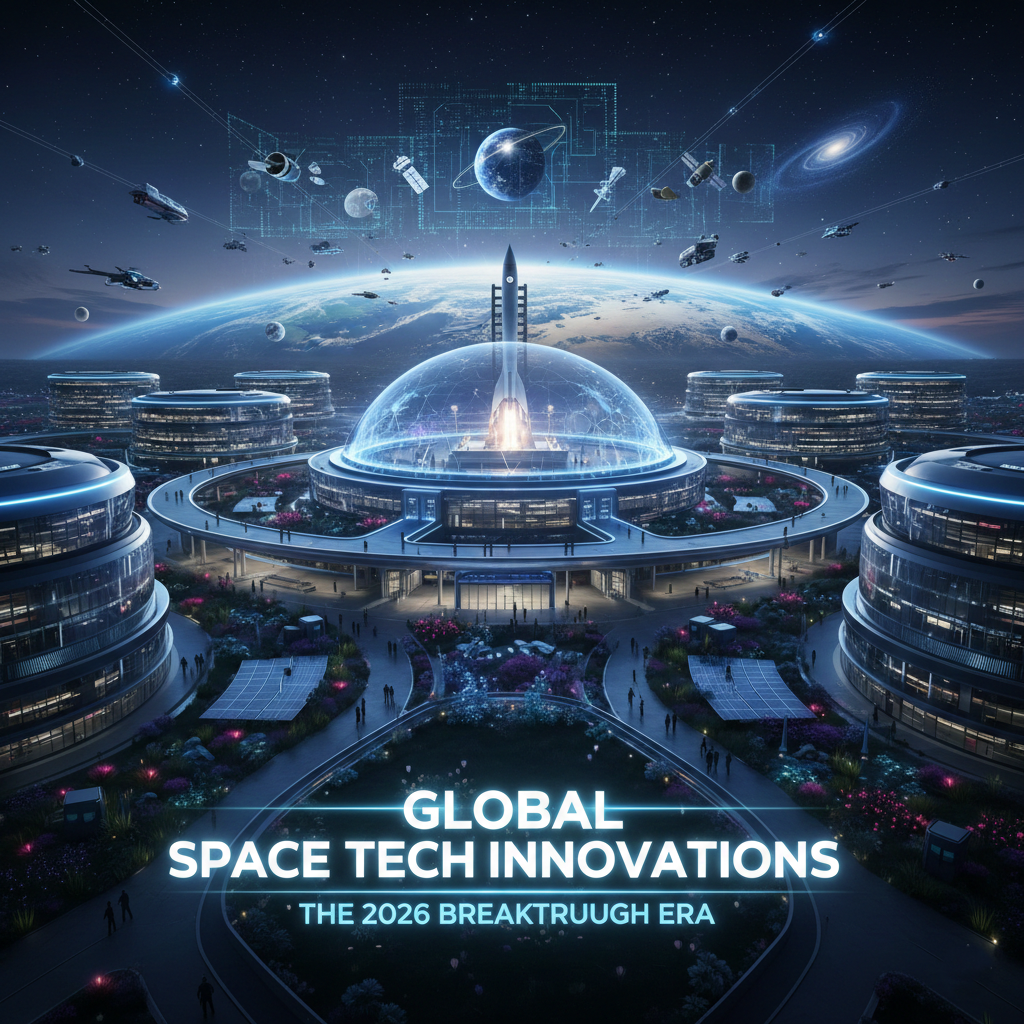
Space technology is entering a golden age. What was once limited to giant space agencies has now become a playground for private companies, AI-powered missions, reusable rockets, deep-space observations, and ambitious plans to colonize the Moon and Mars. As we step deeper into 2026, space innovation isn’t slowing down—it’s accelerating faster than at any time in human history.
From SpaceX’s rapid Starship launches to India’s rising presence in global space science, from quantum communications satellites to the booming space-tourism economy—2026 is shaping up to be a landmark year.
This blog explores the biggest global space tech innovations, their impact, and what the future holds for humanity among the stars.
🚀 1. Reusable Rockets Become Ultra-Efficient
The biggest shift in space tech today is the refinement of reusable rocket systems.
🔹 What’s New in 2026?
- SpaceX Starship achieving highly efficient rapid reusability
- Blue Origin New Glenn completing commercial heavy-lift missions
- ISRO’s Reusable Launch Vehicle (RLV) entering final testing
- China’s reusable rocket variants nearing operational cycles
Reusable rockets have slashed launch costs dramatically, making space more accessible to:
- Universities
- Startups
- Developing space nations
- Private research labs
- New space-tourism companies
The world is no longer dependent on billionaire-funded missions—space access has become democratized.
🛰️ 2. Satellite Mega-Constellations Transform Earth Connectivity
2026 is the year global satellite networks truly take over.
Major Players:
- Starlink (SpaceX)
- Kuiper (Amazon)
- OneWeb
- China’s GW Satellite Network
- India’s BharatNet Satellite Expansion
🚀 Innovations:
- Lower latency internet globally
- Satellite-based 5G integration
- Real-time Earth imaging at <30 cm resolution
- Disaster prediction & early warning systems
These constellations are now powering:
- Remote healthcare
- Autonomous vehicles
- Smart agriculture
- Global communication in previously unreachable regions
🌖 3. Moon Missions Shift From Exploration to Development
2026 marks the beginning of the Lunar Economy.
Key Missions:
- NASA Artemis Program preparing permanent lunar bases
- ISRO Chandrayaan Follow-Up Missions
- JAXA–Toyota lunar rover project
- China’s International Lunar Research Station (ILRS)
Infrastructure Being Built:
- Lunar power grids
- Water-ice mining systems
- Permanent habitat modules
- Lunar satellite communication networks
The Moon is no longer just a destination—it is becoming a launchpad for interplanetary missions and a hub for scientific and resource exploration.
🚀 4. Mars Research Enters its Next Phase
Though humans haven’t landed on Mars yet, 2026 brings us closing to preparation phase.
Innovations:
- High-definition surface mapping
- Autonomous Martian rovers
- Oxygen extraction experiments (MOXIE 2.0)
- AI-driven habitat design models
- SpaceX’s pre-deployment cargo planning missions
Mars exploration is becoming more automated, more intelligent and more connected than ever before.
🛰️ 5. AI-Powered Spacecraft Become Standard
AI is the backbone of modern space science.
AI Enhancements in 2026:
- Autonomous navigation in deep space
- Real-time anomaly detection
- AI-controlled rovers (Mars, Moon, Asteroids)
- Self-repairing spacecraft systems
- Predictive fuel and system management
Even telescopes are now AI-enhanced, helping detect:
- Exoplanets
- Black holes
- Near-Earth asteroids
- Cosmic radiation patterns
AI is unlocking the mysteries of the universe faster—and more accurately—than any human team alone ever could.
🪐 6. The Rise of Asteroid Mining Projects
Mining in space sounds like science fiction, but 2026 marks real beginnings.
Companies and Agencies Preparing:
- NASA
- ESA
- China National Space Administration
- Private companies like AstroForge
Focus areas:
- Platinum-group metals
- Water extraction for space fuel
- Rare minerals for electronics & batteries
Asteroid mining could create a trillion-dollar space economy, impacting Earth industries like EVs, semiconductors, and advanced manufacturing.
🛰️ 7. Quantum Communication Satellites
Security in space is more important than ever.
Enter: quantum encryption satellites.
What they offer:
- Unhackable communication
- Ultra-secure military links
- Encrypted diplomatic channels
- High-speed transfer without signal loss
China, USA, India, and EU nations are racing to deploy quantum-secured satellite networks in 2026.
👩🚀 8. Space Tourism Becomes Mainstream
2026 is the first year space tourism shifts from elite luxury to commercial luxury.
Key Companies:
- SpaceX
- Blue Origin
- Virgin Galactic
- Axiom Space
Experiences Now Available:
- Sub-orbital flights
- Orbital stays at commercial stations
- Training at simulated lunar-gravity camps
A new industry is forming—
the global space travel market, expected to cross $25 billion by 2030.
🔭 9. Next-Generation Telescopes Redefine Space Observation
The James Webb Space Telescope (JWST) created history, and now 2026 brings more.
Innovations:
- 4D space observation
- Ultra-deep infrared scanning
- AI-based cosmic mapping
- First-ever real-time exoplanet spectral analysis
We are getting closer to discovering:
- Habitable exoplanets
- Better models of cosmic evolution
- Clearer understanding of dark energy
Space science is witnessing a renaissance.
🌍 10. Earth Monitoring Through Hyper-Precision Satellite Imaging
Climate, agriculture, water, food security—everything is linked to satellites now.
2026 Upgrades:
- <10 cm accuracy imaging
- Real-time forest, ocean & pollution tracking
- Climate prediction using AI + space data
- Satellite-based carbon emission monitoring
This is helping governments:
- Prevent disasters
- Improve agriculture yields
- Track illegal mining
- Manage water resources
- Enforce environmental laws
Space is no longer “up there”—
it’s directly improving life down here.
✨ The Future of Space Tech: What’s Coming Next?
2026 is foundational, but the next 5–10 years promise even more breakthroughs:
⭐ 2030 Predictions:
- First human habitats on the Moon
- Fully operational lunar industries
- Manned Mars orbit missions
- Regular space tourism flights
- Asteroid mining commercialization
- AI-built space stations
- Quantum-powered rover missions
Humanity is no longer just exploring space—
we’re becoming a multi-planet species.
📌 Final Thoughts
Global space tech innovations in 2026 are rewriting the future of civilization. What was once unimaginable is now not only possible but happening faster than expected.
AI, robotics, private companies, and international collaboration are accelerating space advancement at an exponential rate.
This decade will determine:
- How humans expand into the solar system
- What role countries play in space economy
- How AI and quantum tech reshape exploration
- Whether we become a spacefaring civilization
Space is not the future.
Space is NOW.
