

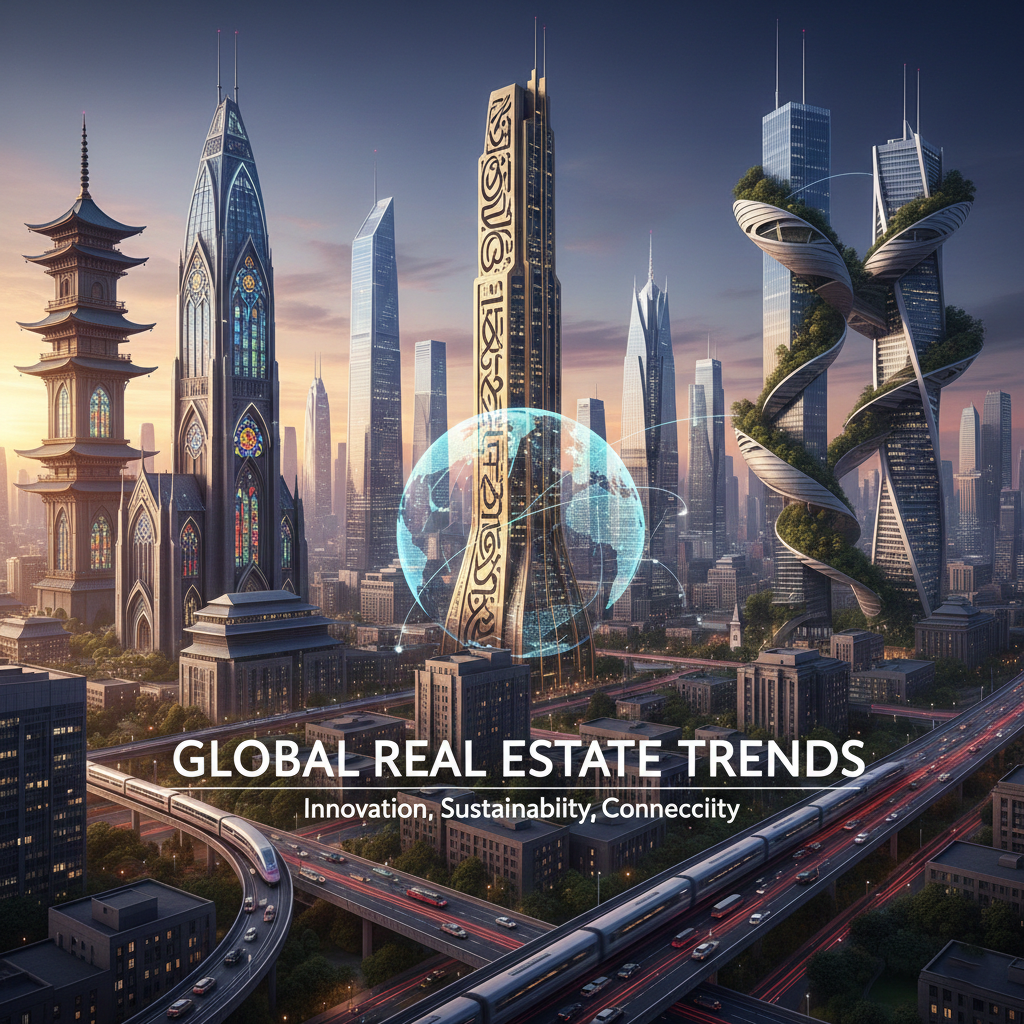
Real estate is often seen as a stable, long-term investment — but today, the global property market is changing faster than ever. Thanks to shifting demographics, remote work patterns, technological advances, climate awareness, and evolving investor priorities, what “real estate success” looks like in 2025–2026 is very different than a decade ago. Whether you’re a home-buyer, investor, developer, or just curious about global housing trends — this overview gives you a complete picture of what’s hot, what’s cooling, and where opportunity lies in global real estate.
📊 Global Market Context & Growth Forecast
- According to recent market research, the global real estate market — spanning residential, commercial, industrial, land and other segments — is projected to grow at a compound annual growth rate (CAGR) of about 5.5% from 2025 to 2034.
- By 2034, the market size is expected to reach USD 7.03 trillion, up from about USD 4.34 trillion in 2025.
- Regionally, the Asia-Pacific (APAC) region contributes a major share of revenue and is poised for strong growth — reflecting rising urbanization, population growth, and economic development.
- Demand is not just from traditional home-buyers: rental markets, commercial real estate, industrial & logistics real estate, and specialized assets like data-centers and senior housing are showing rising interest.
What this means: Real estate globally remains a major investment class — but the opportunities and risks are more diverse than “buy a house and wait.” Success depends a lot on segment (residential vs commercial vs industrial), location, regulatory environment, and global macroeconomic factors.
✅ Key Global Real Estate Trends for 2025–2026
1. Rise of Sustainable & Green Real Estate
Environmental awareness and climate risk are reshaping real estate demand. Around the world:
- Developers are increasingly building energy-efficient, low-carbon homes and commercial properties. “Green buildings,” energy efficiency standards, and sustainable materials are becoming selling points.
- Investors are shifting towards properties that meet environmental, social, and governance (ESG) criteria — expecting long-term returns and lower regulatory risk.
- Residential buyers increasingly value features like better insulation, solar energy capabilities, green surroundings, and sustainable water-/energy-use systems rather than just luxury finishes.
The message is clear: green real estate is no longer niche — it’s becoming the norm.
2. Remote Work & Demand Shift: Suburbs, Small Cities, Flexible Spaces
The pandemic-era remote/work-from-home revolution is leaving a lasting mark on real estate demand globally:
- Many workers now prefer more space — larger apartments or houses with dedicated offices. This is fueling demand in suburban areas, secondary cities, smaller metros, and even rural/village real estate.
- As a result, some suburban and non-central areas are seeing price appreciation, as people trade city-center convenience for space, affordability, and lifestyle.
- On the commercial side, with many companies adopting hybrid or flexible work models, demand for co-working spaces, flexible office leases, satellite offices is rising — while traditional large office towers are seeing slower demand.
Investors and developers taking note are shifting focus: building mixed-use, flexible, and work-from-home-friendly properties instead of classic high-density city-center projects.
3. Diversification of Real Estate: Beyond Homes — Data Centers, Senior Housing, Industrial, Logistics
Real estate is no longer just about homes or offices. New asset classes are emerging globally:
- According to a 2026 industry report by PwC / Urban Land Institute (ULI), sectors to watch include data centres, senior / retirement housing, and other specialized real estate — all marked as top-opportunity segments in coming years.
- Industrial, logistics, and warehousing property demand is rising — driven by e-commerce growth, global supply-chain shifts, and increased demand for storage, fulfillment centers, and distribution hubs.
- Commercial real estate investment is gradually picking up, though with more caution — a rebound in retail real estate, mixed-use developments, and flexible commercial leases are trending.
That means for investors looking beyond traditional residential real estate, there are lucrative, less-crowded opportunities in emerging sectors.
4. Demand for Rentals, Co-living & Flexible Housing Solutions
Global housing supply shortage and rising property prices are pushing many toward renting rather than buying:
- According to a global housing-market report, there is a massive supply gap — a shortage of millions of housing units worldwide. This shortage, combined with rising prices, has made renting more attractive.
- Consequently, there is increasing appetite for purpose-built rental accommodations, co-living spaces, and flexible rental housing — especially among younger people, expatriates, and remote workers.
- In major global cities, “buy vs rent” calculations are shifting — high property-buy costs + uncertain job/mobility + evolving lifestyle preferences make long-term renting more popular than ever.
This trend creates a strong and stable rental-market dynamic, opening opportunities for rental-property investors and developers focusing on long-term rentals, co-living, or multi-family housing.
5. Smart Homes, PropTech & Digital Integration in Real Estate
Real estate is becoming tech-enabled. The adoption of property technology (“PropTech”) is transforming how properties are built, managed, bought, sold, and rented:
- Smart-home integration (IoT, energy management, smart security) is becoming an increasingly popular selling point among buyers and renters.
- Virtual property tours, digital staging, drone images/3D walkthroughs are becoming standard — enabling global buyers to explore and invest without physical presence.
- On the investment and valuation side, data-center real estate (supporting cloud, AI, internet infrastructure) is gaining prominence — reflecting growing global digital demand.
As digital adoption rises globally, properties offering smart, tech-integrated features will command a premium — and developers/investors who embrace PropTech will likely outperform traditional players.
6. Institutional Investment & Capital Flows into Real Estate
Institutional investors — from global funds, REITs, pension funds — are increasingly active in real estate again:
- A recent global real estate outlook predicts that institutional real estate investments will maintain strong momentum, with significant capital flows continuing through 2026.
- Emerging markets — especially Asia-Pacific and select developing regions — are attracting more of this capital, thanks to growth potential, rising urbanization, and relatively lower valuations compared to Western markets.
- This influx of capital stabilizes markets, drives new developments (residential, commercial, infrastructure), and enables large-scale mixed-use and smart-city projects.
For first-time investors or emerging-market owners, this trend squeezes competition but also offers opportunities — especially in growing markets that haven’t yet peaked.
7. Geographic Shifts: Secondary Cities, Rural & Non-Traditional Markets Gaining Traction
As demand and price pressure rise in major global cities, attention is shifting to smaller or secondary cities — and even rural or peri-urban areas:
- Remote-work trends, desire for space, lower cost of living are pushing people to suburbs and smaller cities — increasing demand there.
- Some rural/village real estate markets are seeing growth — especially in attractive climates or where infrastructure is improving, as remote-work becomes permanent.
- This redistribution may relieve pressure from overcrowded metro areas and create new real-estate growth zones — potentially offering higher value appreciation and lower entry cost compared to traditional hotspots.
⚠️ Challenges, Risks & What to Watch Out For
Even with these promising trends, global real estate markets face multiple headwinds and uncertainties:
🔹 Affordability Crisis & Housing Shortage — Pressure on Demand
- In many developed markets (and some developing ones), home prices have soared — sometimes reaching 8+ times median household income, putting home-ownership out of reach for many.
- This is fueling increased demand for rentals — but also increasing risk of social inequality, housing instability, and affordability crises, especially among low/middle-income groups.
🔹 Commercial Sector Uncertainty — Especially Offices & Retail
- The shift toward remote work continues to undermine demand for traditional office spaces. Many companies are downsizing offices, reducing footprint, or switching to flexible/co-working models.
- Retail real estate is also under pressure globally, as e-commerce grows and consumer behavior changes — meaning retail spaces must evolve or risk vacancy.
🔹 Regulatory, Economic & Global Shocks — Inflation, Interest Rates, Economic Slowdowns
- High interest rates, inflation, and economic uncertainty can dampen demand for mortgages, property purchases, and real-estate investments. This can reduce property values and slow growth.
- Changing regulation — especially around sustainability, zoning, foreign investment, taxation — can affect global real-estate flows and returns. For example, stricter environmental standards or property taxes for foreign buyers.
🔹 Over-Supply in Some Markets & Risk of Overvaluation
- In fast-growing areas, speculative building, over-supply, or luxury-focused development can lead to market bubbles — especially if buyer demand cools.
- Properties built without regard to long-term sustainability, infrastructure, or shifting demand (e.g. old-style offices, luxury apartments in remote areas) risk losing value or becoming stranded assets.
🔹 Inequality, Social Impact & Affordability Issues
- As premium and luxury real estate booms, affordability for middle and low-income populations worsens — raising social, economic and policy concerns.
- Rental markets can become unstable; over-dependence on rental yields may impact social housing, access, and affordability.
🎯 What This Means for Different Players
Here’s how various stakeholders — home-buyers, investors, developers, governments — should interpret these trends:
🏡 For Home-Buyers & Renters
- If you seek long-term stability, look for green, smart, sustainable properties with energy-efficient or smart-home features.
- Renting or flexible housing may remain the more practical option in many markets — especially where property prices are high or unstable.
- Consider smaller cities or suburbs instead of overpriced metro centers: you may get more space, better cost-to-value ratio, and future growth potential.
📈 For Investors & Speculators
- Diversify: don’t just look at residential — consider data-centers, logistics, industrial warehouses, mixed-use developments, senior-housing, etc.
- Focus on growth regions: APAC, emerging markets, and secondary cities may offer better value and upside than saturated global metros.
- Prioritize sustainability and ESG-compliant projects — as these are likely to appreciate more and avoid regulatory risks.
🏗️ For Developers & Real Estate Companies
- Mixed-use, sustainable, tech-enabled, flexible-space projects will be the future winners: co-living, co-working, smart homes, eco-cities.
- Blockchain, PropTech, digital valuation, virtual tours, AI-based property management — adopting these early gives a competitive edge.
- Focus on rental housing, build-to-rent, and long-term rental demand — especially in urban areas with affordability issues.
🌐 For Governments & Urban Planners
- Encourage sustainable building codes, green housing, and affordable housing supply — to prevent affordability crises and social inequality.
- Support infrastructure expansion in suburbs and secondary cities — to manage population migration, remote work shifts, and demand decentralization.
- Balance regulation and investment — e.g. environmental regulation + incentives for green building + support for low-cost housing to ensure inclusive growth.
Outlook: What to Expect Through 2026 and Beyond
- The global real estate market will continue to grow — but with diversified asset classes (residential, commercial, industrial, data-centers, rental housing) claiming shares, rather than just traditional homes.
- Demand for sustainable, green, smart, and flexible real estate will increase, reshaping property design, building standards, and buyer/renter expectations.
- Secondary cities, suburbs, and emerging markets will gain importance, as people move away from megacities in search of affordability, space, and quality of life.
- Institutional investment and global capital flows will drive large-scale developments — but investors will demand transparency, ESG compliance, and long-term viability.
- The gap between luxury/ premium real estate and affordable housing/ rentals may widen — with rising socio-economic and policy pressure to address inequality and housing access globally.
Real estate will remain a key pillar of global wealth, urban development, and human settlement — but success will belong not to the traditional models of “buy-and-hold”— but to those who adapt: developers, investors, renters, and policymakers willing to build for the future.
