

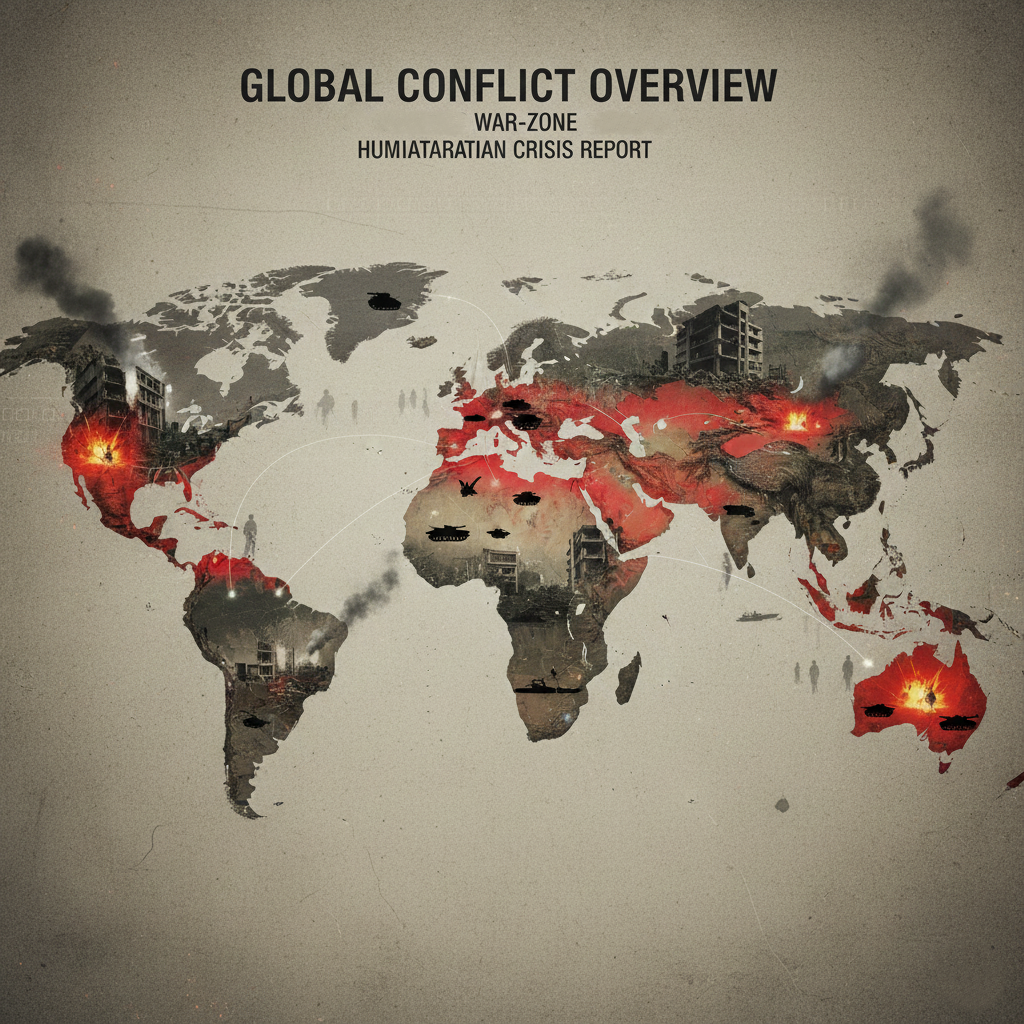
The world in late 2025 remains deeply entangled in multiple conflicts—some long-standing, others recently escalated. From brutal civil wars to tense border disputes, from humanitarian crises to fragile ceasefire efforts, major conflict zones demand global attention.
This overview covers the most significant wars, crises, humanitarian disasters and peace efforts as of December 2025. It highlights key regions: their background, current status, humanitarian impact, and potential future trajectories.
🌍 Why 2025–2026 Mark a Critical Period for Global Conflict
According to conflict-tracking organisations, political violence surged in 2024 and 2025 globally — with many long-dormant wars intensifying and new conflicts erupting.
Several factors contribute:
- Fragmented state authority in conflict zones
- Rise of non-state armed groups & insurgencies
- Spillover effects of major wars (refugees, arms flows)
- Resource competition, economic instability & climate stress
- Global polarization and geopolitical rivalries
As a result, by late 2025 dozens of countries remain deeply unstable, and many regions face humanitarian collapse without immediate global intervention.
🔎 Key Conflict Hotspots & Updates
1. Sudan — Civil War & Humanitarian Collapse
The civil war between the national armed forces and the paramilitary Rapid Support Forces (RSF) continues, with catastrophic consequences.
- Recent escalation in the oil-rich Kordofan region has seen deadly aerial strikes, shelling, and multiple civilian casualties.
- Displacement numbers are staggering: millions forced from homes, rampant food insecurity, and widespread destruction of infrastructure.
- International concern is growing. The newly proposed agreement to host a foreign naval base has further complicated regional dynamics, potentially expanding geopolitical stakes.
- Aid agencies warn that ongoing violence and humanitarian collapse could trigger one of the worst displacement crises in recent history.
Why this matters: Sudan remains one of the world’s most severe — yet under-reported — crises, with long-term regional instability and major human suffering.
2. Democratic Republic of the Congo (DRC) — Conflict in the East, Fragile Peace Pushes
The eastern DRC continues to be a conflict hotspot, despite recent peace agreements.
- The rebel group M23 has carried out major offensives across North and South Kivu provinces in 2025. Goma — a major city — was briefly seized during clashes.
- The violence has displaced hundreds of thousands internally. Civilians have suffered from loss of homes, livelihoods, and massive instability.
- On 28 June 2025, a U.S.-mediated peace agreement between DRC and neighbouring Rwanda was signed — raising hopes for stability.
- Still, ground realities remain tense: the region is fraught with distrust, multiple armed groups, and fragile ceasefires. The agreement’s success depends on disarmament, humanitarian aid, and sustainable governance reforms.
Why this matters: The DRC conflict affects regional security, critical mineral supply chains (since eastern Congo is mineral-rich), and millions of lives. A failed peace could lead to renewed large-scale displacement and resource exploitation dynamics.
3. Middle East — Multi-Front Tensions: Gaza, Israel–Iran, & Red Sea Crisis
The Middle East remains unstable on multiple fronts, with cascading conflicts that have global ripple effects.
a. Ongoing Israel–Palestine Conflict & Wider Tensions
Despite ceasefire attempts, violence continues in Gaza and the West Bank. Civilian casualties, infrastructure destruction, and mass displacement persist.
b. Israel–Iran Tensions Escalate (2025)
According to a global conflict monitor, 2025 saw renewed hostilities between Israel and Iran — including air and missile strikes, and regional spill-over affecting neighboring countries.
c. Red Sea & Yemen Conflict Fallout
The maritime security crisis in the Red Sea and Gulf region — including attacks on shipping lines and US–UK military interventions targeting militant groups — continues to destabilize trade routes and threaten civilian security.
Why this matters: Persistent Middle East instability impacts global oil supply, refugee flows, international diplomacy, and regional security architecture. Moreover, humanitarian fallout continues to ravage civilian populations.
4. Regional Instability & Border Conflicts: Examples from Southeast Asia
One recent flashpoint: tensions along the border between Thailand and Cambodia. In 2025, airstrikes, ground clashes, and border-region violence escalated sharply.
This highlights how historical border disputes, even if low-intensity for decades, can flare up unpredictably — displacing populations, disrupting trade, and destabilizing regional politics.
🆘 Humanitarian Impact: Displacement, Aid Crisis, and Global Response
- Recent data indicates a steep drop in global humanitarian aid funding — with the relevant UN agency cutting its 2026 appeal significantly due to donor shortfalls.
- As a result, millions of people displaced by war, climate disasters, or famine face limited support, with vulnerable groups — women, children, refugees — at highest risk.
- The sheer scale of crises (Sudan, DRC, Middle East, border conflicts) underscores an urgent need for renewed global cooperation, crisis management, and long-term humanitarian strategies.
📈 What to Watch in 2026: Key Risks & Possible Flashpoints
| Region / Conflict | What Could Happen |
|---|---|
| Sudan | Escalation of civil war, humanitarian collapse, regional destabilization if foreign involvement deepens. |
| Eastern DRC | Peace agreement may collapse — renewed rebel offensives, displacement, resource exploitation. |
| Middle East | New escalation cycles (Israel–Iran, Gaza, Red Sea), spill-overs to neighboring states, energy & refugee crises. |
| Border Disputes (e.g. Thailand–Cambodia) | Renewed clashes, displacement, trade disruptions — potential spillover into regional instability. |
| Global Aid Shortfall | Reduced humanitarian support could worsen crises, lead to mass starvation, social collapse. |
💡 Why Global Stability Depends on Conflict Resolutions Now
- Global supply chains — especially critical minerals, energy — are linked to conflict zones (DRC, Middle East). Instability affects global markets.
- Refugee and displacement crises strain neighbouring countries, create regional tensions, and challenge international humanitarian systems.
- Climate change, economic downturns, and shortage of resources amplify risk of conflict — making peace, diplomacy, and aid essential.
- Global peace and security shape migration, trade, economic growth, and geopolitical alignments.
📣 Call to Global Action: What Needs to Be Done
- Renew humanitarian funding — the world can’t afford shrinking support when need is rising.
- Support verified peace agreements — between nations, rebel groups, communities.
- Ensure protection for civilians and IDPs — prioritise safe corridors, food & medical aid, reconstruction efforts.
- Promote diplomacy & conflict resolution mechanisms — in hotspots like Sudan, DRC, Middle East, border-dispute zones.
- Strengthen global early-warning and conflict-forecast systems — to anticipate crises before they explode.
🔚 Conclusion: A Fragile 2026 — Global Conflict at a Crossroads
As of December 2025, the world stands at a dangerous crossroads. Multiple wars, humanitarian crises, regional tensions, resource disputes, and refugee flows threaten not just individual nations — but global stability.
Yet 2026 might also be a turning point. With renewed diplomacy, responsible global cooperation, and revived humanitarian efforts, some conflicts may de-escalate; peace agreements may hold; crisis zones may rebuild.
What happens in the next few months will shape whether 2026 becomes a year of geopolitical fragmentation and humanitarian disaster — or the start of global stabilization and recovery. The choice lies in global will, leadership, and collective compassion.
