

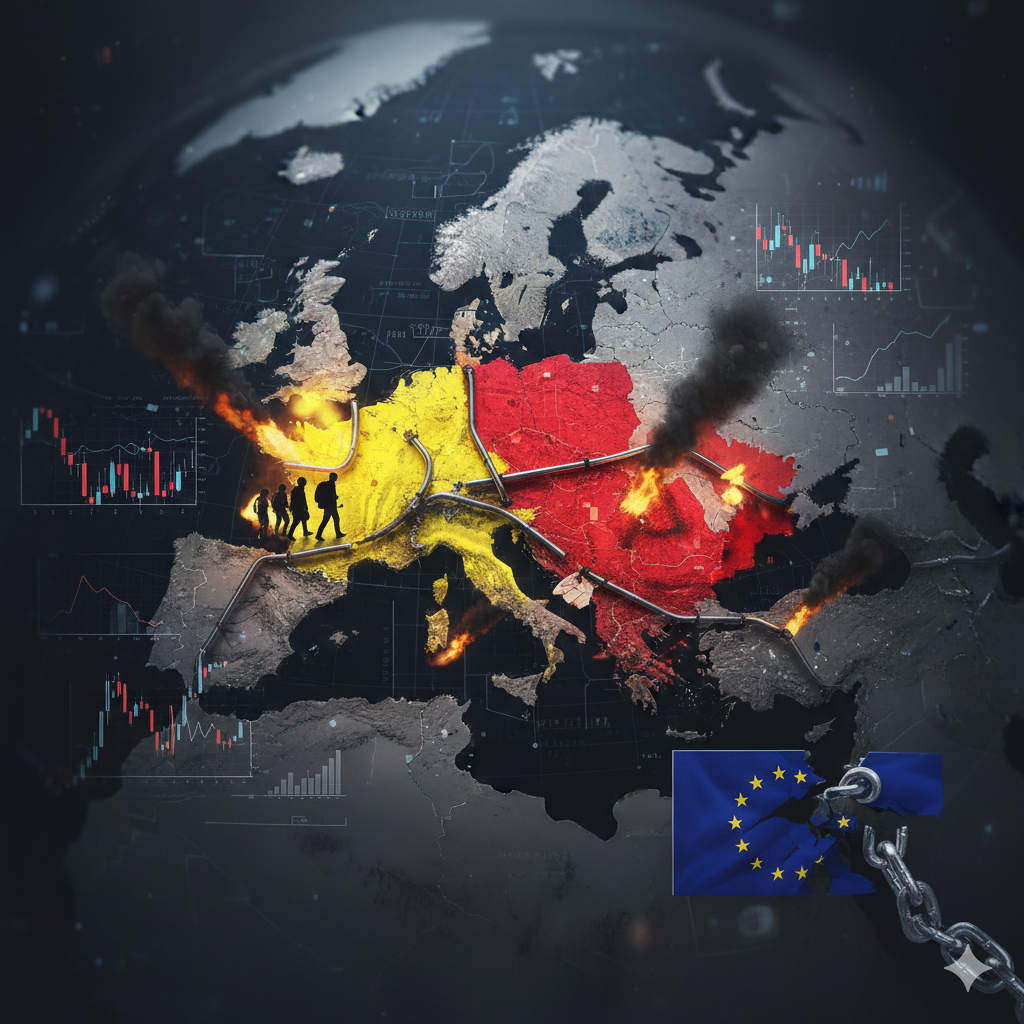
When Russia invaded Ukraine in February 2022, few could fully grasp how deeply the conflict would reverberate across Europe. For the member states of the European Union, the war has triggered an era of major upheaval — affecting energy supply, inflation, economic growth, social welfare, foreign policy, and even the identity of the EU as a geopolitical actor.
Even three years later — in late 2025 — the consequences are still unfolding.
1. Economic Shock: Energy Crisis, Inflation & Slowed Growth
1.1. Energy Dependence Exposed — And Costs Soared
Prior to the war, many EU countries relied heavily on Russian gas and oil. The invasion and subsequent Russian retaliation — including supply disruptions — triggered an energy shock. The result: dramatic spikes in energy prices, widespread uncertainty about supply, and a rapid push to rework energy strategy.
The EU was forced to scramble: cut consumption, diversify imports (especially gas), accelerate LNG deals, and shift toward alternative energy sources.
This energy squeeze rippled across economies — households paid more, industries faced higher input costs, and many countries experienced sharp increases in utilities, heating, production, and transport costs.
1.2. Inflation Surge & Cost-of-Living Crisis
Because energy and food prices spiked (both heavily influenced by disruptions in Russian/Ukraine supply chains), inflation across the EU surged. For many households, real incomes shrank, savings eroded, and the cost of essentials rose significantly.
Many businesses — especially energy‑intensive ones — saw margins squeezed; some scaled back operations; others passed costs to consumers, further fueling inflation. Indebted households suffered especially, with loans and mortgages becoming costlier due to interest‑rate hikes.
1.3. Slower Growth & Economic Uncertainty
The war has derailed the post‑COVID economic recovery. Forecasts made by the EU before 2022 projected solid growth, but by 2023 many economies slowed dramatically; uncertainty about energy, supply chains, inflation and demand dampened investment and consumer confidence.
Some sectors and regions have been hit worse than others — especially those heavily dependent on external energy or on trade with Russia/Ukraine. Border‑adjacent states and those with older industrial bases felt the contraction more sharply.
1.4. Supply‑Chain Disruptions & Food Security Risks
Russia and Ukraine were major suppliers of various commodities — gas, grains, fertilizers — to Europe and the world. The war disrupted shipments and export flows, creating shortages, pushing food prices up, and causing supply‑chain instability.
For the EU, this meant increased pressure on agriculture, food producers, and export‑import dependent businesses — and greater food‑security concerns among lower-income households.
2. Political & Strategic Shift: From Integration to Autonomy & Security
2.1. EU’s Foreign Policy & Geopolitical Identity Transformed
The war forced the EU out of a largely neutral or economically driven stance — and into outright political and military alignment for the first time in decades. The bloc condemned Russia’s aggression, supported Ukraine diplomatically, and sanctioned Russian entities massively.
This conflict revived debates about European “strategic autonomy” — less dependence on Russian energy and more on European resilience, defense, and internal cohesion. The EU’s role as a geopolitical actor has been renewed, bridging foreign‑policy, defense, and humanitarian collaboration.
2.2. Energy Realignment: The Clean‑Energy Push Accelerates
Given the energy shock, the EU has accelerated its shift away from fossil fuels — especially Russian imports — toward renewables, energy diversification, and sustainable energy infrastructure. This is perhaps one of the most dramatic structural shifts triggered by the war.
What was once a long‑term goal — green transition, renewable energy, energy independence — became urgent. The EU moved rapidly to secure LNG supplies, build alternative infrastructure, and invest in sustainable energy — altering Europe’s energy landscape for decades to come.
2.3. Migration & Refugee Influx: Social & Humanitarian Strain
The war triggered one of the largest migratory flows in recent European history. Millions of Ukrainians crossed into EU countries as refugees, leading to a surge in demand for housing, social services, jobs, and integration support.
For some countries — especially those close to Ukraine — the influx has created challenges: pressure on social welfare systems, strains on public finances, labour‑market adjustments, and social integration issues. But also, in many cases, opportunities: increased labour force, demographic balancing, and cultural exchange.
This migration wave also stirred political debates within the EU — on asylum policy, border security, EU enlargement (Ukraine’s candidacy status), and long-term integration.
3. Internal Strains: Inequality, Poverty Risk & Social Challenges
3.1. Rising Poverty & Socio‑Economic Disparities
With inflation, higher energy prices, and cost-of-living increases — many households have seen living standards drop. Lower-income groups, migrants, refugees, and vulnerable communities are disproportionately affected.
Small businesses — especially energy-intensive ones, or those reliant on imports/exports — have faced rising costs, shrinking margins, and in some cases closure. This threatens employment in sectors already stressed post-pandemic.
3.2. Pressure on Social Safety Nets & Public Finances
Governments across the EU have had to increase spending — for refugee support, social aid, subsidies (especially energy subsidies), and inflation relief measures. This puts pressure on public finances, especially in countries with high debt or already fragile economies.
In parallel, private debt servicing becomes more expensive due to rising interest rates — impacting mortgages, loans, and corporate financing. This creates vulnerability for households and firms alike.
3.3. Business Uncertainty & Investment Delays
Uncertainty about energy costs, supply‑chain stability, and geopolitical risk has led many firms to delay or shelve investments, especially in energy‑intensive manufacturing, logistics, or export‑oriented sectors.
Some sectors are adapting faster — renewables, green energy, energy‑efficient industries, digital services — but structural transformation takes time, investment, and social adaptation.
4. Institutional & Policy Response by the EU — Measures, Sanctions & Strategic Shift
4.1. Sanctions & Economic Pressure on Russia
In response to the war, the EU imposed sweeping sanctions: targeting individuals, entities, energy trade, banking operations, exports/imports — aiming to curtail Russia’s war‑funding capability.
These measures forced the EU to rethink long‑timing relationships — economically and politically — with Russia, but also forced member states to reconfigure energy sourcing and supply security.
4.2. Strategic Autonomy & European Resilience Push
Recognizing the risks of over‑dependence on external suppliers, the EU has embraced a new strategy of “strategic autonomy.” This includes energy diversification, strengthening internal supply chains, boosting renewables, and building resilience to geopolitical shocks.
At institutional level, the war led to increased coordination among member states on energy policy, defence cooperation, refugee support, and external aid to Ukraine — reinvigorating EU integration in unexpected ways. Consilium+2Consilium+2
4.3. Financial & Humanitarian Support for Ukraine
Since 2022, the EU and its member states have committed substantial humanitarian, economic, financial, and military support for Ukraine. As of 2025, ongoing financial aid packages, refugee support, and reconstruction commitments continue. European Parliament+2Consilium+2
At the same time, the EU opened accession talks with Ukraine (candidate status), signaling a long-term geopolitical shift. This changes the EU’s borders, its responsibility, and its strategic outlook for Eastern Europe. Consilium+1
5. Long-Term Structural Impact: What Europe Looks Like Post‑War
5.1. Energy Transition & Green Revolution in Overdrive
The energy crisis triggered by the war has become a catalyst for accelerated renewable energy adoption across Europe. Investments in wind, solar, energy storage, hydrogen, LNG terminals, energy efficiency — all escalated rapidly.
Long-term, this could reduce Europe’s fossil-fuel dependence, lower carbon emissions, and propel the EU as a global leader in clean energy and climate action.
5.2. Reinventing the Single Market & Resilience Economics
The EU is working to rebuild supply‑chain resilience, encourage “near-shoring” or “friend‑shoring,” diversify trade partners, and reduce vulnerability to external shocks. This may lead to a more fragmented but resilient single market — with stronger internal cooperation.
Industries may shift toward sustainability, energy efficiency, and technological modernization — favoring green manufacturing, digital services, high‑tech industries, and away from heavy energy‑dependent manufacturing.
5.3. Social Transformation & Migration Integration
The refugee influx may, over time, lead to better integration policies, demographic rejuvenation in aging societies, labor‑market revitalization, and cultural transformation. Many EU countries now face aging populations; migration can help fill labor shortages.
But this requires robust policies on integration, employment, education, and social cohesion — otherwise risks of inequality, social tension, and political polarization persist.
5.4. Geopolitics & European Strategic Identity Redefined
The war has redefined the EU as more than an economic bloc — increasingly a political and security actor. The loosening of Russia’s influence, the strengthening of NATO-EU cooperation, enlargement talks with Ukraine, and renewed focus on defense mark a new era.
In the longer term, this might lead to:
- deeper defense collaboration
- new security policies
- greater EU foreign‑policy independence
- redefined relations with neighboring regions (Eastern Europe, Black Sea, energy exporters)
6. Risks & Challenges Ahead: What Could Go Wrong for the EU
Even as the EU adapts, the fallout from the war creates risks:
- Economic vulnerability: prolonged inflation, debt burdens, slow growth can worsen social inequality and lead to political instability.
- Energy‑transition strain: shifting to renewables is costly, infrastructure takes time, and there is risk of energy shortages or transition‑cost burden.
- Social integration pressure: migrant and refugee integration could strain public services, welfare systems, housing, education, and social cohesion if not managed well.
- Political fragmentation: differing national interests may strain EU solidarity — example: countries with stronger energy dependence or pro-Russia sentiment may resist unified EU policies.
- External dependencies: in shifting energy and trade partners, the EU may become dependent on other global powers (US LNG, Middle East oil, etc.), leading to new geopolitical dependencies.
7. What This Means for India, Asia & the Global South (Brief Context)
Though this blog focuses on the EU, the wider global systemic changes triggered by the war also affect the rest of the world — including India, Asia, Africa, Latin America:
- Energy‑price volatility and global food supply disruptions impact emerging economies.
- Demand for alternative energy, minerals, and trade diversification opens new global supply‑chain routes.
- Migration flows and refugee crises reshape global migration patterns.
- EU’s redefined foreign‑policy & trade stance influences global geopolitical alignment.
For countries like India, this means potential shifts in trade, energy procurement, global alliances, and economic partnerships — a topic worth exploring separately.
Conclusion: A Changed EU — Resilience, Risks, and Reinvention
The Russia–Ukraine war is more than a regional conflict — it has been a catalyst that exposed structural vulnerabilities in the European Union. Energy dependence, supply‑chain fragility, economic interdependence, and demographic challenges were all laid bare.
But the shock has also triggered transformation: the EU is reinventing itself — aiming for energy independence, strategic autonomy, social resilience, and renewed geopolitical purpose.
In the coming years, Europe’s ability to navigate inflation, energy transition, social integration, and foreign policy will determine whether it emerges as a stronger, more unified global player — or fractures under internal and external pressures.
One thing is clear: the war has changed Europe irreversibly. The EU will not — and cannot — go back to the “old normal.”
