

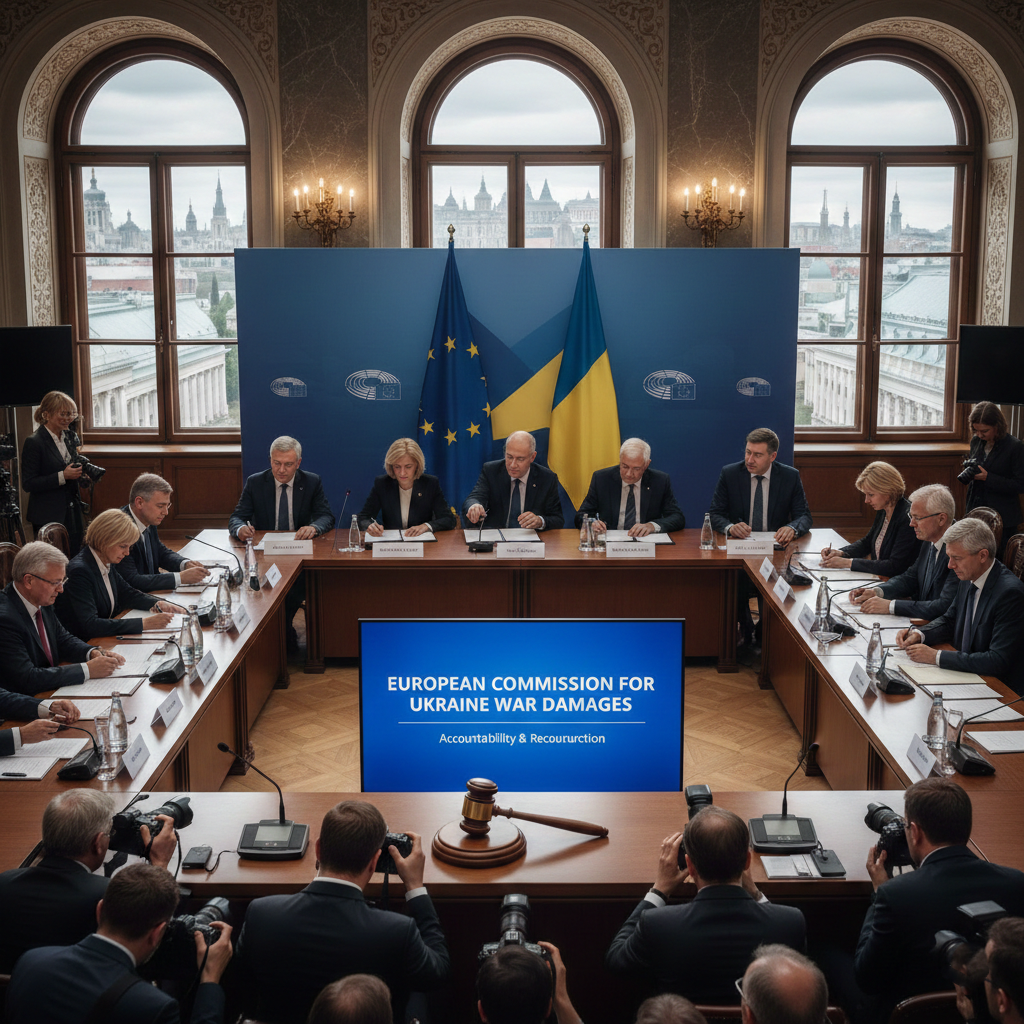
Europe Takes a Defining Step on Ukraine War Damages
Europe has officially launched a commission for Ukraine war damages, marking one of the most significant legal and political steps since the conflict began. This move signals a shift from emergency support to long-term accountability, documentation, and justice for the destruction caused by the war.
As cities lie in ruins, infrastructure is shattered, and millions remain displaced, the European commission on Ukraine war damages aims to systematically record losses, identify responsibility, and pave the way for compensation and reconstruction. Beyond legal symbolism, this initiative could redefine how war damages are addressed in modern international conflicts.
This article explains what the commission is, why it matters, how it will work, and what it means for Ukraine, Europe, and global geopolitics.
What Is the Europe Commission for Ukraine War Damages?
The newly launched commission is a formal European-led mechanism designed to assess, document, and quantify damages resulting from the Ukraine war. Its scope goes far beyond physical destruction, covering economic losses, civilian harm, environmental damage, and violations of international law.
Core Purpose of the Commission
The commission has been created to:
- Document war-related destruction across Ukraine
- Establish a credible legal and financial record of damages
- Support future compensation and reparations claims
- Strengthen international accountability mechanisms
- Lay the groundwork for Ukraine’s reconstruction funding
This is not a symbolic gesture. It is a structured, data-driven process that could shape future legal cases and international recovery frameworks.
Why Europe Launched the Commission Now
From Emergency Aid to Long-Term Justice
Since the war began, Europe has focused heavily on:
- Humanitarian assistance
- Military and defense support
- Economic sanctions
- Refugee protection
However, as the conflict stretches on, European leaders increasingly recognize that post-war accountability must be prepared in parallel.
Launching the commission now allows Europe to:
- Preserve evidence while it is still available
- Prevent loss or manipulation of damage data
- Build a legal foundation before post-war negotiations begin
Political and Legal Timing
Europe’s decision also reflects:
- Growing international consensus on accountability
- Pressure from Ukraine and civil society groups
- The need to align with international law frameworks
- Preparation for future peace or ceasefire negotiations
In simple terms, Europe is ensuring that war damages are not forgotten, disputed, or erased by time.
What Types of War Damages Will Be Assessed?
The scope of the commission is intentionally broad to capture the full human and economic cost of the war.
Physical Infrastructure Damage
This includes destruction to:
- Homes and residential buildings
- Hospitals and healthcare facilities
- Schools and universities
- Roads, bridges, railways, and airports
- Power plants, water systems, and energy grids
Ukraine has already reported hundreds of billions of euros in infrastructure losses, and this commission will aim to validate and standardize those figures.
Economic and Industrial Losses
Beyond visible destruction, the commission will analyze:
- Loss of industrial capacity
- Agricultural damage and food supply disruption
- Business closures and job losses
- Export and trade interruptions
- GDP decline and long-term economic impact
These assessments are critical for determining reconstruction funding needs.
Civilian Harm and Human Losses
The commission will also address:
- Civilian casualties and injuries
- Forced displacement and refugee costs
- Damage to civilian livelihoods
- Violations of humanitarian law
This human-centered approach strengthens the moral and legal case for reparations.
Environmental Damage
One of the most overlooked aspects of war is environmental destruction. The commission will assess:
- Contaminated land and water
- Damage to forests and ecosystems
- Industrial pollution from destroyed facilities
- Long-term health risks
Environmental war damage assessments are increasingly important under international law.
How the Commission Will Work in Practice
Independent Experts and Legal Frameworks
The commission will rely on:
- Independent legal experts
- Damage assessment specialists
- Economists and infrastructure analysts
- Human rights investigators
Their work will align with:
- International humanitarian law
- European legal standards
- United Nations frameworks
This ensures credibility and global acceptance.
Data Collection and Verification
The commission will use:
- Satellite imagery and geospatial data
- On-ground inspections
- Government and local authority reports
- NGO and international organization data
- Witness testimonies and digital evidence
All data will undergo verification and cross-checking to prevent misinformation.
Transparency and Documentation
A major goal is to create:
- A centralized, transparent damage database
- Legally admissible documentation
- Publicly accessible summaries
This level of transparency is designed to build trust and prevent disputes over numbers and responsibility.
How This Impacts Ukraine’s Reconstruction
Creating a Financial Roadmap
Ukraine’s reconstruction is expected to cost hundreds of billions of euros. The commission’s findings will help:
- Estimate total reconstruction needs
- Prioritize sectors and regions
- Attract international donors and investors
- Structure long-term recovery plans
Without verified damage data, reconstruction funding risks being inefficient or politicized.
Strengthening Compensation Claims
The commission provides Ukraine with:
- Legally grounded evidence for reparations
- Support in international courts or arbitration
- A stronger position in future negotiations
This could play a decisive role in how reconstruction costs are ultimately shared.
Europe’s Strategic and Political Motivations
Upholding International Law
By launching the commission, Europe reinforces the principle that:
- War crimes and destruction have consequences
- Aggression cannot be normalized
- Accountability is non-negotiable
This sends a clear message beyond Ukraine.
Setting a Global Precedent
This initiative could influence how future conflicts are handled by:
- Encouraging early damage documentation
- Linking reconstruction to accountability
- Strengthening multilateral legal responses
Europe is positioning itself as a leader in post-conflict justice mechanisms.
Challenges and Criticisms of the Commission
Political Resistance and Legal Complexity
Some challenges include:
- Disputes over responsibility
- Enforcement of compensation decisions
- Jurisdictional limitations
- Political resistance from involved parties
International law often moves slowly, and outcomes are not guaranteed.
Risk of Delayed Justice
Critics warn that:
- Damage documentation alone does not ensure compensation
- Legal processes may take years
- Victims need immediate support, not just future promises
Europe will need to balance long-term justice with short-term humanitarian needs.
Comparison: Ukraine War Damages vs Past Conflicts
| Conflict | Damage Assessment Mechanism | Compensation Outcome |
|---|---|---|
| Iraq–Kuwait War | UN Compensation Commission | Billions paid |
| Balkan Wars | International tribunals | Limited reparations |
| Syria Conflict | Fragmented documentation | Minimal compensation |
| Ukraine War | European-led commission | Still in progress |
The Ukraine commission stands out for its early launch and European coordination, increasing its chances of long-term impact.
Global Reaction to Europe’s Decision
Support from Allies
Many countries and institutions have welcomed the move, viewing it as:
- A step toward justice
- A foundation for reconstruction
- A deterrent against future aggression
International Legal Community Response
Legal experts see the commission as:
- A serious attempt to formalize war damage accountability
- A potential model for future conflicts
- A bridge between humanitarian aid and legal responsibility
Frequently Asked Questions (FAQs)
What is the Europe commission for Ukraine war damages?
It is a European-led body created to document, assess, and quantify damages caused by the Ukraine war, supporting accountability and reconstruction.
Will the commission lead to compensation for Ukraine?
The commission itself does not pay compensation, but its findings can support future legal claims, reparations, and reconstruction funding.
Who is responsible for funding the commission?
European institutions and participating member states are expected to support the commission financially and administratively.
How long will the commission operate?
The timeline has not been fixed, but such commissions typically operate for several years to ensure comprehensive documentation.
Why is damage documentation important during an ongoing war?
Early documentation preserves evidence, prevents data loss, and strengthens future legal and reconstruction processes.
What This Means for Europe’s Role in Global Affairs
By launching this commission, Europe is:
- Expanding its role beyond diplomacy and sanctions
- Reinforcing international legal norms
- Demonstrating long-term commitment to Ukraine
This move could redefine Europe’s influence in conflict resolution and post-war recovery worldwide.
Conclusion: A Crucial Step Toward Justice and Recovery
The launch of the Europe commission for Ukraine war damages represents more than a bureaucratic initiative. It is a powerful statement that destruction, suffering, and loss will be documented, remembered, and addressed.
While challenges remain, this commission lays the groundwork for accountability, fair reconstruction, and historical truth. For Ukraine, it offers hope that rebuilding will be guided by justice. For Europe, it reinforces leadership in upholding international law.
As the war continues to shape global politics, one thing is clear: the path to peace begins with accountability.
👉 Stay informed on global developments, international justice, and post-war reconstruction by following our latest in-depth analyses and breaking news updates.
