

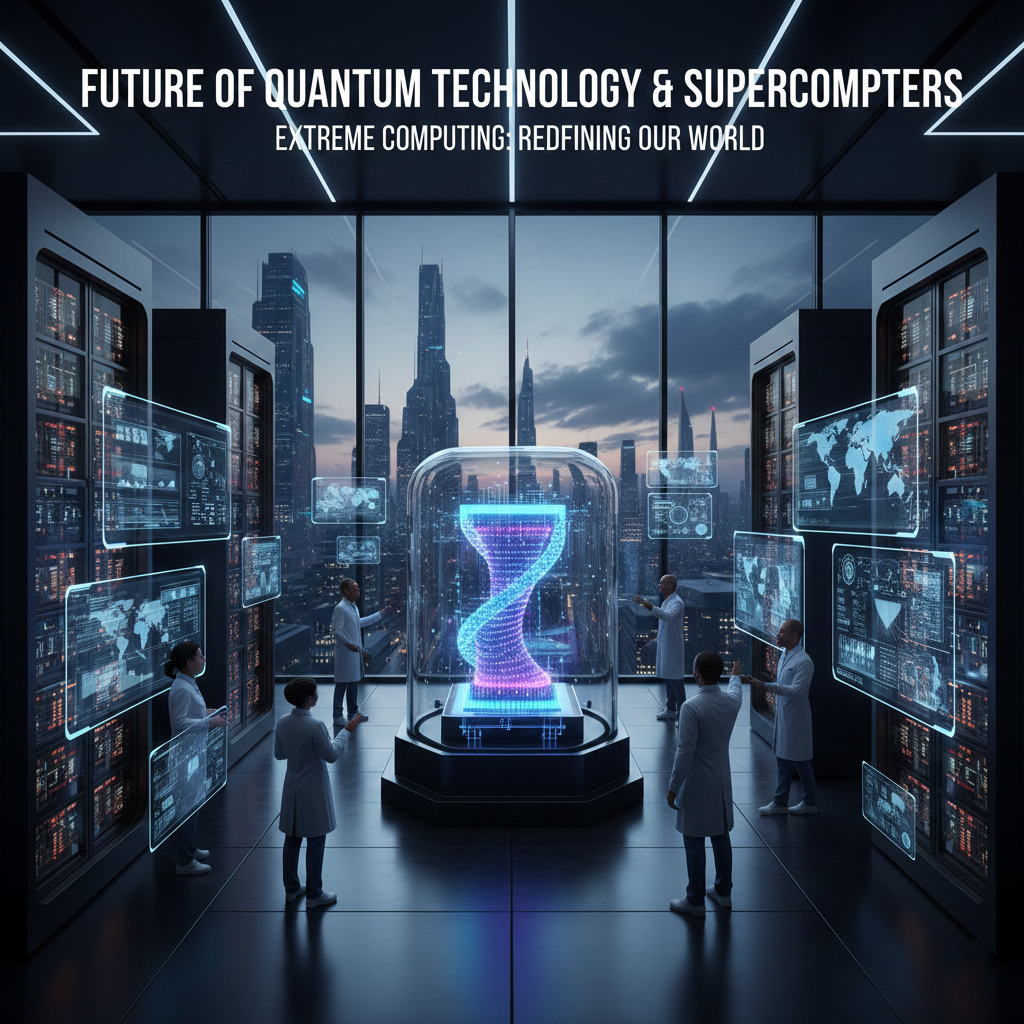
Why Quantum Tech and Supercomputers Matter More Than Ever
The future of quantum technology and supercomputers is no longer a distant science-fiction concept—it is unfolding right now. As classical computers approach their physical and performance limits, the world is turning toward quantum computing and next-generation supercomputers to solve problems that were once considered impossible.
From drug discovery and climate modeling to financial forecasting, cybersecurity, and artificial intelligence, extreme computing power is becoming the backbone of global innovation. Governments, tech giants, and research institutions are investing billions to gain an edge in what many call the next computing revolution.
In this in-depth guide, we’ll explore how quantum tech and supercomputers work, where they are headed, their real-world applications, key challenges, and what the future holds for businesses, researchers, and everyday life.
Understanding Quantum Technology in Simple Terms
Quantum technology is built on the principles of quantum mechanics, the science that explains how matter and energy behave at atomic and subatomic levels.
How Quantum Computing Is Different from Classical Computing
Traditional computers use bits, which exist as either 0 or 1. Quantum computers use qubits, which can exist in multiple states at once.
Key quantum properties include:
- Superposition: Qubits can be 0 and 1 simultaneously
- Entanglement: Qubits can be linked, even across long distances
- Quantum interference: Helps amplify correct results and cancel errors
This allows quantum computers to process vast combinations of data at unprecedented speeds.
What Are Supercomputers and Why They Still Matter
Supercomputers are the most powerful classical computers ever built. They rely on massive parallel processing, advanced CPUs and GPUs, and optimized software.
Key Characteristics of Modern Supercomputers
- Millions of processing cores
- Performance measured in petaflops and exaflops
- Designed for simulations, modeling, and big data analysis
Unlike quantum computers, supercomputers are already widely used in real-world applications.
Quantum Computers vs Supercomputers: A Clear Comparison
| Feature | Quantum Computers | Supercomputers |
|---|---|---|
| Core Technology | Qubits (quantum states) | CPUs & GPUs |
| Strength | Solving complex probability-based problems | Large-scale simulations |
| Current Maturity | Early-stage | Highly mature |
| Error Sensitivity | Very high | Low |
| Ideal Use Cases | Cryptography, molecular modeling | Weather forecasting, AI training |
Rather than replacing each other, the future points toward hybrid systems where quantum processors work alongside supercomputers.
Current State of Quantum Technology in 2025
Quantum computing is still in its early stages, but progress is accelerating rapidly.
Major Developments Driving Growth
- Quantum processors with over 1,000 qubits
- Advances in quantum error correction
- Cloud-based quantum computing platforms
- Government-backed national quantum missions
Countries like the US, China, and members of the EU are competing fiercely in what’s often called the quantum race.
The Rise of Exascale Supercomputing
Exascale computing represents systems capable of performing one quintillion calculations per second.
Why Exascale Supercomputers Are Game-Changers
- Enable ultra-precise climate simulations
- Improve nuclear safety and energy research
- Advance AI model training dramatically
- Support national security and space research
Exascale systems are bridging the gap between classical and quantum computing capabilities.
Real-World Applications of Quantum Tech and Supercomputers
Revolutionizing Healthcare and Drug Discovery
Quantum simulations can model molecular interactions accurately, while supercomputers analyze clinical data at scale.
Benefits include:
- Faster drug development
- Personalized medicine
- Improved disease modeling
- Reduced R&D costs
This could cut years off drug discovery timelines.
Transforming Artificial Intelligence and Machine Learning
Supercomputers already train massive AI models. Quantum computing could:
- Optimize neural networks
- Improve pattern recognition
- Speed up AI training processes
- Solve complex optimization problems
The combination of AI + quantum computing is expected to redefine intelligent systems.
Financial Modeling and Risk Analysis
Banks and investment firms use high-performance computing for:
- Portfolio optimization
- Fraud detection
- Market simulations
- Risk assessment
Quantum algorithms can process countless financial scenarios simultaneously, offering a significant competitive edge.
Climate Change, Weather, and Earth Science
Accurate climate modeling requires enormous computing power.
Advanced computing enables:
- Long-term climate prediction
- Extreme weather forecasting
- Disaster preparedness
- Sustainable energy research
These insights are critical for global policy planning.
Cybersecurity and Cryptography
Quantum computing poses both a threat and a solution.
Challenges:
- Ability to break traditional encryption
- Risks to banking and national security
Solutions:
- Development of quantum-resistant cryptography
- Quantum key distribution (QKD)
- Secure communication networks
Cybersecurity will be completely redefined in the quantum era.
Industries That Will Be Disrupted First
Industries likely to experience early transformation include:
- Pharmaceuticals
- Aerospace and defense
- Energy and materials science
- Logistics and supply chain
- Telecommunications
Organizations that adopt early will gain massive strategic advantages.
Key Challenges Slowing Mass Adoption
Despite rapid progress, several obstacles remain.
Technical Barriers
- Qubit instability and noise
- Error correction complexity
- Cooling requirements near absolute zero
Economic and Talent Challenges
- High development and maintenance costs
- Shortage of quantum-skilled professionals
- Limited real-world-ready algorithms
These challenges are being actively addressed through global research initiatives.
Government and Global Investment Trends
Governments see quantum technology as a strategic national asset.
Key trends include:
- National quantum missions
- Public-private research partnerships
- Defense and cybersecurity funding
- Academic research grants
Investment in quantum and supercomputing is expected to exceed hundreds of billions globally by 2035.
The Future Roadmap: What the Next 10–20 Years Look Like
Short-Term (2025–2030)
- Hybrid quantum-classical systems
- Industry-specific quantum applications
- Improved error correction
Mid-Term (2030–2040)
- Fault-tolerant quantum computers
- Wider enterprise adoption
- Quantum-secure internet infrastructure
Long-Term Vision
- Universal quantum computing
- Discovery of new materials
- Solving problems beyond human comprehension
How Businesses Can Prepare for the Quantum Future
Forward-thinking organizations should:
- Invest in quantum education and research
- Explore quantum-as-a-service platforms
- Partner with research institutions
- Build quantum-ready cybersecurity systems
Preparation today will define market leadership tomorrow.
Frequently Asked Questions (FAQs)
What is the future of quantum technology?
Quantum technology will enable breakthroughs in computing, communication, security, and scientific discovery that classical systems cannot achieve.
Will quantum computers replace supercomputers?
No. Quantum computers will complement supercomputers, working together in hybrid systems for maximum performance.
When will quantum computers become mainstream?
Widespread adoption is expected between 2035 and 2045, starting with specialized enterprise use cases.
Are quantum computers dangerous for cybersecurity?
They pose risks to current encryption but also enable more secure, quantum-resistant security systems.
Which industries will benefit the most from quantum computing?
Healthcare, finance, energy, defense, AI, and logistics are expected to see the biggest impact.
Conclusion: Entering the Era of Extreme Intelligence
The future of quantum technology and supercomputers marks one of the most significant technological shifts in human history. These systems will unlock solutions to global challenges—from curing diseases and combating climate change to advancing AI and securing digital infrastructure.
While challenges remain, the momentum is undeniable. Businesses, governments, and individuals who understand and prepare for this transformation will shape the next era of innovation.
The quantum future isn’t coming—it’s already beginning.
👉 Stay ahead of the curve. Invest in knowledge, innovation, and quantum readiness today.
