

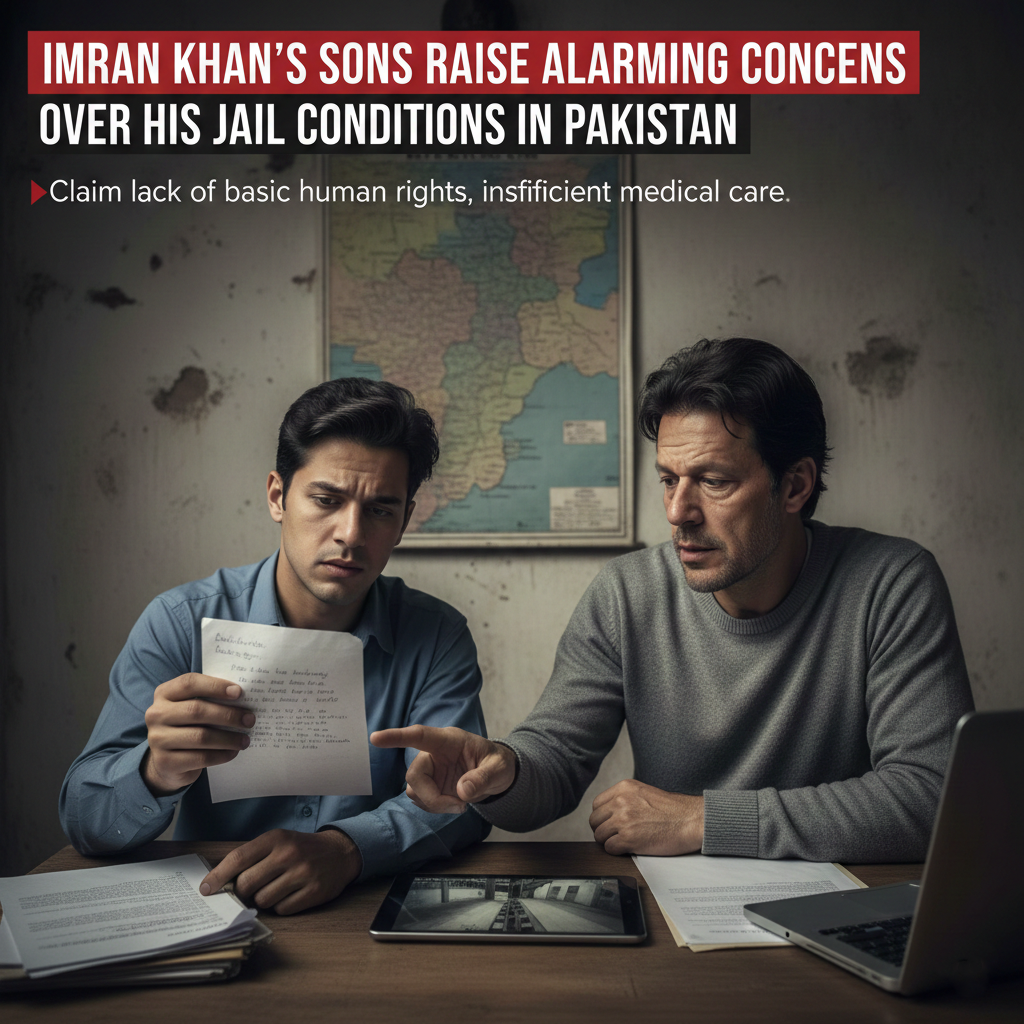
The detention of former Pakistani Prime Minister Imran Khan has remained a focal point of national and international discussion. Recently, the spotlight intensified when Imran Khan’s sons publicly raised concerns over his jail conditions in Pakistan, triggering fresh debates on human rights, rule of law, and political accountability.
Their statements have not only humanized the political crisis but also reignited global scrutiny of Pakistan’s justice system. From alleged lack of medical care to restricted family access, the concerns raised paint a troubling picture that demands attention.
This article provides a clear, factual, and human-centered analysis of the issue—why his sons spoke out, what conditions were highlighted, how authorities responded, and what this means for Pakistan’s political and legal future.
Why Imran Khan’s Jail Conditions Became a Global Issue
Imran Khan is not just another political detainee. As a former Prime Minister and a globally recognized figure, his treatment in custody naturally attracts international interest.
Key Reasons This Issue Gained Attention
- Imran Khan’s global political stature
- Public statements by his sons living abroad
- Involvement of international human rights groups
- Pakistan’s sensitive political climate
- Concerns over judicial transparency
When family members raise alarms, it often signals deeper systemic issues rather than isolated discomfort.
Who Are Imran Khan’s Sons and Why Their Voice Matters
Imran Khan has two sons, Sulaiman Khan and Qasim Khan, who have largely stayed away from Pakistani politics. Their decision to speak publicly marked a significant shift.
Why Their Statements Carry Weight
- They are direct family members with moral authority
- They have no political ambitions in Pakistan
- Their appeal focuses on humanitarian concerns, not power
- They addressed global audiences, not party supporters
This made their message resonate beyond political lines.
Concerns Raised About Imran Khan’s Jail Conditions
The sons highlighted several troubling aspects regarding their father’s imprisonment.
Alleged Issues in Custody
- Limited access to medical care
- Prolonged isolation
- Restricted communication with family
- Inadequate living conditions
- Mental and physical health risks
These concerns were framed not as political accusations but as basic human rights issues.
Medical Care and Health-Related Fears
Why Health Is a Major Concern
Imran Khan is in his early 70s and has a documented medical history. According to his sons, prolonged confinement without proper healthcare could worsen existing conditions.
Reported Health-Related Issues
- Delayed medical checkups
- Limited access to personal doctors
- Stress-related complications
- Poor sleeping arrangements
Health experts often warn that long-term incarceration under stressful conditions can accelerate physical decline, especially for older individuals.
Isolation and Mental Well-Being
One of the most serious concerns raised relates to isolation.
Why Solitary Conditions Are Harmful
- Can cause anxiety and depression
- Increases psychological stress
- Reduces emotional stability
- Considered a human rights issue by UN bodies
Imran Khan’s sons emphasized that isolation should not be used as a punitive tool, especially without transparent legal justification.
Family Access and Communication Restrictions
Family contact is considered a basic right for detainees under international law.
Current Allegations Include
- Irregular or denied family visits
- Limited phone communication
- Delayed legal correspondence
Such restrictions, if proven, could violate international detention standards.
Pakistan’s Legal Obligations Under International Law
Pakistan is a signatory to several international human rights conventions.
Relevant Legal Frameworks
- International Covenant on Civil and Political Rights (ICCPR)
- UN Standard Minimum Rules for the Treatment of Prisoners (Nelson Mandela Rules)
- Pakistan’s own constitutional guarantees
These frameworks require:
- Humane treatment of prisoners
- Access to medical care
- Fair trial rights
- Family contact
Government and Prison Authorities’ Response
Pakistani authorities have repeatedly stated that Imran Khan is being treated according to law.
Official Position Includes
- Denial of mistreatment claims
- Assurance of medical access
- Claims of equal treatment under prison rules
However, critics argue that lack of transparency fuels suspicion and mistrust.
Political Context Behind the Detention
Understanding the jail conditions debate requires context.
Political Background Snapshot
| Aspect | Details |
|---|---|
| Position | Former Prime Minister |
| Party | Pakistan Tehreek-e-Insaf (PTI) |
| Legal Cases | Multiple ongoing cases |
| Political Climate | Highly polarized |
| Public Support | Strong grassroots base |
Many believe the detention reflects political rivalry, while others argue it is purely legal.
Public Reaction Inside Pakistan
Public response has been deeply divided.
Supporters Say
- Detention is politically motivated
- Conditions are intentionally harsh
- Human rights are being violated
Critics Argue
- Law applies equally to all
- No one is above accountability
- Claims are exaggerated
This divide mirrors Pakistan’s broader political polarization.
International Reaction and Human Rights Attention
Imran Khan’s sons directed their appeal to the global community, including:
- Human rights organizations
- Foreign governments
- International media
Why International Voices Matter
- Diplomatic pressure influences reform
- Global image impacts economic ties
- Human rights records affect aid and trade
Silence from the international community could set a concerning precedent.
Comparison With Other High-Profile Detentions
To understand the gravity, it helps to compare.
| Case | Conditions Scrutinized | International Pressure |
|---|---|---|
| Imran Khan | Yes | Increasing |
| Nawaz Sharif (past) | Yes | Moderate |
| Zulfikar Ali Bhutto (historic) | Limited | Minimal |
The difference today lies in digital transparency and global connectivity.
Media Coverage and Narrative Control
Media narratives play a crucial role.
Key Observations
- Local media coverage is cautious
- International media highlights human rights angle
- Social media amplifies family voices
This has shifted the conversation from politics to human dignity.
Why This Issue Matters Beyond One Individual
This debate is not just about Imran Khan.
Broader Implications
- Treatment of political prisoners
- Strength of judicial independence
- Trust in democratic institutions
- Pakistan’s global reputation
If high-profile detainees face questionable conditions, ordinary prisoners may face worse.
Potential Outcomes and What Lies Ahead
Several scenarios could unfold:
- Improved transparency in jail conditions
- Judicial review of detention practices
- Continued international scrutiny
- Escalation of political tensions
The direction taken will shape Pakistan’s democratic future.
Frequently Asked Questions (FAQs)
Why did Imran Khan’s sons speak out now?
They believe his health and well-being are at serious risk and felt international attention was necessary.
Are the claims about jail conditions verified?
Authorities deny mistreatment, but independent verification remains limited.
Is Imran Khan allowed medical care?
Officials claim yes, while family members argue access is insufficient.
Does international law protect prisoners’ rights?
Yes. Pakistan is bound by multiple international conventions.
Could this affect Pakistan’s global image?
Absolutely. Human rights concerns often impact diplomacy and trade.
Conclusion: A Test of Justice, Humanity, and Transparency
The concerns raised by Imran Khan’s sons over his jail conditions in Pakistan have transformed a political detention into a global human rights conversation. At its core, this issue is not about political loyalty—it is about dignity, fairness, and the rule of law.
How Pakistan handles this situation will send a powerful message to its citizens and the world.
