

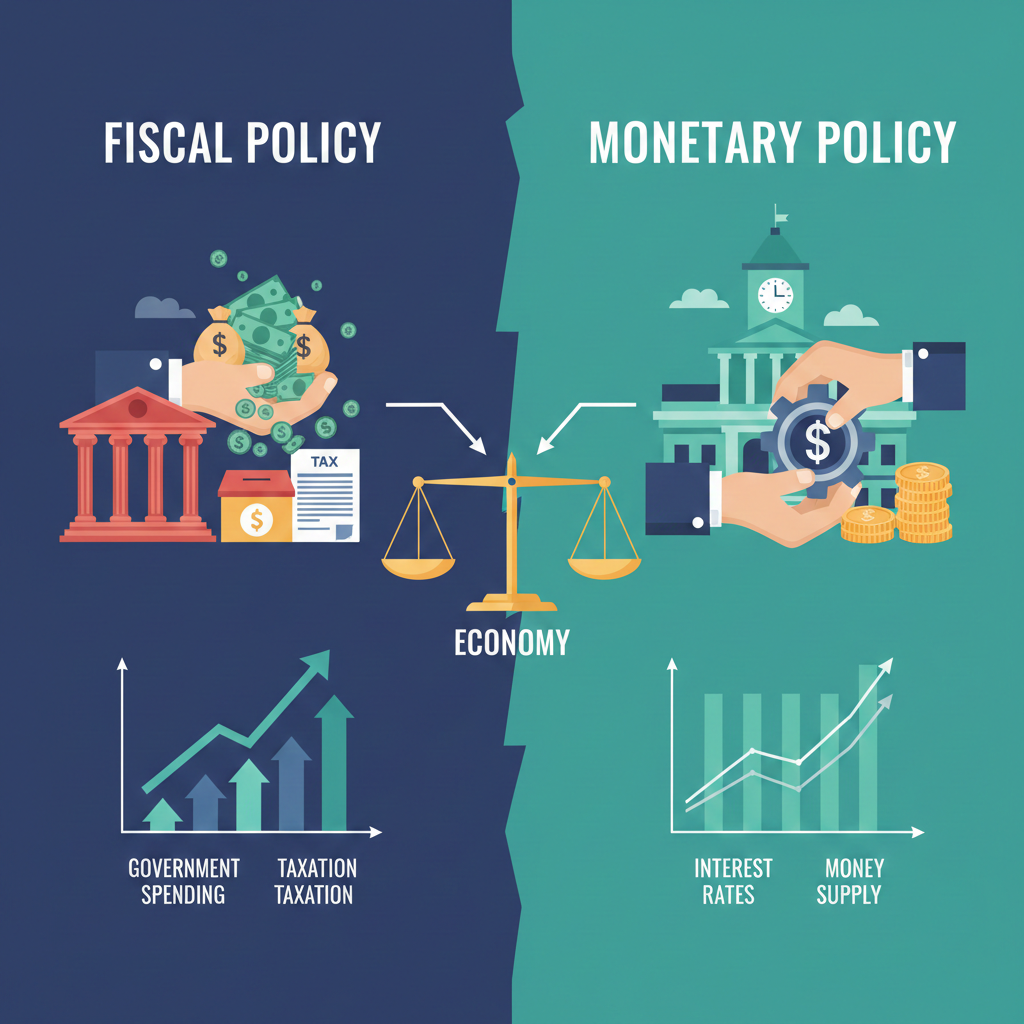
Fiscal Policy vs Monetary Policy is one of the most important concepts in economics, yet it often confuses students, professionals, and even business owners. These two policies shape how an economy grows, slows down, or recovers from crises. Whether it’s controlling inflation, reducing unemployment, or stabilizing markets, governments rely heavily on these tools.
In simple terms, fiscal policy is managed by the government through spending and taxation, while monetary policy is controlled by the central bank through interest rates and money supply. Both aim to keep the economy stable, but they work in very different ways.
Understanding the difference between fiscal policy vs monetary policy is essential if you follow economic news, invest in markets, run a business, or prepare for competitive exams. In this guide, we’ll break down everything step by step—using real-world examples, clear comparisons, and practical insights—without complex jargon.
What Is Fiscal Policy and Why Does It Matter?
Fiscal policy refers to the government’s strategy of using public spending and taxation to influence the economy.
It is designed and implemented by the central government, usually through the finance ministry or treasury.
Key Objectives of Fiscal Policy
- Promote economic growth
- Reduce unemployment
- Control inflation
- Reduce income inequality
- Stabilize the economy during recessions
Main Tools of Fiscal Policy
1. Government Spending
This includes spending on:
- Infrastructure (roads, railways, airports)
- Education and healthcare
- Defense and public administration
- Welfare schemes and subsidies
When the government increases spending, demand rises, businesses grow, and employment increases.
2. Taxation
Taxes directly affect disposable income.
- Lower taxes → more consumer spending
- Higher taxes → reduced inflation and deficit control
Types of Fiscal Policy
Expansionary Fiscal Policy
Used during economic slowdown or recession.
- Increased government spending
- Reduced taxes
Example: COVID-19 relief packages, stimulus checks, infrastructure spending
Contractionary Fiscal Policy
Used when inflation is high.
- Reduced government spending
- Increased taxes
Example: Cutting subsidies or raising income tax to reduce excess demand
What Is Monetary Policy and How Does It Work?
Monetary policy is the process by which a country’s central bank controls money supply and credit conditions to manage economic stability.
In India, monetary policy is managed by the Reserve Bank of India (RBI). In the U.S., it’s handled by the Federal Reserve.
Main Objectives of Monetary Policy
- Control inflation
- Maintain price stability
- Regulate money supply
- Encourage or discourage borrowing
Monetary Policy Tools Explained
1. Interest Rates
- Lower interest rates → cheaper loans → more spending
- Higher interest rates → expensive loans → less inflation
2. Open Market Operations (OMO)
Central bank buys or sells government securities.
- Buying securities → injects money
- Selling securities → absorbs money
3. Cash Reserve Ratio (CRR)
Percentage of deposits banks must keep with the central bank.
4. Repo Rate and Reverse Repo Rate
- Repo rate: rate at which banks borrow from the central bank
- Reverse repo rate: rate at which banks deposit money
Types of Monetary Policy
Expansionary Monetary Policy
- Lower interest rates
- Increased money supply
Used during recessions.
Contractionary Monetary Policy
- Higher interest rates
- Reduced money supply
Used to control inflation.
📌 Image Suggestion:
Interest rate movement and inflation control illustration
Alt text: Monetary policy tools interest rates inflation fiscal policy vs monetary policy
Fiscal Policy vs Monetary Policy: Core Differences Explained
Understanding the difference between fiscal policy and monetary policy becomes much easier with a side-by-side comparison.
| Basis | Fiscal Policy | Monetary Policy |
|---|---|---|
| Controlled by | Government | Central Bank |
| Main tools | Taxes, Spending | Interest rates, Money supply |
| Speed of impact | Slow | Faster |
| Political influence | High | Low |
| Primary goal | Economic growth & welfare | Price stability |
| Implementation | Annual budgets | Regular policy reviews |
Real-World Examples of Fiscal Policy vs Monetary Policy
Fiscal Policy Example
Increased spending on highways and railways:
- Creates jobs
- Boosts steel, cement, and logistics sectors
- Raises overall GDP growth
Monetary Policy Example
Central bank increases interest rates:
- Loan EMIs increase
- Consumers reduce spending
- Inflation gradually comes down
During Economic Crises
Both policies often work together.
Example: Global Financial Crisis & COVID-19
- Governments increased spending (fiscal)
- Central banks cut interest rates (monetary)
This coordination is crucial for economic recovery.
Which Policy Is More Effective?
There is no one-size-fits-all answer.
When Fiscal Policy Works Better
- During deep recessions
- When infrastructure investment is needed
- When unemployment is high
When Monetary Policy Is More Effective
- For controlling inflation
- For managing liquidity
- For quick market responses
In modern economies, both policies complement each other.
Fiscal Policy vs Monetary Policy: Impact on Common People
Impact of Fiscal Policy
- Changes in income tax affect savings
- Welfare schemes improve living standards
- Fuel subsidies affect daily expenses
Impact of Monetary Policy
- Interest rate changes affect home loans
- EMI fluctuations impact household budgets
- Inflation control protects purchasing power
Understanding these policies helps individuals make better financial decisions.
Advantages and Limitations of Both Policies
Advantages of Fiscal Policy
- Direct impact on employment
- Addresses inequality
- Supports long-term development
Limitations of Fiscal Policy
- Political delays
- Budget deficits
- Implementation lag
Advantages of Monetary Policy
- Quick execution
- Independent decision-making
- Strong inflation control
Limitations of Monetary Policy
- Limited impact during deep recessions
- Less direct job creation
How Fiscal Policy and Monetary Policy Work Together
Modern economic management relies on policy coordination.
- Fiscal policy boosts demand
- Monetary policy ensures price stability
Without coordination:
- Excess spending can cause inflation
- Excess tightening can slow growth
Balanced use ensures sustainable economic growth.
Suggested
Economic growth strategies → Related blog on growth models
Inflation explained → Guide on inflation causes
Role of central banks → RBI and global central banks
Outbound High-Authority References
- Wikipedia – Fiscal Policy
- Wikipedia – Monetary Policy
- Reserve Bank of India official publications
FAQs: Fiscal Policy vs Monetary Policy
What is the main difference between fiscal policy and monetary policy?
Fiscal policy is controlled by the government through taxes and spending, while monetary policy is managed by the central bank using interest rates and money supply.
Which policy controls inflation more effectively?
Monetary policy is more effective in controlling inflation because central banks can quickly adjust interest rates.
Can fiscal and monetary policy be used together?
Yes, both policies are often used together during economic crises to stabilize growth and control inflation.
Who implements fiscal policy in India?
Fiscal policy in India is implemented by the central government through the Union Budget.
What are common monetary policy tools?
Interest rates, repo rate, CRR, SLR, and open market operations are key monetary policy tools.
Conclusion
The debate around Fiscal Policy vs Monetary Policy isn’t about which is better, but how both work together to shape economic stability. Fiscal policy drives growth and welfare through government spending and taxation, while monetary policy ensures price stability and controls inflation through interest rates and liquidity management.
When used wisely and in coordination, these two policies can guide an economy through booms, recessions, and global crises. Understanding their roles empowers citizens, investors, and businesses to make informed decisions.
📢 Enjoyed this guide?
Share it, leave a comment with your thoughts, or explore more in-depth economic explainers on our blog.
