

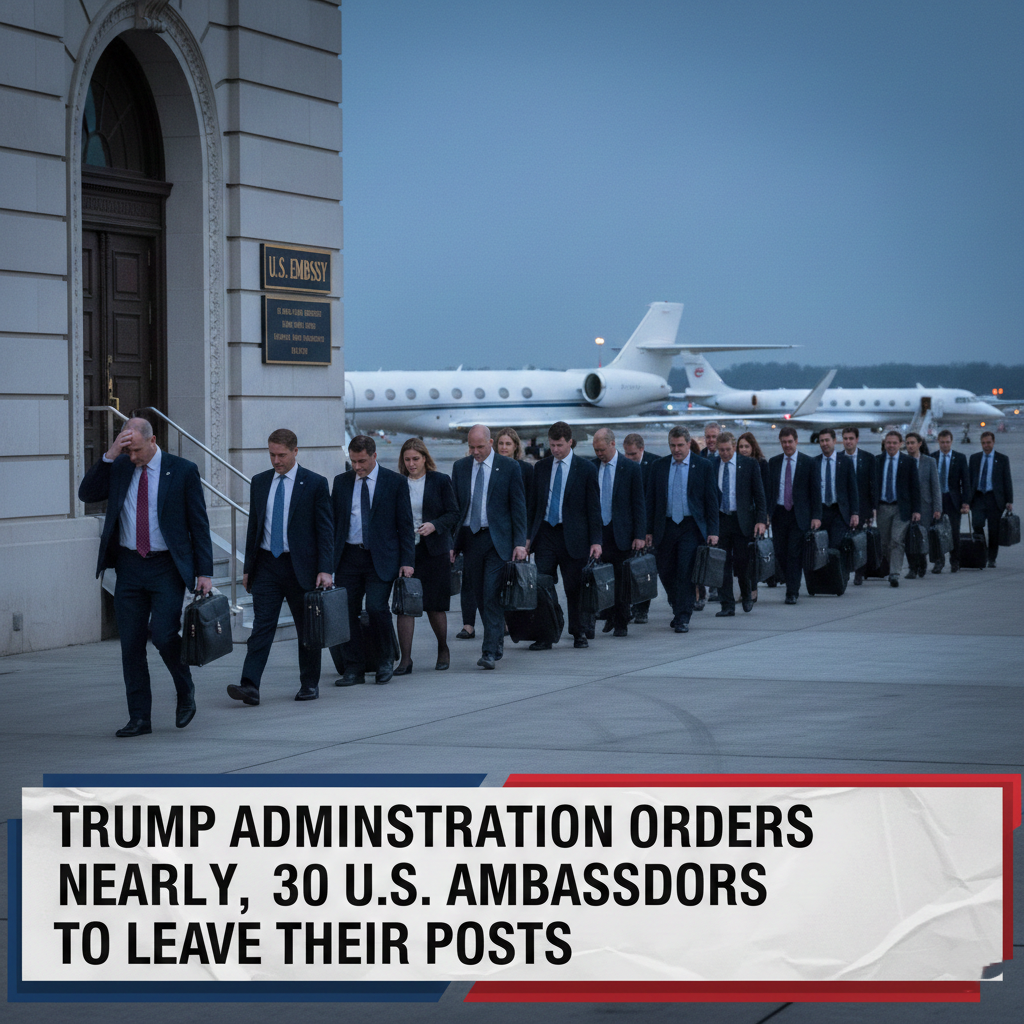
A Sudden Diplomatic Shake-Up That’s Raising Eyebrows Worldwide
The Trump administration ordering nearly 30 U.S. ambassadors to leave their posts has triggered intense discussion across Washington and global diplomatic circles. The decision, which came swiftly and with limited public explanation, marks one of the most significant reshuffles in U.S. foreign representation in recent history.
Ambassadors are the face of American diplomacy abroad. Removing such a large number at once is not routine. Supporters call it a necessary reset. Critics warn it could weaken long-standing alliances, disrupt sensitive negotiations, and send confusing signals to allies and adversaries alike.
In this deep-dive analysis, we break down why the Trump administration made this move, which regions are most affected, how it compares with previous administrations, and what it means for America’s global influence going forward.
For ongoing diplomatic and political coverage, visit thenews.zone.
What Exactly Happened: Nearly 30 U.S. Ambassadors Asked to Step Down
According to multiple government and media sources, the Trump administration directed close to 30 U.S. ambassadors and senior diplomatic envoys to vacate their positions. Most were career diplomats or appointees from the previous administration, though some Trump-era ambassadors were also affected.
Key details of the order
- Ambassadors were instructed to leave their posts within a short timeframe
- Several embassies were placed under chargé d’affaires leadership
- The move affected Europe, Asia, Africa, and Latin America
- No single official memo publicly explained the criteria for removal
This scale of ambassadorial turnover is rare and immediately drew attention from foreign governments and U.S. lawmakers.
Why the Trump Administration Ordered Ambassadors to Leave
A political reset aligned with “America First”
The Trump administration has long emphasized reshaping U.S. foreign policy around its America First doctrine. Officials argue that many ambassadors were not fully aligned with the administration’s priorities, particularly on trade, defense spending, and multilateral agreements.
From this perspective, replacing ambassadors allows the White House to:
- Ensure loyalty to current policy goals
- Push tougher stances in trade and security talks
- Reduce resistance from career diplomats
Frustration with the State Department
Former Trump officials have repeatedly criticized what they describe as a “deep-state culture” within the State Department. Removing ambassadors was seen as a way to assert executive control over foreign policy implementation.
Outbound reference: U.S. Department of State leadership structure (state.gov)
Regions Most Affected by the Ambassadorial Shake-Up
Europe: Allies watching closely
Several ambassadors in European NATO countries were among those asked to leave. This raised concerns at a time when:
- Defense spending disputes were ongoing
- Trade tensions with the EU remained unresolved
- Russia and Ukraine dominated security discussions
European leaders privately expressed worry that frequent diplomatic changes could complicate coordination.
Asia-Pacific: Strategic uncertainty
In Asia, U.S. ambassadors play a critical role in managing relations with:
- China
- North Korea
- Japan
- Southeast Asian allies
A sudden leadership vacuum in embassies may slow negotiations on trade agreements and security cooperation.
Africa and Latin America: Diplomatic continuity at risk
Many affected ambassadors served in developing regions where personal relationships matter deeply. Analysts warn that sudden departures could weaken U.S. influence, especially as China and Russia expand their presence.
How This Compares to Previous U.S. Administrations
| Administration | Ambassador Removals (Early Term) | Style |
|---|---|---|
| Obama | Limited, gradual changes | Institutional continuity |
| Bush | Moderate reshuffle | Party-aligned appointments |
| Trump | Nearly 30 at once | Aggressive reset |
Unlike previous presidents, Trump favored large-scale, fast diplomatic changes, prioritizing loyalty and policy alignment over continuity.
Outbound reference: Historical ambassador data analysis via Congressional Research Service (crsreports.congress.gov)
Supporters vs Critics: The Debate Explained Clearly
Supporters say the move strengthens leadership
Proponents argue:
- Presidents deserve diplomats who fully support their agenda
- Ambassadors shape policy, not just deliver messages
- A reset sends a strong signal of leadership
They view the decision as bold and decisive.
Critics warn of long-term diplomatic damage
Opponents counter that:
- Diplomacy relies on trust built over years
- Sudden exits disrupt negotiations
- Allies may question U.S. reliability
Former diplomats called the move “destabilizing” and “counterproductive.”
Impact on Global Perception of the United States
Diplomacy is as much about symbolism as policy. Ordering nearly 30 ambassadors to leave at once sends mixed messages internationally.
Possible global interpretations
- Allies: Concern about consistency
- Rivals: Opportunity to exploit uncertainty
- Neutral nations: Hesitation to commit
Soft power, once weakened, is difficult to rebuild.
For more geopolitical insights, explore thenews.zone.
What Happens Next: Interim Diplomats and New Appointments
Chargé d’affaires step in
Until replacements are confirmed, embassies are led by chargé d’affaires, who:
- Have limited authority
- Cannot shape long-term policy
- Often avoid controversial decisions
Senate confirmation delays
New ambassadors require Senate approval, which can take months or even years, extending diplomatic gaps.
Outbound reference: Ambassador appointment process explained by the U.S. Senate (senate.gov)
Historical Context: Is This Truly Unprecedented?
While presidents routinely replace ambassadors, experts note that:
- The scale of removals is unusually large
- The speed of implementation is uncommon
- The lack of public explanation is notable
This combination makes the Trump administration’s decision stand out in modern U.S. history.
What This Means for American Foreign Policy Long Term
Short-term consequences
- Slower negotiations
- Reduced embassy influence
- Confusion among partner nations
Long-term risks
- Erosion of diplomatic expertise
- Reduced credibility abroad
- Increased reliance on military over diplomacy
Foreign policy experts argue that diplomacy works best when it is stable, strategic, and consistent.
Frequently Asked Questions (FAQs)
Why did the Trump administration remove so many U.S. ambassadors?
The administration aimed to realign diplomatic leadership with its foreign policy priorities and reduce resistance within the State Department.
Is removing ambassadors legal?
Yes. Ambassadors serve at the pleasure of the president, though mass removals are rare.
Were all removed ambassadors from the previous administration?
Most were, but not all. Some Trump-appointed diplomats were also affected.
Does this weaken U.S. diplomacy?
Critics argue it does, especially in regions where relationships are crucial. Supporters disagree.
Where can I follow verified updates on U.S. diplomacy?
High-authority sources include the U.S. State Department (state.gov) and independent analysis at thenews.zone.
Conclusion: A Defining Moment for U.S. Diplomacy
The decision to order nearly 30 U.S. ambassadors to leave their posts is more than an administrative change—it reflects a broader shift in how America engages with the world. Whether seen as decisive leadership or diplomatic disruption, its impact will be felt for years.
As global politics grow more complex, the balance between political control and diplomatic continuity remains critical. The world is watching how the United States navigates this moment.
👉 Stay informed with expert political and global affairs coverage at thenews.zone. Bookmark us for daily updates, deep analysis, and breaking news that matters.
