

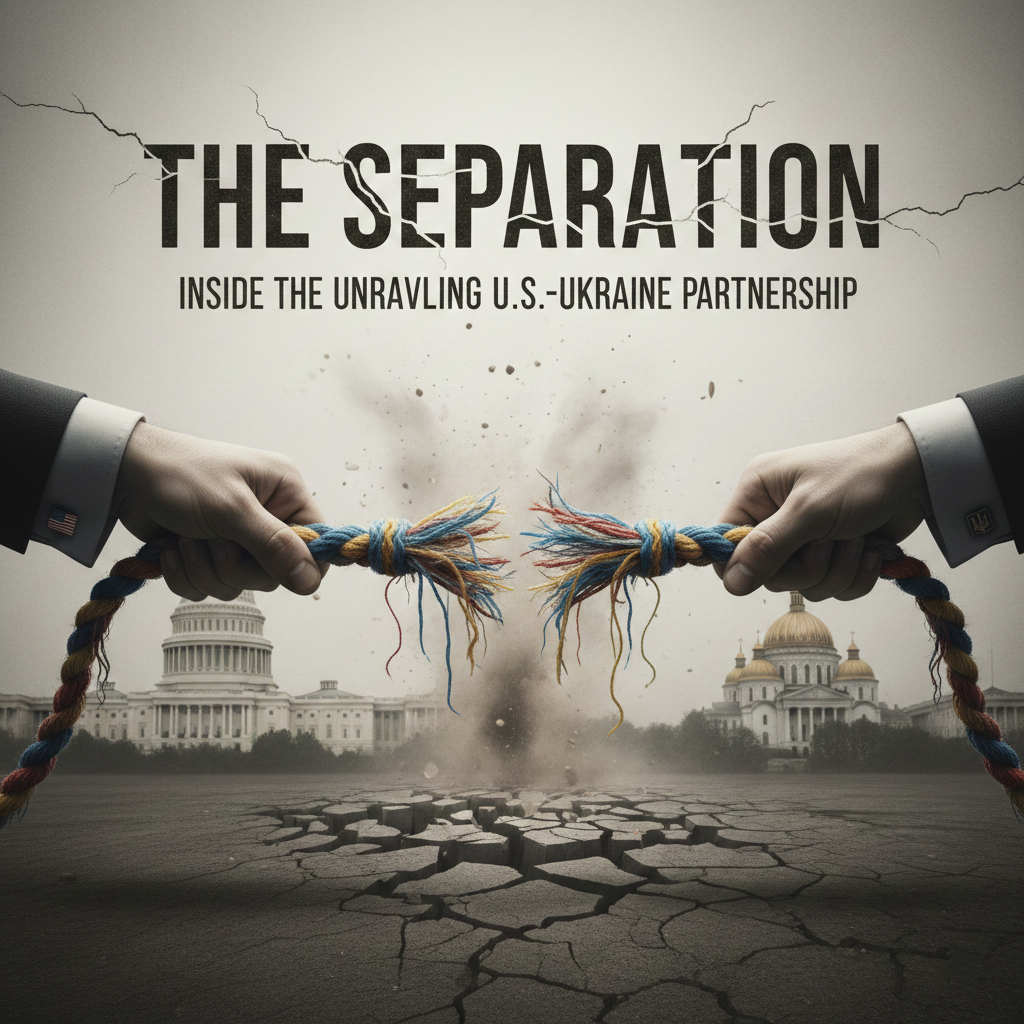
Understanding the Separation Between the U.S. and Ukraine
The separation between the United States and Ukraine is no longer a quiet diplomatic concern—it has become a defining geopolitical shift with global consequences. Once viewed as a strong strategic alliance built on shared security interests, democratic values, and resistance to Russian aggression, the U.S.-Ukraine partnership is showing visible cracks.
From delayed military aid to political fatigue in Washington and strategic recalculations in Kyiv, the unraveling relationship signals a new phase in international politics. This article takes a deep, human-centered look at why the U.S.-Ukraine relationship is weakening, how it happened, and what the separation means for Europe, NATO, and the global balance of power.
For more global political analysis, readers can explore related coverage on thenews.zone, a growing hub for international affairs and policy insights.
The Foundation of the U.S.-Ukraine Partnership
How the Alliance Was Built After 1991
Ukraine’s independence in 1991 marked the beginning of a cautious but growing relationship with the United States. Washington viewed Ukraine as a critical buffer between Russia and NATO, while Kyiv sought economic support and security assurances.
Key pillars of early cooperation included:
- Nuclear disarmament under the Budapest Memorandum (1994)
- Economic reforms backed by U.S. institutions
- Military training and defense cooperation
- Support for democratic governance
The partnership strengthened significantly after 2014, following Russia’s annexation of Crimea.
Post-2014: A Strategic Turning Point
After the annexation of Crimea, the U.S. became one of Ukraine’s strongest allies, providing:
- Billions in military assistance
- Intelligence-sharing support
- Diplomatic pressure on Russia
- Sanctions coordination with allies
This period marked the peak of U.S.-Ukraine cooperation, particularly during the early years of the Russia-Ukraine war.
Why the U.S.-Ukraine Partnership Is Unraveling
Political Fatigue in Washington
One of the most critical reasons behind the separation is growing political fatigue in the U.S.
Several factors contribute to this:
- Rising domestic priorities such as inflation and immigration
- Election-year polarization in Congress
- Concerns over long-term financial commitments
- Public skepticism about “endless foreign wars”
According to a 2024 Pew Research survey, over 41% of Americans believe the U.S. is doing too much to help Ukraine, a sharp rise from previous years.
Delays and Disputes Over Military Aid
Military assistance has become a flashpoint. While the U.S. remains Ukraine’s largest donor, aid packages have faced repeated delays due to congressional deadlock.
| Year | U.S. Military Aid to Ukraine | Major Challenges |
|---|---|---|
| 2022 | $48+ billion | Emergency approvals |
| 2023 | $36 billion | Congressional delays |
| 2024 | Slowed approvals | Political resistance |
These delays have had real consequences on the battlefield, weakening Ukraine’s defensive capacity.
For official aid data, see the U.S. Department of State resource:
https://www.state.gov/u-s-security-cooperation-with-ukraine/
Ukraine’s Growing Frustration and Strategic Reassessment
Kyiv’s Changing Expectations
Ukraine expected sustained, long-term support from the U.S. Instead, it now faces uncertainty. Ukrainian leaders have increasingly voiced concerns about:
- Inconsistent military supplies
- Shifting U.S. priorities
- Lack of clear long-term commitments
President Volodymyr Zelenskyy has repeatedly emphasized that uncertainty itself is a strategic disadvantage.
Exploring Alternatives Beyond Washington
As confidence in U.S. reliability weakens, Ukraine is expanding its diplomatic outreach:
- Stronger defense ties with the EU
- Increased cooperation with the UK, France, and Germany
- Domestic weapons production initiatives
This diversification reflects a quiet acceptance that the partnership with Washington may never return to its earlier strength.
The Role of NATO and European Allies
Europe Stepping In as the U.S. Steps Back
European nations are increasingly filling the gap left by the U.S. slowdown.
Key developments include:
- Germany expanding arms production
- France providing long-range missile support
- The EU approving multi-year aid frameworks
However, Europe alone cannot fully replace U.S. military and intelligence capabilities.
NATO’s Strategic Dilemma
The separation complicates NATO’s long-term strategy. While NATO remains unified publicly, internal divisions are growing over:
- Ukraine’s potential membership
- Burden-sharing among members
- Risk of escalation with Russia
For NATO’s official stance, visit:
https://www.nato.int/cps/en/natohq/topics_192648.htm
Russia’s Strategic Advantage in the Separation
How Moscow Benefits From the Rift
Russia has capitalized on the unraveling partnership by:
- Prolonging the conflict
- Targeting Ukrainian infrastructure
- Increasing influence in the Global South
The Kremlin sees weakening U.S.-Ukraine ties as validation of its long-term strategy to outlast Western support.
Information Warfare and Diplomacy
Russia has also intensified its global messaging, framing the separation as proof that Western alliances are unstable and unreliable.
Economic and Human Costs of the Separation
Impact on Ukraine’s Economy
Reduced confidence in U.S. backing has affected:
- Foreign investment flows
- Currency stability
- Reconstruction planning
Ukraine’s GDP remains heavily dependent on external assistance.
Humanitarian Consequences
The slowdown in support directly affects civilians:
- Delays in rebuilding hospitals and schools
- Reduced humanitarian aid pipelines
- Increased displacement risks
According to the UN, over 14 million Ukrainians still require humanitarian assistance.
Source:
https://www.unocha.org/ukraine
Comparing the Past and Present U.S.-Ukraine Relationship
| Aspect | Strong Partnership Era | Current Separation Phase |
|---|---|---|
| Military Aid | Consistent, fast | Delayed, uncertain |
| Political Support | Bipartisan | Deeply divided |
| Strategic Trust | High | Declining |
| Long-Term Vision | Clear | Uncertain |
This comparison highlights how dramatically the relationship has shifted in just a few years.
What This Separation Means for Global Geopolitics
A Shift Toward Multipolar Power
The unraveling U.S.-Ukraine partnership reflects a broader global trend:
- Declining U.S. dominance
- Rise of regional power centers
- Pragmatic, interest-based alliances
Countries are increasingly preparing for a world where U.S. support is conditional, not guaranteed.
Implications for Other U.S. Allies
Nations in Asia, the Middle East, and Eastern Europe are watching closely. The separation sends a message that strategic partnerships require constant political alignment, not just shared values.
For related geopolitical analysis, internal coverage on thenews.zone explores how shifting alliances are redefining global power structures.
FAQs: The Separation Between the U.S. and Ukraine
Why is the U.S.-Ukraine partnership weakening?
Political polarization in the U.S., aid fatigue, and shifting global priorities have reduced consistent support for Ukraine.
Is the U.S. abandoning Ukraine completely?
No, but support is becoming slower, more conditional, and less predictable.
Can Europe fully replace U.S. support for Ukraine?
Europe can help significantly, but it lacks the scale and intelligence capabilities of the U.S.
Does this separation benefit Russia?
Yes. Reduced Western unity strengthens Russia’s strategic position.
Where can I read more in-depth geopolitical analysis?
Visit thenews.zone for ongoing coverage of global conflicts and alliances.
Conclusion: A Partnership at a Crossroads
The separation between the U.S. and Ukraine is not a sudden break—it is a gradual unraveling shaped by politics, fatigue, and shifting global realities. While the alliance still exists, it no longer carries the certainty or momentum it once did.
For Ukraine, the challenge is survival and adaptation. For the U.S., it is credibility and strategic clarity. And for the world, this separation marks a turning point in how alliances are built, tested, and sustained.
As global power dynamics continue to evolve, staying informed is more important than ever.
👉 Stay updated with expert insights, global political analysis, and breaking international news—visit thenews.zone today.
