

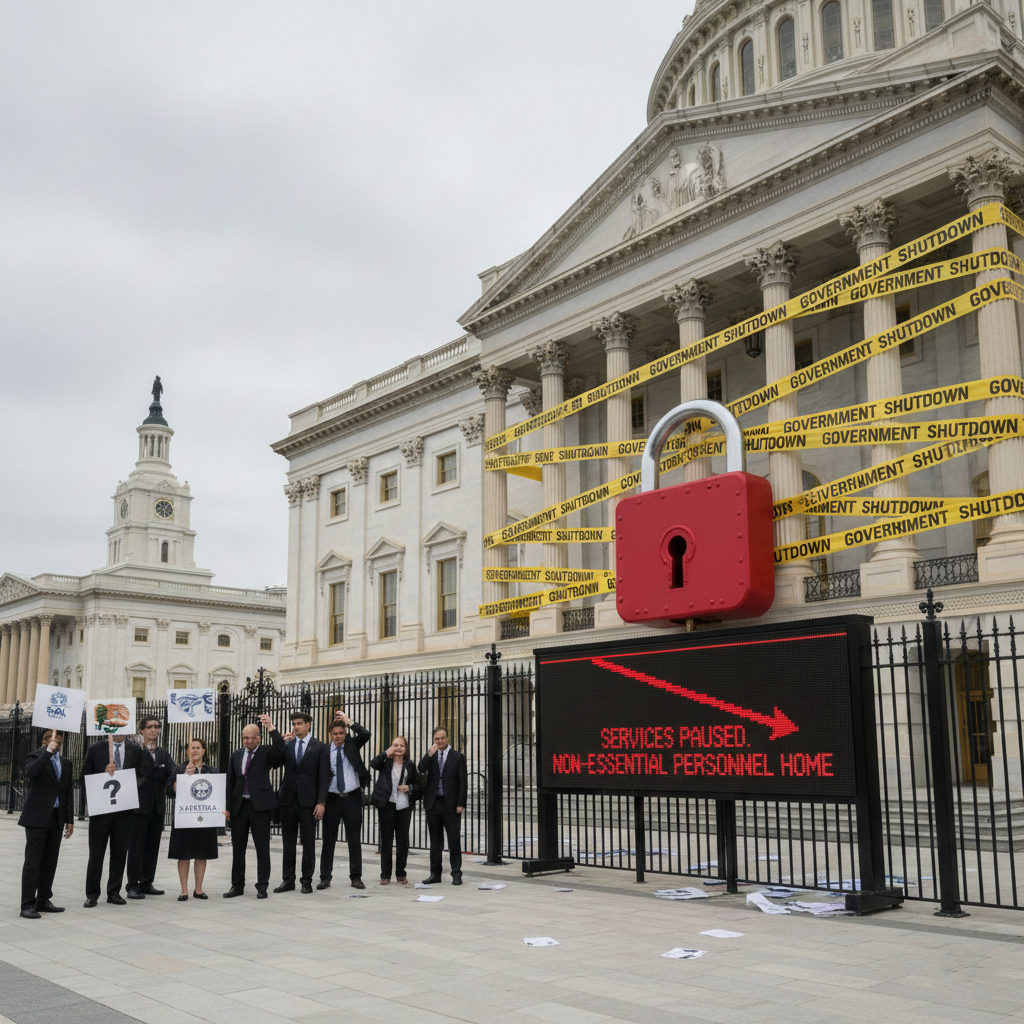
A government shutdown is one of the most disruptive events in public administration, yet it often confuses citizens. When headlines announce a shutdown, people immediately worry about salaries, public services, the economy, and political stability.
In simple terms, a government shutdown happens when lawmakers fail to approve funding for federal operations. As a result, many government agencies stop working, employees are furloughed, and essential services operate with limited capacity.
This in-depth guide breaks down what a government shutdown is, why it happens, who it affects, and why it matters—using clear language, real examples, and practical insights. For more daily political explainers, visit thenews.zone.
What Is a Government Shutdown?
A government shutdown occurs when the legislative body does not pass budget legislation to fund government operations.
How it works in simple terms
- Governments operate on approved budgets
- If funding bills are not passed on time
- Agencies legally cannot spend money
- Operations partially or fully stop
This usually affects non-essential services, while critical functions like national security and emergency response continue.
👉 Official explanation:
Outbound reference – USA Government shutdown overview:
https://www.usa.gov/government-shutdown
Why Government Shutdowns Happen
Shutdowns are rarely accidental. They usually result from political disagreement.
Common reasons behind a shutdown
- Budget disputes between political parties
- Disagreements over government spending levels
- Conflicts on major policy issues
- Failure to pass appropriations bills on time
Key political factors
- Divided government (different parties controlling branches)
- Election-year pressure
- Policy standoffs (healthcare, immigration, defense)
These disagreements delay funding approvals, triggering shutdowns by law.
Government Shutdown vs Budget Crisis: Key Differences
| Factor | Government Shutdown | Budget Crisis |
|---|---|---|
| Cause | No funding approval | Long-term fiscal imbalance |
| Duration | Days to weeks | Years |
| Impact | Immediate disruption | Gradual economic strain |
| Resolution | Passing funding bill | Structural reforms |
A shutdown is sudden and visible, while a budget crisis unfolds slowly.
History of Government Shutdowns
Government shutdowns are not new. They have occurred multiple times over the past decades.
Major shutdowns in history
| Year | Duration | Key Cause |
|---|---|---|
| 1995–96 | 21 days | Budget dispute |
| 2013 | 16 days | Healthcare funding |
| 2018–19 | 35 days | Border security |
The 2018–19 shutdown was the longest in modern history, affecting over 800,000 federal workers.
For historical political timelines, see thenews.zone.
Who Is Affected by a Government Shutdown?
Shutdowns ripple across society, impacting more than just politicians.
Federal employees
- Furloughed workers receive no immediate pay
- Essential workers work without pay
- Paychecks may be delayed
Citizens and public services
- Passport and visa processing slows
- National parks may close
- Government helplines operate with limited staff
Businesses and contractors
- Delayed payments
- Paused government contracts
- Reduced economic activity
Economic Impact of a Government Shutdown
A shutdown can cost billions in lost productivity.
Key economic consequences
- Reduced GDP growth
- Loss of consumer confidence
- Stock market volatility
- Delayed government data releases
According to estimates from the Congressional Budget Office, prolonged shutdowns can shave billions off economic output.
Outbound reference:
https://www.cbo.gov
Impact on Stock Markets and Investors
Markets dislike uncertainty, and shutdowns create plenty of it.
Short-term effects
- Increased volatility
- Sector-specific losses (defense, travel)
- Risk-off investor sentiment
Long-term impact
- Usually limited if shutdown is short
- Markets recover once funding resumes
Investors often focus more on duration than the shutdown itself.
How Government Shutdowns Affect Global Confidence
Shutdowns don’t just stay domestic.
International consequences
- Reduced investor trust
- Delayed trade negotiations
- Weakened diplomatic credibility
Global markets watch shutdowns closely as indicators of political stability.
Essential vs Non-Essential Services Explained
During a shutdown, not all services stop.
Essential services (continue operating)
- Military operations
- Air traffic control
- Emergency healthcare
- Law enforcement
Non-essential services (paused)
- Public research programs
- Cultural institutions
- Some administrative offices
This classification is defined by law and reviewed during each shutdown.
Can a Government Shutdown Be Avoided?
Yes—but it requires political cooperation.
Preventive measures
- Passing temporary funding bills
- Long-term budget agreements
- Bipartisan negotiations
Structural reforms (long-term)
- Automatic funding extensions
- Budget deadline enforcement
- Spending cap agreements
Many experts argue reforms are needed to reduce repeated shutdowns.
How Long Does a Government Shutdown Last?
There is no fixed timeline.
Duration depends on:
- Political negotiations
- Public pressure
- Economic consequences
Shutdowns can last:
- A few hours
- Several days
- Multiple weeks
The longer it lasts, the higher the cost.
Government Shutdown Myths vs Reality
Myth 1: All government work stops
Reality: Essential services continue.
Myth 2: Shutdowns save money
Reality: They often cost more due to back pay and lost productivity.
Myth 3: Citizens are not affected
Reality: Services, benefits, and economic stability are impacted.
FAQs About Government Shutdowns
What exactly triggers a government shutdown?
A shutdown begins when lawmakers fail to pass funding legislation by the deadline.
Do government employees get paid during a shutdown?
Essential workers work unpaid temporarily, while furloughed workers may receive back pay later.
Are social security and pensions affected?
No, entitlement programs usually continue because they are funded separately.
Does a government shutdown affect taxes?
Tax collection continues, but refunds may be delayed due to staffing shortages.
Where can I get official updates during a shutdown?
Outbound link:
https://www.usa.gov/government-shutdown
Internal coverage: thenews.zone
Why Government Shutdowns Matter to Everyday People
Even if you don’t work for the government, shutdowns matter.
Real-life effects
- Slower public services
- Economic uncertainty
- Market fluctuations
- Reduced trust in governance
They reflect broader issues in political cooperation and governance efficiency.
The Bigger Picture: Democracy and Accountability
Shutdowns raise important questions:
- How effective is political leadership?
- Should public services be bargaining tools?
- What reforms are needed?
A functioning democracy depends on stable governance.
Conclusion: Understanding Government Shutdowns Clearly
A government shutdown is more than a political headline—it’s a real-world disruption that affects workers, businesses, markets, and public trust. While shutdowns are legal mechanisms, their repeated occurrence highlights deeper governance challenges.
Staying informed helps citizens understand not just what is happening, but why it matters.
👉 For clear, timely, and people-first news analysis, explore more at thenews.zone and stay ahead of the story.
