

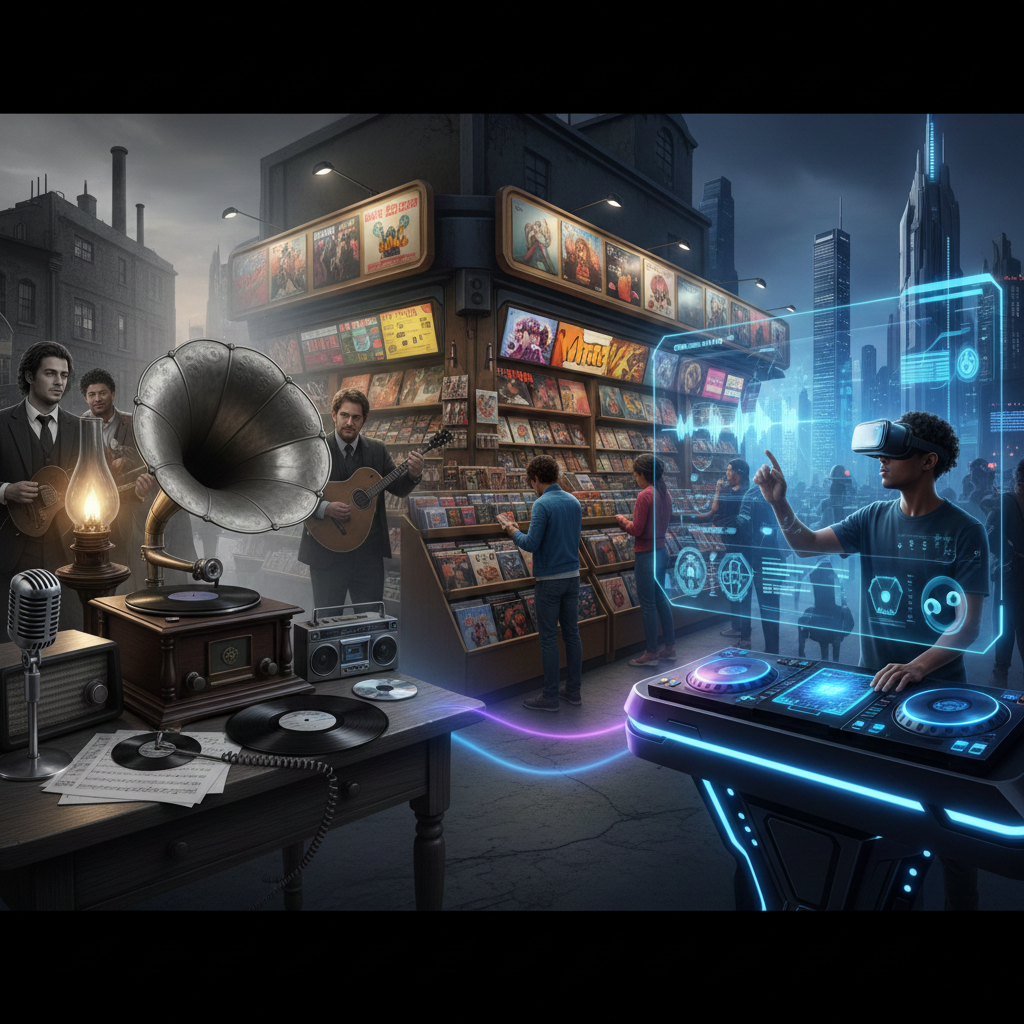
Understanding the Music Industry Evolution
The music industry evolution is one of the most fascinating transformations in modern cultural and business history. From live performances in royal courts to vinyl records, CDs, digital downloads, and now AI-driven streaming platforms, music has constantly adapted to technology, audience behavior, and economic change.
Today, music is more accessible than ever—but also more competitive. Artists can go viral overnight, labels rely on data instead of intuition, and listeners expect unlimited music at their fingertips. This article explores how the music industry evolved over time, what caused major disruptions, and where the future is heading.
If you’re a music lover, creator, marketer, or industry professional, this deep dive will give you real insight—not surface-level facts.
For more cultural and industry insights, explore our related articles on thenews.zone.
Early Foundations of the Music Industry
Music Before Recording Technology
Before the late 19th century, music existed only in live form. If you wanted to hear music, it had to be performed in front of you.
Key characteristics of early music distribution:
- Live performances in churches, royal courts, and public gatherings
- Music passed down orally or through written notation
- Musicians depended on patrons, not audiences
- No mass distribution or ownership of music
This era focused purely on performance, not production or profit.
The Birth of Recorded Music (Late 1800s – 1920s)
Invention of the Phonograph and Gramophone
The real music industry evolution began with Thomas Edison’s phonograph in 1877. For the first time, sound could be recorded and replayed.
Major changes:
- Music became a product
- Artists could reach people without being physically present
- Record companies emerged as powerful intermediaries
Early formats included:
- Wax cylinders
- Shellac records
- Gramophone discs
This laid the foundation for the commercial music business.
📌 Outbound reference:
History of recorded sound – https://www.loc.gov/audio/
The Golden Age of Vinyl and Radio (1930s – 1950s)
Vinyl Records Take Over
Vinyl records replaced fragile shellac discs, offering:
- Better sound quality
- Longer playtime
- Mass production
Music consumption shifted from elite audiences to the general public.
Radio’s Massive Influence
Radio revolutionized music promotion:
- Songs reached millions instantly
- DJs became tastemakers
- Record sales skyrocketed
Genres like jazz, blues, swing, and early rock gained mainstream popularity.
Key industry shift:
Promotion became as important as production.
Rock, Pop, and the Rise of Global Superstars (1960s – 1970s)
Artist Branding Becomes Central
This era introduced:
- The Beatles, Elvis Presley, Bob Dylan, Michael Jackson
- Album-focused artistry
- Stadium tours and fan culture
Music was no longer just sound—it was identity.
Music Industry Structure
| Role | Function |
|---|---|
| Record Labels | Production, promotion, contracts |
| Artists | Content creation |
| Distributors | Physical delivery |
| Retail Stores | Sales |
The industry was profitable but tightly controlled by labels.
Cassette Tapes and the Power of Portability (1970s – 1980s)
The Cassette Revolution
Cassette tapes changed everything:
- Music became portable
- Users could record at home
- Mix tapes personalized listening
Sony’s Walkman turned music into a personal experience.
Challenges for Labels
- Piracy increased
- Control over distribution weakened
- Artists gained limited independence
This was the first crack in the traditional music business model.
Compact Discs and Peak Industry Profits (1990s)
CDs Redefined Audio Quality
Compact Discs (CDs) offered:
- Clear digital sound
- Durability
- Higher profit margins
The 1990s were the most profitable decade in music industry history.
📊 Stat Insight:
According to the RIAA, global music revenue peaked in 1999 at over $27 billion.
📌 Outbound source:
RIAA Music Revenue Data – https://www.riaa.com/u-s-sales-database/
Digital Disruption and the Napster Shock (Early 2000s)
MP3s and File Sharing
Napster changed the rules overnight:
- Free music downloads
- Peer-to-peer sharing
- Collapse of CD sales
Consumers embraced digital access, while labels struggled to adapt.
Industry Impact
- Thousands of record stores closed
- Artists lost traditional income streams
- Labels shifted focus to lawsuits instead of innovation
This phase marked the most disruptive moment in music industry evolution.
iTunes and the Legal Digital Marketplace
Apple’s Game-Changing Model
Apple introduced iTunes:
- Legal music downloads
- Pay-per-song pricing
- User-friendly ecosystem
This restored some balance between consumers and the industry.
Limitation:
Downloads were still ownership-based, not access-based.
Streaming Era: Spotify, Apple Music, and Beyond
Music as a Service
Streaming platforms transformed music into an on-demand service.
Key features:
- Unlimited access
- Algorithm-based discovery
- Monthly subscriptions
Top platforms include:
- Spotify
- Apple Music
- YouTube Music
- Amazon Music
📌 Outbound reference:
Global streaming trends – https://www.ifpi.org/
Pros and Cons of Streaming
Advantages:
- Global reach for artists
- Easy discovery for listeners
- Data-driven decisions
Challenges:
- Low per-stream payouts
- Oversaturation of content
- Dependence on algorithms
Social Media and the Rise of Independent Artists
TikTok, Instagram, and YouTube
Social platforms reshaped music marketing:
- Viral trends replace radio hits
- Artists build direct fanbases
- No label required to break out
Examples:
- TikTok songs topping Billboard charts
- YouTube artists signing global deals
For emerging artist stories and digital culture updates, visit thenews.zone.
The Modern Music Industry Business Model
Multiple Revenue Streams
Artists today earn from:
- Streaming royalties
- Live concerts and tours
- Brand collaborations
- Merchandise
- NFTs and digital collectibles
Comparison: Then vs Now
| Aspect | Old Industry | Modern Industry |
|---|---|---|
| Distribution | Physical | Digital |
| Control | Labels | Artists + Platforms |
| Revenue | Album sales | Multiple streams |
| Discovery | Radio | Algorithms & social |
Artificial Intelligence and the Future of Music
AI in Music Creation and Marketing
AI is reshaping the industry through:
- AI-generated compositions
- Voice cloning
- Predictive hit analysis
- Personalized playlists
While controversial, AI offers efficiency and new creative tools.
📌 Outbound reference:
AI in music research – https://www.bbc.com/future/article/ai-music-industry
Challenges Facing the Music Industry Today
Key Issues
- Fair artist compensation
- Copyright enforcement
- Algorithm bias
- Market saturation
The industry must balance innovation with ethical responsibility.
FAQs: Music Industry Evolution
How has the music industry evolved over time?
The music industry evolved from live performances to physical recordings, then digital downloads, and now streaming and AI-driven platforms.
What caused the biggest disruption in music history?
Digital file sharing and streaming caused the most significant disruption by changing ownership into access-based consumption.
Is streaming good or bad for artists?
Streaming offers global exposure but often pays lower royalties, requiring artists to diversify income streams.
What role does AI play in modern music?
AI assists in music creation, discovery, marketing, and audience analysis, shaping future industry trends.
Where can I read more about music and culture?
Visit thenews.zone for in-depth articles on music, entertainment, and digital trends.
Conclusion: What the Music Industry Evolution Teaches Us
The music industry evolution proves one thing clearly—music never stops adapting. Technology will change, platforms will rise and fall, but the human desire for music remains constant.
Artists who embrace innovation, build authentic connections, and adapt to new tools will thrive in the modern era.
🎵 Want more deep insights on music, culture, and digital industries?
Explore expert-curated articles only on thenews.zone and stay ahead of the curve.
