

A Cautious Opening Amid Global Tensions
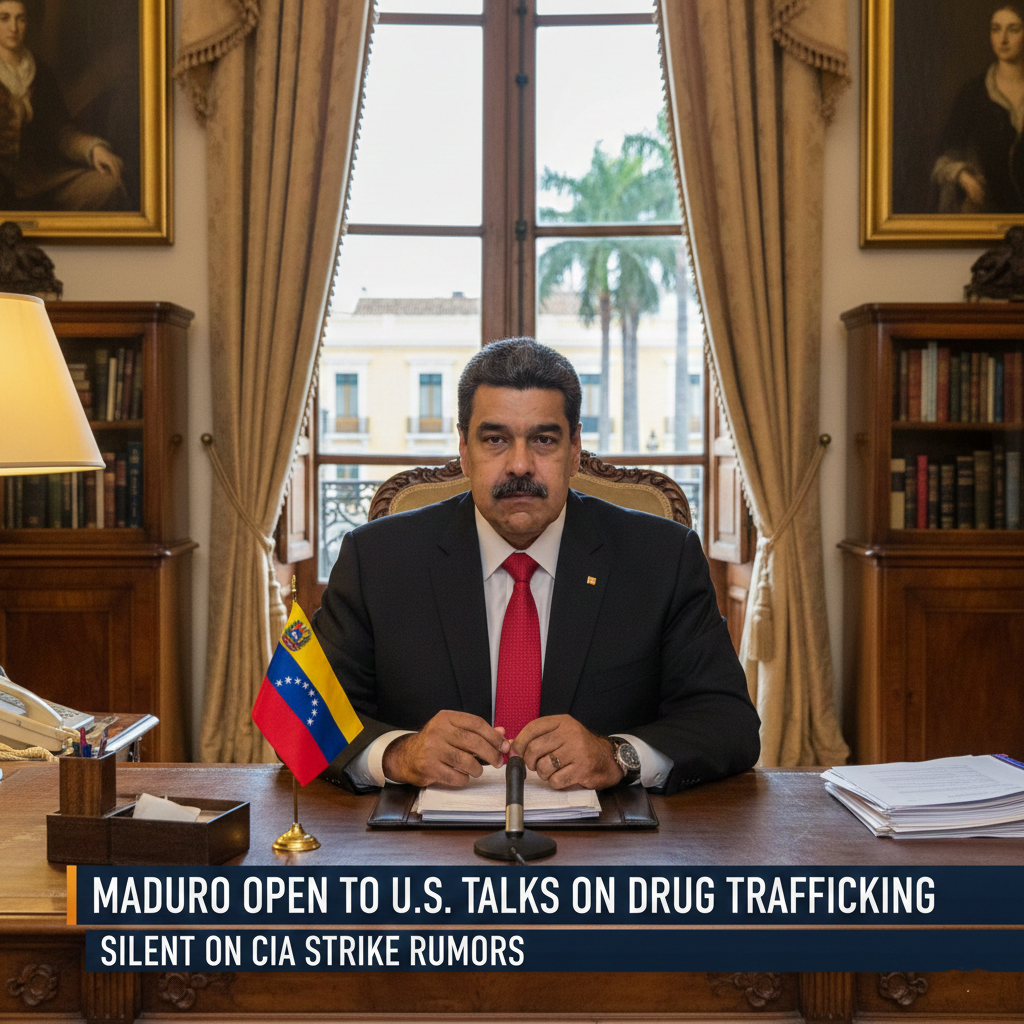
The phrase “Maduro open to U.S. talks on drug trafficking, but silent on CIA strike” captures a complex and delicate moment in international diplomacy. Venezuelan President Nicolás Maduro has publicly signaled a willingness to engage with the United States on counter-narcotics cooperation—an area where both nations share overlapping interests.
Yet, at the same time, Maduro has chosen not to directly address or respond to allegations and reports surrounding a CIA-linked strike or covert operation, a silence that has raised eyebrows across diplomatic, intelligence, and media circles.
This contrast—openness on drug trafficking, silence on intelligence matters—reveals much about Venezuela’s current foreign policy strategy, the state of U.S.–Venezuela relations, and the broader geopolitical chessboard in Latin America.
In this in-depth analysis, we break down what Maduro’s statements really mean, why drug trafficking has become a negotiation entry point, and how silence on alleged CIA actions fits into a larger diplomatic playbook.
Maduro’s Willingness to Talk: Why Drug Trafficking Is the Chosen Topic
Drug Trafficking as a Diplomatic Bridge
Drug trafficking has long been a transnational security issue, affecting not just Venezuela and the United States but the entire Western Hemisphere. For Caracas, discussing narcotics control offers a relatively low-risk diplomatic opening.
Key reasons drug trafficking is a strategic entry point:
- It is framed as a shared regional problem
- It avoids ideological debates about governance or democracy
- It allows Venezuela to project an image of cooperation
- It aligns with global anti-narcotics norms
Maduro’s openness suggests a calculated attempt to re-engage Washington without conceding political ground on more contentious issues like elections, human rights, or sanctions.
Venezuela’s Geographic Role in the Drug Trade
Venezuela’s location makes it a crucial transit route for narcotics, particularly cocaine originating in Colombia and destined for North America and Europe.
Key geographic realities:
- Proximity to major cocaine-producing regions
- Extensive Caribbean coastline
- Porous borders and remote airstrips
- Limited international enforcement cooperation in recent years
According to multiple international monitoring agencies, Venezuela has increasingly been used as a transshipment hub, even if it is not a primary producer.
This reality gives both Caracas and Washington a mutual incentive to at least talk.
The Silence on the CIA Strike: Strategic Avoidance or Tactical Calm?
What Is Being Left Unsaid Matters Most
While Maduro has spoken openly about drug trafficking talks, he has remained notably silent on reports and allegations of a CIA-linked strike or covert operation. This silence is not accidental.
In diplomacy, what leaders do not say can be just as important as what they do.
Possible reasons for Maduro’s silence include:
- Avoiding escalation with the United States
- Preventing domestic panic or unrest
- Denying legitimacy to unconfirmed intelligence claims
- Keeping diplomatic channels open
Publicly accusing the CIA without concrete evidence could force Washington into a defensive posture, effectively closing the door on talks.
Intelligence Operations: A Red Line in Public Discourse
Intelligence agencies operate in a realm where plausible deniability is central. By staying silent, Maduro avoids:
- Triggering retaliatory rhetoric
- Justifying further covert actions
- Internationalizing a sensitive security issue
This approach allows Venezuela to separate security concerns from diplomatic negotiations, at least in public messaging.
U.S.–Venezuela Relations: A History of Conflict and Missed Opportunities
A Relationship Defined by Sanctions and Standoffs
Relations between Washington and Caracas have been strained for over two decades. The U.S. has imposed multiple rounds of sanctions targeting:
- Venezuelan oil exports
- Government officials
- Financial institutions
The stated goals include restoring democracy, addressing corruption, and protecting human rights.
For Venezuela, sanctions have become both an economic burden and a political rallying point.
Drug Policy as Neutral Ground
Unlike sanctions or electoral reform, drug trafficking discussions:
- Do not require immediate political concessions
- Can be framed as technical cooperation
- Are supported by international frameworks
This makes counter-narcotics cooperation one of the few areas where dialogue is politically survivable for both sides.
For more geopolitical analysis, readers can explore related coverage on thenews.zone.
Regional Implications: Latin America Is Watching Closely
How Neighboring Countries View the Shift
Maduro’s openness to U.S. talks sends signals across Latin America. Governments in Colombia, Brazil, and the Caribbean are closely monitoring whether this marks:
- A genuine thaw
- A tactical pause
- Or a temporary maneuver
Many regional states are concerned about:
- Cross-border drug flows
- Organized crime networks
- U.S. intelligence activity in the region
Any shift in U.S.–Venezuela relations could reshape regional security dynamics.
Comparison: Cooperation vs Confrontation
| Issue Area | Cooperation Path | Confrontation Path |
|---|---|---|
| Drug Trafficking | Intelligence sharing, joint monitoring | Accusations, sanctions |
| CIA Allegations | Silence, de-escalation | Public blame, retaliation |
| Sanctions | Gradual easing | Expanded restrictions |
| Regional Stability | Improved coordination | Increased tension |
The current signals suggest Caracas is testing the cooperation path, at least narrowly.
Why the Timing Matters Now
Global Energy and Security Pressures
Global energy markets, migration concerns, and rising geopolitical instability have forced Washington to reconsider rigid foreign policy positions.
Venezuela, with the world’s largest proven oil reserves, remains strategically significant.
Drug trafficking talks may also serve as a confidence-building measure before addressing more complex issues like energy cooperation or sanctions relief.
Domestic Pressures Inside Venezuela
Internally, Venezuela faces:
- Economic strain
- Migration challenges
- Public service shortfalls
Reopening limited dialogue with the U.S. could eventually ease pressure without appearing weak domestically.
Media and Public Perception: Why Silence Can Be Powerful
Controlling the Narrative
By focusing public messaging on drug trafficking and ignoring CIA-related claims, the Maduro government:
- Redirects media attention
- Avoids inflaming nationalist sentiment prematurely
- Maintains diplomatic flexibility
This narrative control is essential in an era of rapid information cycles and social media amplification.
For global media perspectives, outlets like Reuters and BBC News offer ongoing coverage of U.S.–Venezuela relations.
What Comes Next: Possible Scenarios
1: Limited Technical Talks
- Quiet discussions on narcotics monitoring
- No public breakthroughs
- No mention of intelligence issues
2: Broader Diplomatic Engagement
- Drug talks expand into sanctions discussions
- Confidence-building measures emerge
- CIA allegations remain unspoken
3: Breakdown and Escalation
- Talks stall
- New accusations surface
- Sanctions or covert actions intensify
At present, Scenario 1 appears the most likely.
FAQs: Maduro, the U.S., and the CIA Question
Is Maduro officially negotiating with the United States?
No formal negotiations have been announced, but public statements indicate openness to talks focused on drug trafficking.
Why is drug trafficking a safer topic than politics?
It is a shared security concern that avoids ideological disputes and allows technical cooperation without political concessions.
Has the CIA confirmed any strike in Venezuela?
There has been no official confirmation. Intelligence agencies typically do not comment on covert operations.
Why is Maduro silent on CIA allegations?
Silence helps avoid escalation, preserves diplomatic options, and prevents legitimizing unverified claims.
Could these talks lead to sanctions relief?
Possibly, but only gradually and likely tied to broader conditions beyond drug trafficking.
For deeper insights into international diplomacy, visit thenews.zone.
Conclusion: A Calculated Silence, a Careful Signal
The situation summarized by “Maduro open to U.S. talks on drug trafficking, but silent on CIA strike” is not contradictory—it is strategic.
By extending an olive branch on counter-narcotics cooperation while avoiding public confrontation over intelligence allegations, Venezuela is testing diplomatic waters without burning bridges. For the United States, the response will signal whether pragmatic engagement can coexist with long-standing policy positions.
In global diplomacy, progress often begins not with grand agreements, but with carefully chosen words—and deliberate silences.
👉 Stay informed with balanced, in-depth global analysis. Read more international affairs coverage at thenews.zone.
