

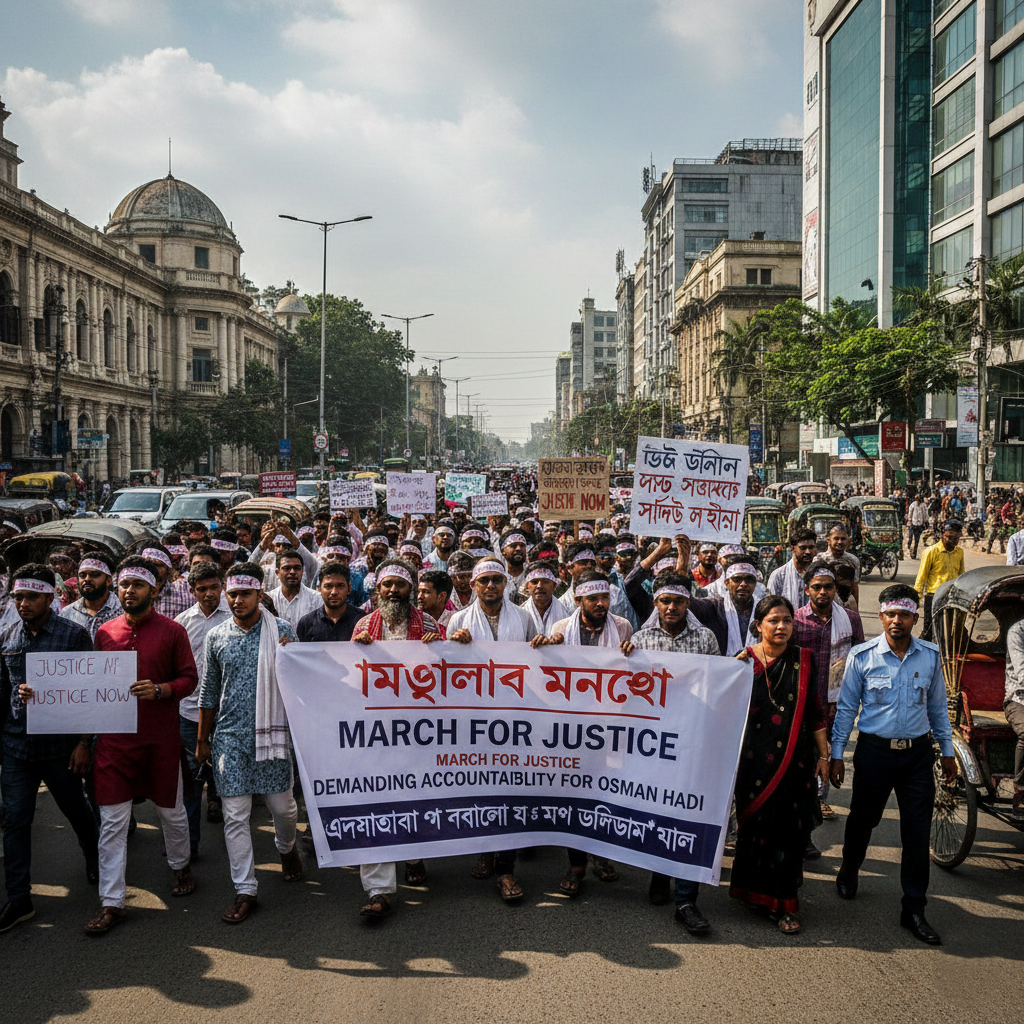
Bangladesh’s political and civil rights landscape is witnessing renewed momentum as Inqilab Moncho announces a nationwide “March for Justice” demanding accountability in the case of Osman Hadi. The movement has already begun drawing attention from civil society groups, rights activists, and political observers across the country.
The March for Justice for Osman Hadi is not just a protest—it is being framed as a broader call for transparency, rule of law, and institutional accountability in Bangladesh. Organizers say the march represents growing public frustration over delayed justice and the lack of clarity surrounding the circumstances linked to Osman Hadi’s case.
As public mobilization increases, the initiative is rapidly becoming a significant moment in Bangladesh’s ongoing debate around justice, governance, and civil liberties.
What Is Inqilab Moncho and Why It Matters
A Platform Rooted in Political Reform
Inqilab Moncho is a political and social platform known for mobilizing grassroots voices around governance reforms, democratic accountability, and citizen rights. Over the years, it has positioned itself as a bridge between public sentiment and institutional responsibility.
Key characteristics of Inqilab Moncho include:
- Advocacy for transparent governance
- Emphasis on constitutional rights
- Mobilization through peaceful civic action
- Focus on justice-driven political reforms
The platform has previously organized marches, public dialogues, and press engagements on issues related to democracy and accountability.
Who Is Osman Hadi and Why the Case Has Sparked Outrage
Understanding the Core of the Protest
The Osman Hadi case has become a focal point for growing public concern due to unanswered questions, delayed legal clarity, and allegations raised by activists and civil society members.
While official investigations continue, critics argue that progress has been slow, fueling skepticism among citizens. For many supporters of the march, Osman Hadi symbolizes more than an individual case—he represents a larger pattern of unresolved justice issues.
Why This Case Resonates Nationally
Several factors have amplified public interest:
- Delay in transparent legal outcomes
- Conflicting narratives around the case
- Lack of timely public communication
- Broader concerns about accountability
Rights groups believe such cases weaken public trust when clarity is not promptly established.
The ‘March for Justice’: Objectives and Demands
What Inqilab Moncho Is Demanding
The March for Justice for Osman Hadi is built around specific, publicly stated demands. According to organizers, the movement seeks institutional reform rather than political confrontation.
Core Demands Include:
- A transparent and independent investigation
- Public disclosure of verified findings
- Protection of legal rights for all involved parties
- Accountability for any misuse of power
Activists emphasize that justice must be both done and seen to be done.
Timeline and Scale of the Planned March
Nationwide Mobilization Strategy
Inqilab Moncho has announced plans for coordinated marches across key cities, aiming to involve students, professionals, lawyers, and human rights activists.
Key Features of the March:
| Aspect | Details |
|---|---|
| Nature | Peaceful civic march |
| Scope | Multiple cities |
| Participants | Civil society, youth, activists |
| Message | Justice, transparency, accountability |
Organizers say logistics are being planned carefully to ensure compliance with legal frameworks and public safety norms.
Why ‘March for Justice’ Is Gaining Momentum Now
Rising Public Awareness and Digital Activism
Social media platforms have played a crucial role in amplifying discussions around the Osman Hadi case. Hashtags, opinion pieces, and independent analyses are circulating widely, increasing public awareness.
Factors contributing to momentum include:
- Increased youth participation
- Digital-first advocacy campaigns
- Public debates in independent media
- Civil society endorsements
News portals such as thenews.zone have also been actively covering governance and rights-related developments, helping inform readers about evolving political narratives.
Human Rights Perspective on the Osman Hadi Case
What Rights Advocates Are Saying
Human rights organizations emphasize that delayed justice undermines democratic trust. While avoiding premature conclusions, advocates argue that procedural transparency is essential.
According to principles outlined by international organizations like Amnesty International and Human Rights Watch, justice systems must ensure:
- Timely investigations
- Due process
- Public accountability
- Victim-centered legal responses
Failure to address public concerns, experts say, can escalate social unrest.
Political Reactions and Public Discourse
Mixed Responses from Political Circles
Political reactions to the March for Justice have been cautious. While some leaders have called for patience and institutional respect, others acknowledge the legitimacy of peaceful civic expression.
Observers note that:
- Some parties support calls for transparency
- Others urge restraint and legal adherence
- Public debate remains active but divided
This diversity of views highlights the complex political environment surrounding justice-related movements in Bangladesh.
Comparing This Movement with Past Justice Campaigns
Lessons from History
Bangladesh has witnessed similar justice-driven civic movements in the past. While contexts differ, common patterns emerge.
| Past Movements | Similarities | Differences |
|---|---|---|
| Justice marches | Public mobilization | Digital amplification today |
| Student-led protests | Youth involvement | Broader civil participation |
| Rights campaigns | Accountability focus | Nationwide coordination |
The March for Justice for Osman Hadi is unique in its blend of offline mobilization and online advocacy.
Role of Independent Media and Public Trust
Why Media Coverage Matters
Independent journalism plays a crucial role in shaping informed public discourse. Accurate, fact-based reporting helps prevent misinformation and builds trust.
Platforms like thenews.zone contribute by:
- Offering balanced reporting
- Publishing verified updates
- Hosting opinion and analysis pieces
Globally respected outlets such as BBC News and Al Jazeera have long emphasized the importance of media transparency in justice-related movements.
FAQs: People Also Ask
What is the March for Justice for Osman Hadi?
The March for Justice is a peaceful civic movement organized by Inqilab Moncho demanding transparency and accountability in the Osman Hadi case.
Who is organizing the march?
The march is being organized by Inqilab Moncho, a platform advocating governance reform and justice-driven civic action in Bangladesh.
Is the march political or peaceful?
Organizers state that the march is peaceful and rights-based, focused on justice rather than political confrontation.
Why is the Osman Hadi case significant?
The case has raised concerns due to delayed clarity and perceived lack of transparency, making it a symbol of broader justice-related issues.
Where can I follow verified updates?
Readers can follow independent news platforms like thenews.zone and international outlets such as Reuters for factual updates.
Broader Implications for Bangladesh’s Justice System
A Moment of Reflection
Beyond a single case, the March for Justice highlights deeper questions:
- How responsive are institutions to public concern?
- What mechanisms ensure accountability?
- How can trust between citizens and the justice system be strengthened?
Experts believe such movements, when peaceful and constructive, can act as catalysts for long-term reform.
Conclusion: Why This March Matters
The March for Justice for Osman Hadi represents a critical moment in Bangladesh’s civic discourse. Whether or not it leads to immediate legal outcomes, it underscores a growing demand for transparency, fairness, and institutional accountability.
As public participation grows, the movement reminds policymakers that justice is not merely a legal obligation—it is a social contract.
Stay informed through trusted sources like thenews.zone, engage in constructive dialogue, and support peaceful civic efforts that strengthen justice and democracy in Bangladesh.
