

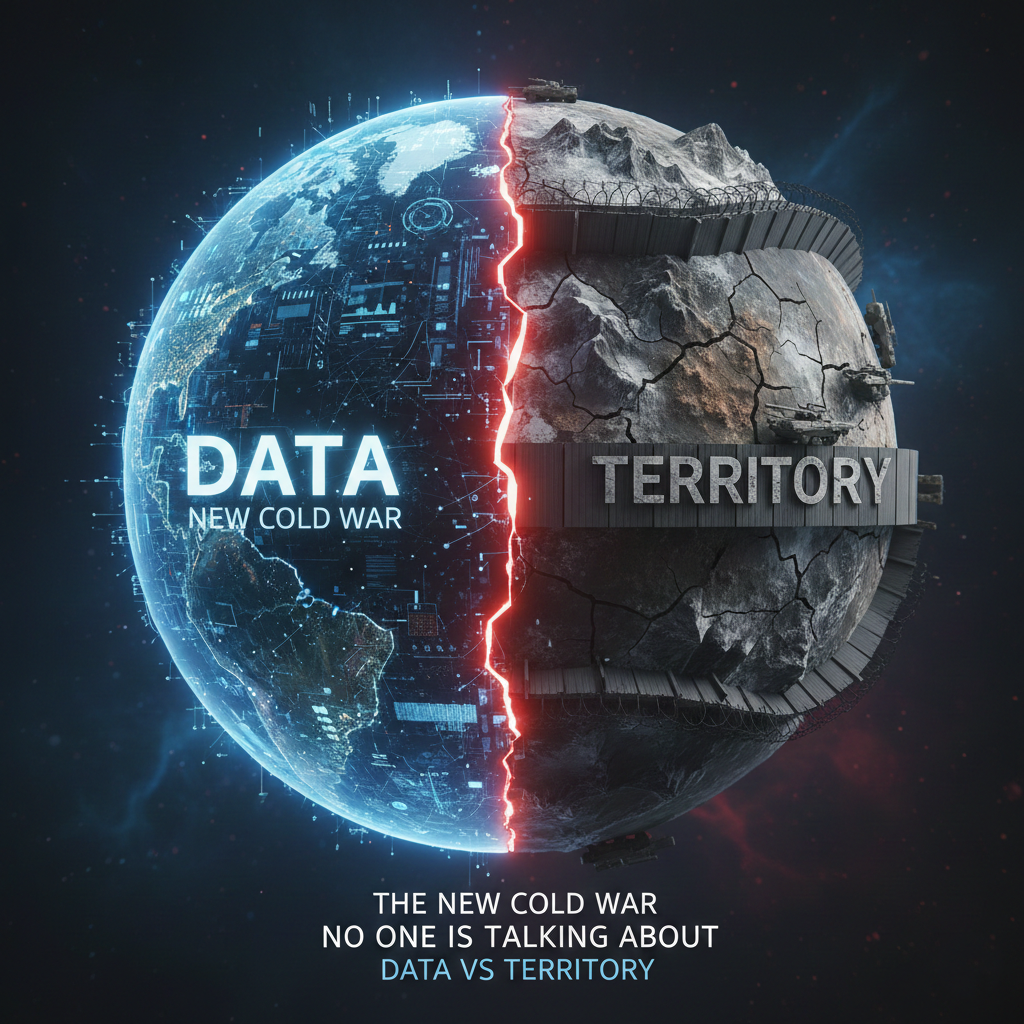
The Cold War Has Changed—and You’re Living Inside It
For decades, global power struggles were measured in territory captured, borders redrawn, and military strength displayed. But today, a quieter and far more influential conflict is unfolding. The new Cold War no one is talking about is not about land—it’s about data.
In this emerging Data vs Territory Cold War, nations are racing to control information, digital infrastructure, artificial intelligence, and the invisible networks that shape modern life. Unlike traditional wars, there are no tanks crossing borders—yet the stakes are just as high.
Every time you use a smartphone, cloud service, social media platform, or AI-powered tool, you are participating in this new geopolitical battleground.
This article breaks down how the world has shifted from physical dominance to digital power—and why data has become the most valuable asset of the 21st century.
From Maps to Megabytes: How Power Redefined Itself
When Territory Meant Power
Historically, global dominance depended on physical factors:
- Land size and strategic borders
- Natural resources like oil, coal, and minerals
- Military bases and troop presence
- Control of sea routes and trade corridors
Empires expanded by conquest. Nations defended borders with force. Power was visible on maps.
Why Territory Is No Longer Enough
In the digital era, territory alone doesn’t guarantee dominance. A small country with advanced data infrastructure can outperform a large nation with outdated systems.
Today’s power depends on:
- Who controls data flows
- Who owns digital platforms
- Who sets technology standards
- Who leads in AI and cybersecurity
This shift marks the birth of a new Cold War—silent, continuous, and global.
Data Is the New Oil—But Far More Dangerous
Why Data Is the World’s Most Valuable Resource
Data fuels almost everything modern societies rely on:
- Artificial intelligence
- Financial markets
- Healthcare systems
- National security
- Elections and public opinion
According to global tech analysts, data-driven economies grow 2–3 times faster than traditional ones. Unlike oil, data is:
- Infinite
- Reusable
- Self-expanding
- Borderless
That makes it both powerful and difficult to control.
How Data Creates Strategic Advantage
Countries that dominate data gain:
- Predictive intelligence on citizens and rivals
- Economic leverage through platforms and patents
- Military superiority via autonomous systems
- Cultural influence through digital media
This is why data is no longer just an economic asset—it’s a strategic weapon.
Data vs Territory: A New Type of Geopolitical Conflict
The Old Cold War vs the New Cold War
| Old Cold War | New Data Cold War |
|---|---|
| Nuclear weapons | Artificial intelligence |
| Military alliances | Tech ecosystems |
| Border conflicts | Cyber conflicts |
| Espionage agents | Algorithms & surveillance |
| Territory expansion | Data accumulation |
This modern Cold War doesn’t end—it evolves daily through software updates, cloud migrations, and policy changes.
Digital Borders: Nations Are Building Invisible Walls
Data Sovereignty Explained Simply
Data sovereignty means that data generated within a country must be:
- Stored locally
- Governed by national laws
- Protected from foreign access
Many governments now treat data like national territory.
Countries Leading the Digital Border Movement
- China: Operates a tightly controlled digital ecosystem
- European Union: Enforces GDPR to protect citizen data
- Russia: Requires domestic data storage
- India: Strengthening data localization laws
These policies signal one thing clearly: data is now a national asset.
For ongoing analysis of digital geopolitics, see insights published on thenews.zone, which frequently covers global power shifts in the tech era.
Technology Giants: The New Superpowers Without Borders
How Big Tech Gained Geopolitical Influence
Companies like Google, Amazon, Microsoft, Apple, Meta, and Tencent now control:
- Global communication channels
- Cloud infrastructure
- AI research pipelines
- Consumer behavior data
Some tech firms hold more data than entire governments.
Governments vs Corporations: A Power Clash
This creates a new tension:
- Governments want control and security
- Corporations want scale and profit
This struggle defines much of today’s digital policy debates, including antitrust laws, data privacy, and platform regulation.
Authoritative discussions on tech power can be found at institutions like the World Economic Forum and Brookings Institution, which examine how corporate data dominance reshapes global order.
Cyber Warfare: The Battlefield You Never See
What Cyber Warfare Really Looks Like
Cyber warfare doesn’t involve explosions. It involves:
- Power grid disruptions
- Financial system attacks
- Election interference
- Data leaks and ransomware
These attacks can destabilize a nation without firing a single bullet.
Why Cyber Conflicts Are Hard to Stop
- Attacks are anonymous
- Attribution is difficult
- Retaliation is unclear
- International law is outdated
This ambiguity makes cyber warfare the perfect weapon in the new Cold War.
Artificial Intelligence: The Ultimate Data Weapon
Why AI Is the Deciding Factor
AI systems learn from data. The more data a country controls, the smarter its AI becomes.
AI influences:
- Military drones and defense systems
- Economic forecasting
- Surveillance and policing
- Healthcare diagnostics
This is why AI leadership is now considered a matter of national security.
The AI Arms Race Has Already Begun
Major powers are investing billions into:
- Large language models
- Autonomous weapons
- Predictive intelligence systems
The competition isn’t public—but it’s relentless.
How This New Cold War Affects Ordinary People
Your Data Is the Frontline
Everyday activities generate data:
- Social media posts
- Online purchases
- Location tracking
- Voice assistants
That data is collected, analyzed, and sometimes weaponized.
Risks for Citizens
- Loss of privacy
- Digital surveillance
- Manipulation of opinions
- Economic discrimination via algorithms
Understanding this new Cold War helps citizens demand better protections.
The Developing World: The New Battleground
Why Emerging Nations Matter Most
Developing countries often lack strong data laws. This makes them vulnerable to:
- Foreign tech dominance
- Digital colonization
- Infrastructure dependency
Whoever builds their networks controls their data future.
Digital Infrastructure as Soft Power
Projects involving:
- Undersea cables
- Cloud regions
- 5G networks
are now tools of geopolitical influence, not just development.
Can International Rules Prevent a Data War?
The Governance Gap
There is no global agreement on:
- Data ownership
- AI weaponization
- Cyber warfare rules
Existing institutions struggle to keep up with technology.
What Experts Suggest
Policy experts from organizations like the United Nations and OECD recommend:
- Global data ethics frameworks
- Cross-border cybersecurity cooperation
- AI transparency standards
But consensus remains slow.
FAQs: The New Cold War Explained Simply
What is the new Cold War about data?
It refers to global competition over data control, digital infrastructure, AI, and cybersecurity instead of land or military conquest.
Why is data more powerful than territory today?
Data drives economies, technology, intelligence, and influence, making it more valuable than physical land.
Which countries are leading the data Cold War?
The US, China, EU nations, and emerging tech powers like India are central players.
How does this affect privacy?
Governments and corporations collect massive amounts of personal data, raising concerns about surveillance and misuse.
Where can I follow updates on digital geopolitics?
Trusted global analysis platforms and independent publishers like thenews.zone regularly explore these evolving conflicts.
Conclusion: Understanding the War You Can’t See
The new Cold War isn’t announced. It doesn’t start with sirens or headlines. It unfolds silently—in servers, algorithms, and data centers.
Territory still matters, but data defines the future. Nations that understand this are already shaping the next global order.
As citizens, businesses, and policymakers, awareness is the first step toward protection and progress.
👉 Stay informed. Question who controls your data. And follow deep global analysis on platforms like thenews.zone to understand the forces shaping tomorrow’s world.
Because the most important war of our time isn’t being fought on land—it’s being fought in the digital shadows.
