

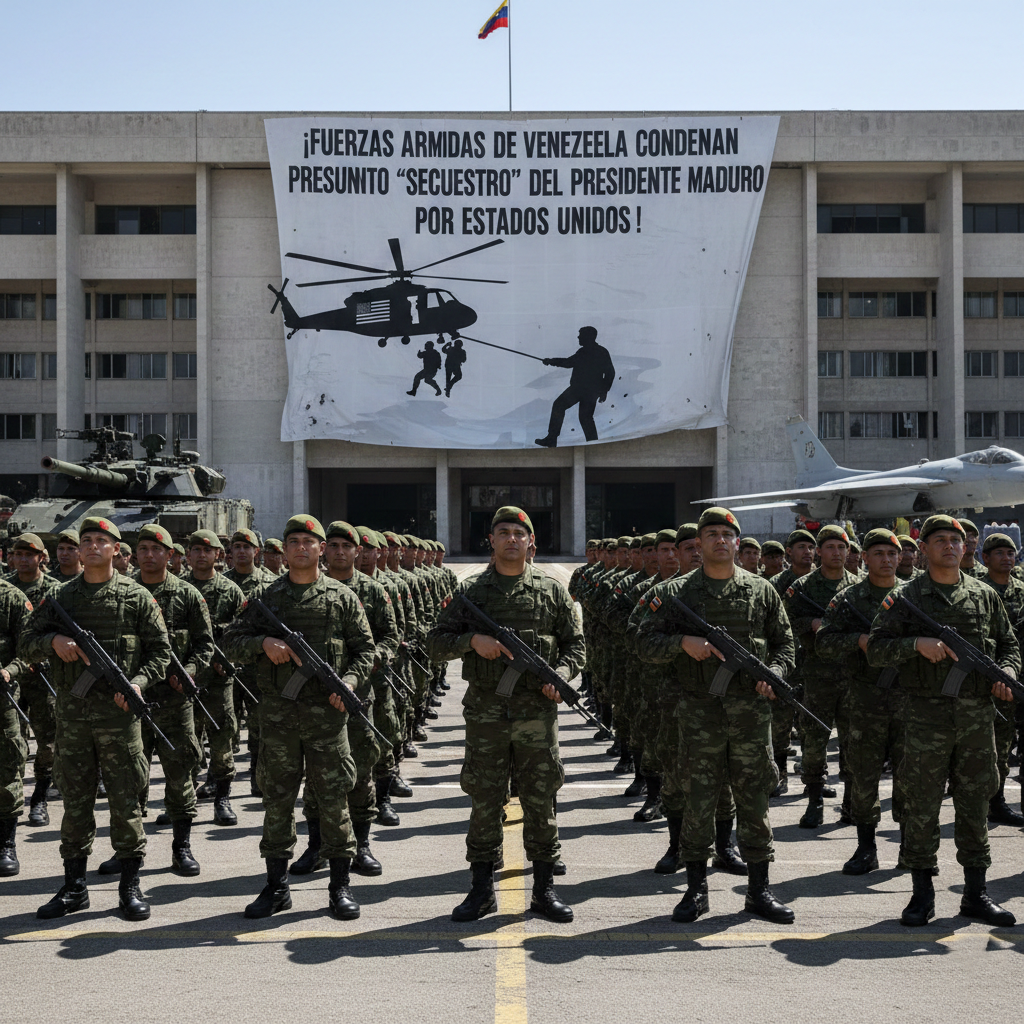
The political temperature in Latin America surged after Venezuela’s Bolivarian National Armed Forces publicly condemned what they described as a “cowardly kidnapping” of President Nicolás Maduro by the United States. The strong statement, released from Caracas, immediately drew global attention and sparked intense debate over sovereignty, international law, and U.S.–Venezuela relations.
For Venezuela, this allegation is not just a diplomatic accusation—it is framed as a direct attack on national sovereignty. For the international community, it raises serious questions about geopolitics, military rhetoric, and the future of regional stability.
This in-depth report breaks down the military’s statement, the broader political context, reactions at home and abroad, and what this development could mean going forward.
What the Venezuelan Military Claims
A Forceful Condemnation from Caracas
On Sunday, Venezuela’s armed forces released a sharply worded declaration accusing the United States of orchestrating or supporting the alleged kidnapping of President Nicolás Maduro.
Key points from the statement include:
- Strong condemnation of what was labeled a “cowardly act”
- Assertion that the action violates international law
- Emphasis on defending national sovereignty
- A warning that Venezuela will not tolerate foreign interference
According to the military leadership, the alleged incident is part of a broader strategy to destabilize Venezuela’s elected government.
Why Nicolás Maduro Remains a Central Figure
Maduro’s Role in Venezuela’s Political Landscape
President Nicolás Maduro has been at the center of Venezuela’s political story for over a decade. As the successor to Hugo Chávez, he represents continuity of the Bolivarian Revolution, a socialist movement deeply opposed to U.S. influence in the region.
Supporters Say
- Maduro defends Venezuelan independence
- He resists economic and political pressure from abroad
- His leadership represents popular sovereignty
Critics Argue
- His government suppresses opposition
- Economic mismanagement has worsened living conditions
- Elections lack transparency
This divide explains why any allegation involving Maduro instantly becomes internationally explosive.
U.S.–Venezuela Relations: A History of Tension
Decades of Political Hostility
Relations between the United States and Venezuela have been strained for years, marked by:
- Economic sanctions
- Diplomatic expulsions
- Accusations of coup attempts
- Recognition disputes over leadership legitimacy
The latest accusation fits into a long pattern of mutual distrust.
| Issue | Venezuela’s Position | U.S. Position |
|---|---|---|
| Sanctions | Economic warfare | Pressure for democracy |
| Elections | Legitimate process | Questioned legitimacy |
| Sovereignty | Foreign interference | Support for opposition |
This history makes the armed forces’ statement unsurprising, yet deeply concerning.
Military’s Message: More Than Just Words
Why the Statement Matters
The Bolivarian National Armed Forces are one of the most powerful institutions in Venezuela. Their public condemnation sends a message to multiple audiences:
- Domestic citizens: The military stands with the president
- Opposition groups: Any external backing will be resisted
- International actors: Venezuela is ready to defend itself
This is not merely political rhetoric—it is a strategic signal.
International Law and Sovereignty Concerns
Why the Allegation Is Serious
If true, the alleged kidnapping would violate several principles of international law:
- Respect for national sovereignty
- Non-intervention in internal affairs
- Protection of heads of state
These principles are foundational to global diplomacy and outlined by institutions like the United Nations (source: un.org).
Even the perception of such actions can destabilize regions and undermine diplomatic norms.
Global Reactions and Regional Impact
Latin America Watches Closely
Latin American nations have historically been sensitive to foreign intervention. While official reactions are still unfolding, analysts expect:
- Calls for investigation
- Diplomatic caution
- Regional dialogue to prevent escalation
Countries aligned with Venezuela are likely to echo concerns, while U.S. allies may urge restraint and clarification.
Media, Narratives, and Information Warfare
The Battle Beyond the Headlines
In today’s digital world, political crises unfold not just on the ground but online. Competing narratives are already emerging:
- Venezuelan state media frames the incident as imperialist aggression
- Western outlets emphasize lack of independent verification
- Social media amplifies both support and skepticism
For readers seeking balanced coverage, platforms like thenews.zone help track evolving developments and multiple perspectives.
Economic and Social Implications for Venezuela
What This Means for Ordinary Citizens
Political escalation often affects everyday life. Potential consequences include:
- Increased economic uncertainty
- Tighter sanctions or restrictions
- Heightened security measures
Venezuela’s fragile economy makes stability especially critical. Any rise in tensions could worsen inflation, supply shortages, and public anxiety.
Comparisons with Past Incidents
Is This a New Strategy?
Similar accusations have surfaced before in Latin America and beyond.
Historical parallels include:
- Alleged coup attempts in Venezuela (2002)
- U.S. interventions during the Cold War
- Covert operations revealed decades later
Whether this incident follows those patterns remains to be seen, but history fuels Venezuela’s suspicion.
What Comes Next? Possible Scenarios
Short-Term Outcomes
- Diplomatic protests and statements
- Increased military readiness
- Calls for international mediation
Long-Term Possibilities
- Renewed sanctions or negotiations
- Shifts in regional alliances
- Greater polarization within Venezuela
The direction will depend on how both governments choose to proceed.
FAQs
What did Venezuela’s military accuse the U.S. of?
The armed forces accused the United States of involvement in a “cowardly kidnapping” of President Nicolás Maduro, calling it an attack on sovereignty.
Has the United States responded?
As of now, responses focus on denying wrongdoing and questioning the credibility of the accusation. Official statements continue to evolve.
Why is this issue important globally?
It touches on international law, sovereignty, and regional stability—key pillars of global order.
Where can readers follow verified updates?
Reliable coverage can be found on international platforms like thenews.zone and global organizations such as the United Nations.
Conclusion: A Moment That Demands Attention
The Venezuelan military’s condemnation of the alleged kidnapping of President Nicolás Maduro marks a critical moment in already tense U.S.–Venezuela relations. Whether the claim leads to escalation or dialogue will shape not just Venezuela’s future, but regional stability across Latin America.
For readers, staying informed through credible sources is essential. Follow ongoing coverage, analyze multiple perspectives, and engage thoughtfully with this evolving story.
👉 For continuous updates, expert analysis, and global political coverage, visit thenews.zone today.
