

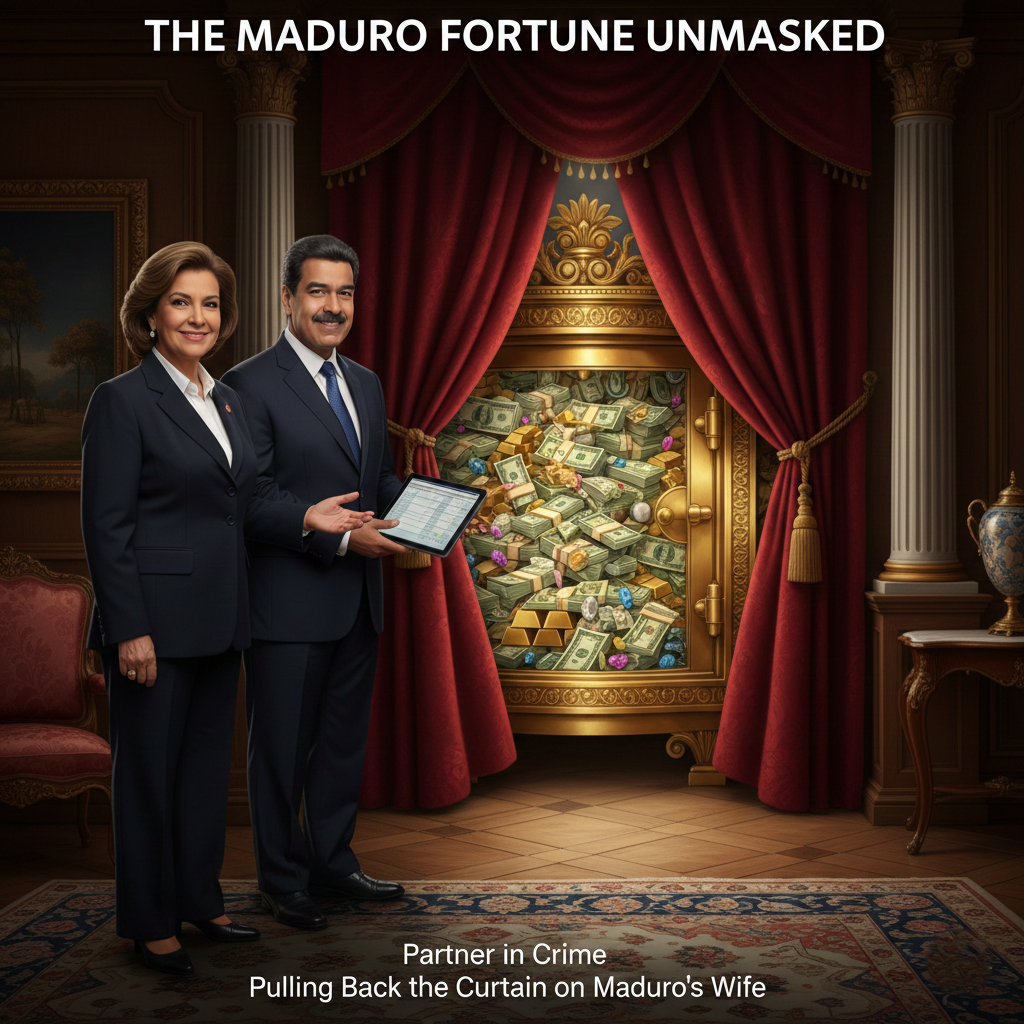
Partner in crime is a phrase increasingly used by critics to describe the political and personal alliance between Venezuelan President Nicolás Maduro and his wife, Cilia Flores. Often referred to by analysts as Maduro’s Latin Lady Macbeth, Flores is widely portrayed as a shadow power behind the presidency and a fundamental figure in corruption allegations that have haunted Venezuela for more than a decade.
While Maduro is the public face of the Venezuelan regime, many international observers, prosecutors, and investigative journalists argue that Flores has played a decisive behind-the-scenes role in shaping state power, influencing judicial outcomes, and protecting illicit networks. Understanding her role is essential to understanding how corruption became deeply embedded in Venezuela’s political system.
This article pulls back the curtain on Cilia Flores, examining her rise to power, the allegations surrounding her, the international response, and why her influence continues to matter for Venezuela and global geopolitics.
For ongoing investigations and geopolitical reporting, readers can also explore related coverage on thenews.zone.
Who Is Cilia Flores the Woman Behind Maduro
Early political life and rise within Chavismo
Cilia Adela Flores de Maduro is not merely the president’s spouse. She is a seasoned political operator who rose through the ranks of Hugo Chávez’s Bolivarian movement long before Maduro became president.
Key milestones in her political ascent include:
- Serving as a deputy in Venezuela’s National Assembly
- Becoming president of the National Assembly from 2006 to 2011
- Acting as attorney general in an interim capacity
- Playing a central role in party strategy within the United Socialist Party of Venezuela
Her political résumé demonstrates that Flores was already powerful in her own right before Maduro assumed the presidency in 2013.
The origin of the Latin Lady Macbeth label
The comparison to Shakespeare’s Lady Macbeth stems from her perceived role as a driving force behind Maduro’s consolidation of power. Critics argue that she is:
- Strategically influential rather than publicly visible
- Instrumental in silencing opposition through legal and political pressure
- Willing to cross ethical and legal lines to protect regime survival
The label is not just rhetorical. It reflects a belief among analysts that Flores acts as an enforcer and protector of the regime’s inner circle.
A Fundamental Figure in Corruption Allegations
Alleged involvement in state level corruption networks
Cilia Flores has repeatedly been named in corruption investigations and reports by international organizations and foreign governments. Although she denies wrongdoing, accusations persist due to patterns of behavior and documented associations.
Common allegations include:
- Influence over judicial appointments to shield allies
- Protection of officials accused of embezzlement
- Participation in opaque financial networks tied to state resources
According to reports cited by Transparency International, Venezuela consistently ranks among the most corrupt countries in the world, with power concentrated in a small political elite.
Outbound reference: Transparency International corruption index
The narcosobrinos case and its global impact
One of the most damaging episodes linked to Flores is the so-called narcosobrinos case. In 2015, two of her nephews were arrested and later convicted in the United States for attempting to traffic cocaine.
Key facts from court proceedings include:
- The drugs were allegedly intended for the US market
- Evidence suggested use of state resources
- The defendants claimed political protection due to family ties
While Flores was not charged, prosecutors argued that her family connections enabled the operation. The case reinforced international perceptions of systemic corruption at the highest levels of Venezuelan power.
Outbound reference: US Department of Justice case summaries via Reuters
How Power Operates Behind the Scenes
Influence over the judiciary and security forces
Analysts frequently describe Flores as a gatekeeper to Venezuela’s justice system. Her past role in the National Assembly and legal background gave her leverage over institutional appointments.
Observers claim her influence extends to:
- Supreme Court justices
- Senior prosecutors
- Internal security agencies
This alleged control helps explain why corruption cases rarely progress within Venezuela, even when evidence is publicly available.
Family, loyalty, and the inner circle
Power within the Maduro government is often described as familial rather than institutional. Flores reportedly plays a central role in deciding who can be trusted.
This system relies on:
- Blood ties and long-standing personal relationships
- Mutual protection agreements
- Shared exposure to legal risk
Such dynamics make the regime more resilient but also more vulnerable to international sanctions.
International Sanctions and Global Repercussions
Sanctions targeting the first lady
Several countries have imposed sanctions on senior Venezuelan officials, including individuals close to Flores. While she has not always been directly sanctioned, her proximity to power places her at the center of international scrutiny.
Sanctions typically include:
- Asset freezes
- Travel bans
- Restrictions on financial transactions
These measures aim to isolate the regime’s leadership and disrupt corruption networks.
Outbound reference: European Union sanctions documentation
Diplomatic fallout and regional instability
The perception of Flores as a fundamental figure in corruption has implications beyond Venezuela. Neighboring countries face:
- Refugee flows driven by economic collapse
- Cross-border crime linked to weak institutions
- Strained diplomatic relations
Regional analysts argue that the normalization of corruption at the top destabilizes Latin America as a whole.
Comparing Cilia Flores to Other Political Power Spouses
Similarities with other influential first ladies
History offers several examples of political spouses wielding immense behind-the-scenes power. Comparisons are often drawn with figures such as:
- Elena Ceaușescu of Romania
- Imelda Marcos of the Philippines
Common traits include:
- Informal authority without direct accountability
- Influence over state resources
- Personal enrichment allegations
Why Flores stands apart
What distinguishes Flores is the combination of:
- Legal expertise
- Direct involvement in legislative leadership
- Allegations intersecting with organized crime
This makes her role more institutionalized than symbolic.
Media, Censorship, and Narrative Control
Managing public perception
State-aligned media in Venezuela portray Flores as a devoted public servant and defender of sovereignty. Critical reporting is often censored or discredited.
Methods of narrative control include:
- Restricting independent journalism
- Harassing reporters
- Promoting alternative narratives through state channels
Independent outlets like thenews.zone play a key role in offering alternative perspectives and investigative reporting.
The cost of silence
Journalists and activists who attempt to expose corruption frequently face intimidation, exile, or imprisonment. This climate of fear reinforces the power of figures like Flores.
Outbound reference: Reporters Without Borders press freedom reports
Key Facts at a Glance
| Aspect | Details |
|---|---|
| Full name | Cilia Adela Flores de Maduro |
| Political roles | National Assembly president, attorney general interim |
| Key allegation areas | Corruption, judicial influence, protection networks |
| International cases | Narcosobrinos drug trafficking case |
| Global response | Sanctions, diplomatic pressure |
Frequently Asked Questions
Why is Cilia Flores called the Latin Lady Macbeth
The nickname reflects her perceived behind-the-scenes influence over Nicolás Maduro and her alleged role in consolidating power through ethically questionable means.
Has Cilia Flores been convicted of corruption
No court has convicted her directly. However, multiple international cases and reports have linked her family and associates to criminal activity.
How does her role affect Venezuela today
Critics argue that her influence contributes to institutional decay, lack of accountability, and continued economic and humanitarian crisis.
Are there international investigations involving her
While not always named as a defendant, she is frequently referenced in investigations by foreign prosecutors and international watchdogs.
Outbound reference: Reuters investigative reports
Conclusion
Pulling back the curtain on Maduro’s Latin Lady Macbeth reveals a complex figure whose power extends far beyond ceremonial duties. Cilia Flores stands at the intersection of politics, loyalty, and corruption allegations that define modern Venezuela. Whether viewed as a strategic mastermind or a symbol of systemic decay, her influence is undeniable.
Understanding her role helps explain why reform has proven so difficult and why international pressure continues to mount. As Venezuela’s crisis deepens, scrutiny of figures like Flores will only intensify.
For continued coverage on global politics, corruption investigations, and Latin American affairs, visit thenews.zone and stay informed with credible, independent reporting.
