

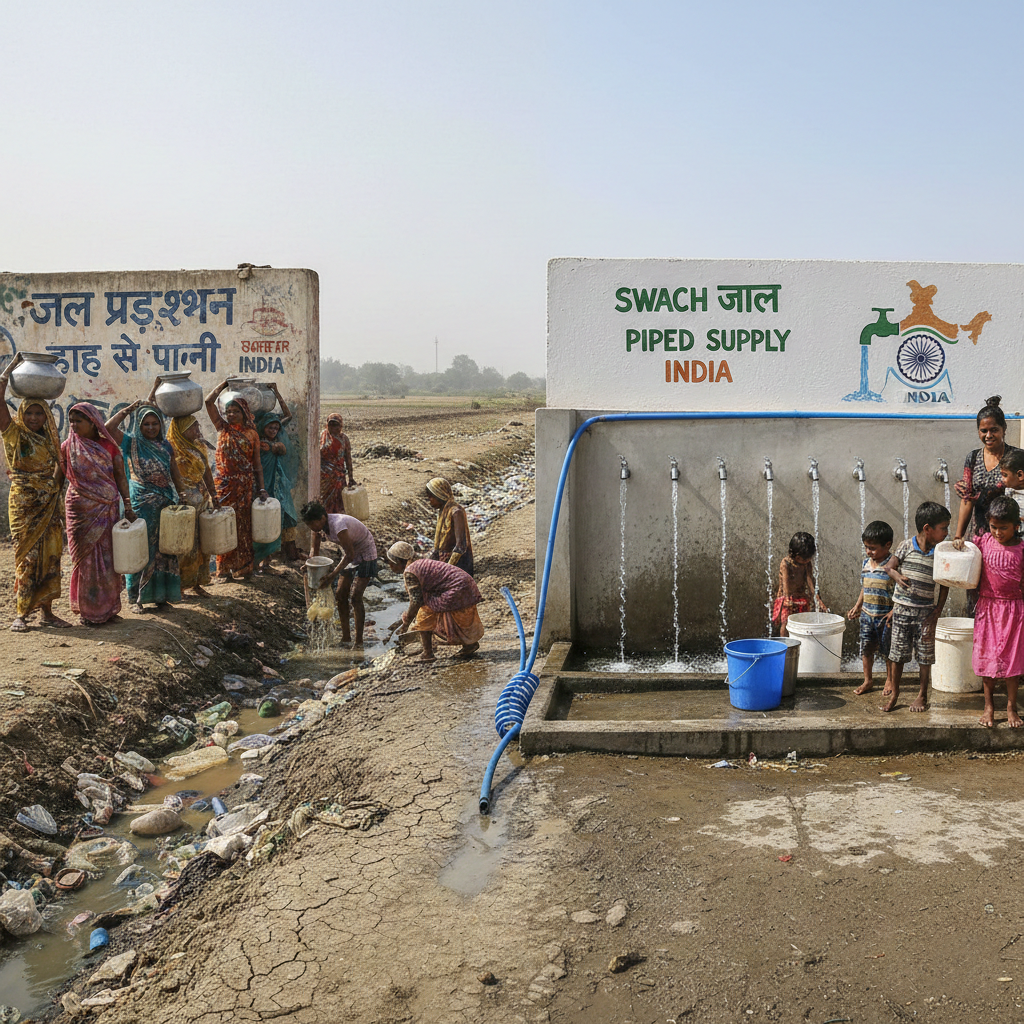
India’s Growing Water Divide
India’s water divide is now more than a rural problem or a seasonal emergency. It’s a structural one, related to the contamination of water, unequal piped water supply in cities and towns, dilapidated infrastructure and governance deficiencies. Official figures may indicate swift strides in household tap connections, but millions of people in the country continue to drink unsafe water every day, jeopardising their health, perpetuating economic losses and widening social inequalities.
Access to safe drinking water is a human right. But in India, who gets clean water and who does not often boils down to geography, income, caste and good governance. Urban dwellers may have water from taps for a few hours each day, but rural homes continue to depend on polluted groundwater.
This post explores the real status of water contamination and piped water in India, with evidence-based statistics, special case studies, policy insights and practical solutions providing an overall SEO-enriching view.
Understanding the Water Divide in India
What Is the Water Divide?
Water divide pertains to the discrepancy in adequate access to safe, affordable and reliable drinking water between different areas or communities of India.
This cleavage appears in three key forms:
- Divide between good and bad: Clean water/Dirty water
- Access gap: Piped Supply vs tankers or dependence on handpump
- That reliability gap: Regular or frequent access to supply versus ad hoc or seasonal access
As government papers promote growth of infrastructure, the road realities usually speak otherwise.
An Unpublished Health Crisis: Water Contamination in India
Major Sources of Water Contamination
The drinking water contamination in India is a result of both natural and manmade causes.
Key sources include:
- Arsenic contamination in eastern India
- High fluoride content in drinking water in central and western India
- Nitrate pollution from agricultural runoff
- Effluent of industries in rivers and aquifers
- Discharge sewage in surface water body
The World Health Organization states more than 485,000 diarrheal deaths are linked to drinking unsafe water each year worldwide.
Outbound reference: https://www.who.int/health-topics/drinking-water
Groundwater Contamination: The Hidden Threat
More than 60 percent of the water for drinking and other uses in India comes from groundwater. Unfortunately, groundwater is increasingly unsafe.
States most affected:
- West Bengal and Bihar: Arsenic
- Rajasthan and Telangana: Fluoride
- Punjab and Haryana: Nitrates
- Uttar Pradesh: Mixed heavy metals
Once groundwater becomes polluted it is costly and time consuming to clean up.
Impact on Health and Economy
Water contamination directly impacts:
- Child stunting and malnutrition
- Water-bourne diseases like cholera and typhoid
- Women’s health from the burden of collecting water
- Productivity loss due to illness
A report by NITI Aayog has calculated that India suffers an annual loss of almost 6 per cent of its GDP on account of insufficient water and sanitation.
Progress and Perils of the Piped Water Dream in India
The Jal Jeevan Mission and What It Promises
With a targeted date of 2024, the Jal Jeevan Mission was announced in 2019 under which Functional Household Tap Connections (FHTCs) are to be created in every rural home.
Key targets:
- 55 litres per capita per day
- Regular and safe water supply
- Community-managed water systems
Official figures put rural coverage at over 75 percent as of 2024.
Outbound reference: https://jaljeevanmission.gov.in
Quality vs Quantity: The Fundamental Issue
Despite improvements in connectivity, the quality of water is unpredictable.
Common issues include:
- Piped water from polluted sources
- Lack of regular water testing
- Intermittent supply causing pipe contamination
- Absence of household-level filtration
In most villages, tap water is only used for washing; drinking water still comes out of handpumps.
Urban Piped Water Reality
different story.
supply issues:
- Hours of supply per day (based on availability)
- Aging pipelines causing leakages
- Collision between the wastewater and potable water
- Heavy reliance on private water tankers
Some cities with piped networks, such as Bengaluru, Chennai, and Delhi, are also struggling to meet the demand for water.
Rural vs Urban Water Access: A Clear Comparison
| Parameter | Rural India | Urban India |
|---|---|---|
| Primary source | Groundwater | Surface water |
| Piped supply | Rapidly expanding | Largely established |
| Water quality | Highly variable | Moderately regulated |
| Reliability | Seasonal | Daily but limited |
| Cost burden | Time and health | Monetary |
This comparison serves as a clear reminder: Infrastructure is not the only factor for safe water.
Gaps on Governance and Policy in Water Management
Water is managed by several organisations:
- Central ministries
- State water departments
- Local panchayats and municipalities
Such fragmentation gives rise to overlapping responsibilities and accountability vacuums.
Monitoring and Data Transparency Issues
Key challenges include:
- Infrequent water quality testing
- Limited public access to water information
- Lack of independent audits
- Weak enforcement of pollution laws
Even when a testing facility is available, the results can fall short of getting into homes.
Climate Change Worsens the Water Divide
Climate change exacerbates water inequities already in place.
Key impacts:
- Erratic rainfall patterns
- Increased drought frequency
- Flood-induced contamination
- Rapid groundwater depletion
The most heavily polluted regions look set to be those already struggling with pollution.
Technology and Community Solutions Bridging the Divide
Decentralised Water Treatment
Community-level solutions show promise:
- Reverse osmosis plants
- Solar-powered filtration units
- Rainwater harvesting systems
Such systems eliminate reliance on contaminated sources.
Role of Local Communities
Community involvement improves sustainability.
Effective strategies include:
- Village water committees
- Women-led water management groups
- Local monitoring of water quality
The evidence is that community-managed systems — as opposed to centrally controlled ones — last longer.
Global Comparisons: Where India Stands
Compared to other developing nations:
- India has greater water investment in infrastructure
- But lower water quality consistency
- And weaker pollution enforcement
Vietnam and Brazil are examples of countries where the integration between quality monitoring and supply expansion is working better.
Internal Perspective: Why It Matters for Indian News Platforms
Heavy reporting of water pollution and coverage of piped water supply all contribute to public consciousness. Platforms like thenews.zone play a crucial role in exposing data-based insights, policy deficiencies and citizen voices to hold the government accountable and ensure informed public debate.
Frequently Asked Questions
Is piped water in India safe to drink all the time?
No. Piped water doesn’t necessarily equal safe water. Quality varies according to the origin, treatment and maintenance of pipelines. Regular testing is essential.
Which Indian states have the worst water pollution?
West Bengal, Bihar, Rajasthan, Punjab, and Uttar Pradesh are among the most affected due to arsenic, fluoride, and nitrate contamination.
How good is the Jal Jeevan Mission?
The project has greatly increased access, yet issues persist around the quality, continuity and longevity of water provision.
Can water pollution ever be eradicated?
Although eradication is challenging, contamination may be decreased by improved regulation, technology and public participation.
Where can I get good information about water quality?
The World Health Organization and government portals such as the Jal Jeevan Mission website are trustworthy sources.
Outbound reference: https://www.who.int
Outbound reference: https://jaljeevanmission.gov.in
Conclusion: Bridging India’s Water Divide
The divide in India is not just about pipes and pumps. It’s about fairness, health, governance and sustainability. Expanding piped water supplies is a step in the right direction, but it is doomed to failure if contamination risks are ignored.
The way forward mandates sound water management, stringent pollution control, open data and communities that are empowered. Only then can India make good on the promise that each and every one of its households receives not just water but safe and dignified water.
For analysis on topics of national interest, visit thenews.zone and be informed with quality, data-backed journalism.
The decision is clear: Invest in water quality now or pay for it in public health later.
