

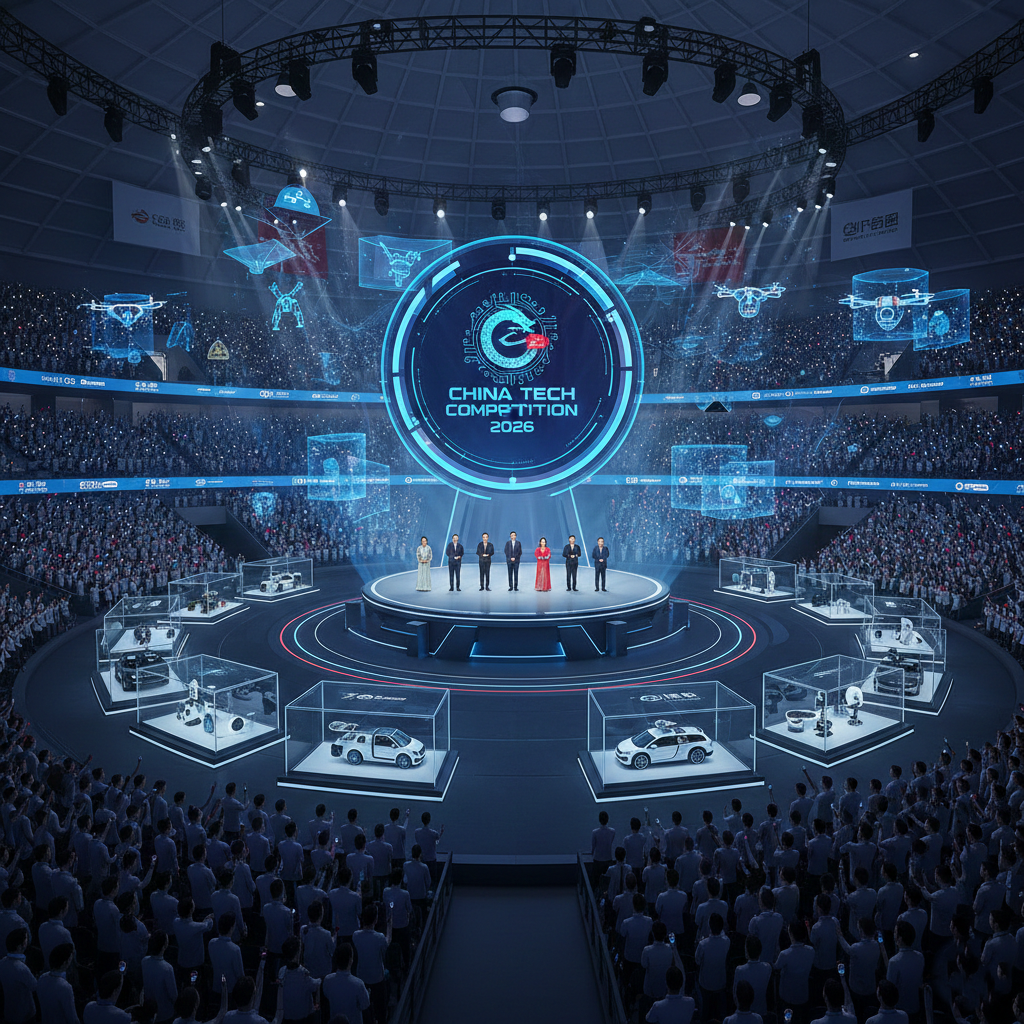
If there’s one country that is reshaping the world’s technology landscape at an unbelievable pace, it’s China — and 2026 is shaping up to be one of the biggest, boldest years yet. The race for global tech leadership is no longer a silent rivalry; it’s an open competition between the East and West, fuelled by AI, chip manufacturing, EVs, aerospace, robotics, and next-generation internet technologies.
In 2026, the world is witnessing a China that is not just catching up — it’s rewriting the rules.
Look anywhere: artificial intelligence research, quantum computing, electric vehicles, semiconductor independence, consumer electronics, drone technology, and green energy. China sits right at the center of global attention. And the competition is fiercer, more strategic, and more influential than ever before.
This blog takes you deep inside the China Tech Competition of 2026 — not with dry data, but with the kind of real, evolving, human-style breakdown that helps readers understand what’s actually happening behind all the headlines.
The Technology Race: No Longer Just China vs. USA — It’s China vs. Everyone
The competition narrative used to be simple: China vs. the United States. But in 2026, the battlefield expanded.
Today, the rivalries look like this:
- China vs USA in AI and military tech
- China vs Taiwan + Japan in chip manufacturing
- China vs Europe in EV dominance
- China vs India in smartphone market and digital ecosystems
- China vs South Korea in displays, consumer electronics, and robotics
- China vs Middle East in renewable energy megaprojects
What makes China different in this race is its speed. When the world is debating “possibilities,” China is already deploying them.
While Western countries debate AI regulations, China launches AI cities.
While others plan semiconductor investments, China builds entire chip supply chains in months.
While Europe experiments with EV adoption, China exports EVs to 80+ countries.
2026 is the year China openly aims to become the world’s #1 tech superpower — and every other nation knows it.
1. AI Dominance: China’s Biggest Weapon in 2026
Artificial Intelligence is no longer a futuristic fantasy — it is the backbone of China’s national growth strategy.
By 2026, China has:
- More AI patents than the entire European Union combined
- More AI researchers than any other country
- The world’s fastest-growing AI startup ecosystem
- Government-backed AI mega-projects in all major cities
China’s AI priorities for 2026 include:
- AI-powered smart cities
- National AI infrastructure
- AI in defense systems
- AI-driven manufacturing
- AI healthcare expansion
Chinese AI models are now competing head-to-head with the biggest Western AI companies. And while the U.S. still leads in frontier AI labs, China is catching up — rapidly.
The result?
A technology race that feels like a space race 2.0, but this time the battlefield is digital, invisible, and much faster.
2. The Semiconductor War: China’s Push for Chip Independence
Perhaps the most intense battle in the China tech competition is the semiconductor war.
The USA’s export controls were designed to slow China down.
Ironically, it pushed China to innovate even faster.
By 2026, China:
- Increased domestic chip production massively
- Built dozens of new fabrication plants
- Developed its own GPU alternatives
- Moved forward with 5nm and experimental 3nm capabilities
- Created local chip supply chains to reduce foreign reliance
China’s biggest breakthroughs in 2026 include:
- AI-optimized GPUs used in local data centers
- High-performance chips for EVs and robotics
- Specialized processors for AI inference
- New memory chips competing with Samsung and SK Hynix
The U.S. and allies still lead the cutting-edge chip race, but China’s progress is no longer “copying.” It is innovating.
3. EV Industry: China Is Unstoppable in 2026
If there is one sector where China is years ahead of the rest of the world, it’s electric vehicles.
Brands like BYD, NIO, XPeng, Geely, and SAIC are now global challengers.
In 2026:
- China exports more EVs than any other country
- BYD overtakes Tesla in several global markets
- China dominates global lithium battery production
- EV prices drop worldwide due to Chinese innovation
- Europe and India implement new tariffs to protect local industries
From luxury EVs to budget-friendly electric microcars, China is shaping the mobility future.
And with the push toward autonomous driving, China’s EV sector will only grow stronger.
4. Space Technology: China’s New Frontier
China’s space ambitions in 2026 are not subtle; they are aggressive and visionary.
China’s goals include:
- Lunar base development
- Expanding the Tiangong Space Station
- Commercial space tourism programs
- Hypersonic launch vehicles
- Satellite internet constellations rivaling Starlink
China is now the second most active space nation after the USA — and it’s closing the gap.
5. Robotics: China Leads in Manufacturing Automation
Robotics is another area where China is beginning to dominate globally.
In 2026:
- China is the world’s largest producer of industrial robots
- AI-driven humanoid robots are entering commercial use
- Chinese robots are powering factories across Asia, Europe, and Africa
- Local robotics startups are booming
The massive push toward “intelligent manufacturing” is reshaping China’s industries faster than anyone predicted.
6. Consumer Electronics: China Sets Global Trends
China is no longer just the world’s factory — it is the world’s innovation hub.
In 2026:
- Xiaomi challenges Apple and Samsung in flagship smartphones
- Huawei rebuilds its global influence despite sanctions
- Honor and Vivo expand aggressively in Europe and India
- Chinese smart home devices dominate international markets
- Foldable phones become mainstream thanks to Chinese innovation
China’s strength lies in its ability to launch:
- Faster
- Cheaper
- Mass-scale
- Feature-packed
- Globally available
Chinese consumer tech is now aspirational, not just affordable.
7. Green Tech & Renewable Energy: China’s Silent Power Move
While the world debates sustainability goals, China is executing them.
In 2026:
- China is the world leader in solar panel manufacturing
- China builds the largest wind and hydro projects
- EV adoption reaches record levels
- Battery energy storage becomes a national priority
- Green hydrogen facilities scale rapidly
China wants to dominate not just the present — but the future of global energy.
8. Digital Ecosystems: China’s Internet Looks Nothing Like the World’s
China has built its own version of everything:
- WeChat instead of WhatsApp
- Baidu instead of Google
- Alibaba instead of Amazon
- Tencent instead of Meta
- Douyin instead of TikTok (yes, China owns both models)
Its digital ecosystem is powerful, closed, and self-sufficient.
In 2026, China doubles down on:
- National data security
- Domestic tech platforms
- E-commerce and fintech dominance
- Super-app expansion
- Digital yuan adoption
The West calls it “protectionism.”
China calls it “strategic independence.”
9. Global Expansion: China’s Tech Influence Is Everywhere
Chinese technology has now entered nearly every continent:
- Smartphones in India & Africa
- EVs in Europe
- AI surveillance systems in the Middle East
- 5G infrastructure in South America
- Robotics in Southeast Asia
- E-commerce investments in Africa
This is not just business expansion — this is influence, strategy, and long-term geopolitics.
10. What the World Thinks About China’s Tech Rise in 2026
Countries fall into three categories:
🔵 Supporters
Africa, Southeast Asia, Middle East
They benefit from low-cost Chinese tech and infrastructure.
🟡 Neutral / Mixed
India, Europe
They compete with China but also need its market and manufacturing power.
🔴 Opponents / Challengers
USA, Japan, Taiwan
They see China’s rise as a strategic threat.
This dynamic fuels the global tech war more intensely each year.
The Big Question: Will China Become the #1 Tech Power by 2030?
Realistically?
China is already #1 in several sectors — EVs, robotics, solar energy, manufacturing, drones, and 5G.
But overtaking the U.S. in AI, aerospace, and next-gen chips is the real test.
2026 looks like the year China stops being a “competitor” and becomes a defining force in global technology.
And whether the world likes it or not, the China tech competition is reshaping everything:
- Jobs
- Industries
- Global markets
- Innovation direction
- International relations
China is not waiting for permission.
It is building the future — one sector at a time.
