
Wealth on the planet keeps shifting — fortunes rise and fall with stock markets, tech booms, global trade, and innovation. As of late 2025, the global elite list shows a new configuration of wealth: dominated by tech magnates, luxury-industry tycoons, and a few business veterans. According to the latest Forbes 2025 “World’s Billionaires” list, there are more than 3,028 billionaires worldwide, together worth over US$ 16.1 trillion — a record high.
In this article we unpack the Top 10 richest people as of 2025–2026, what industries built their empires, how they maintain or grow their wealth, and what their fortunes tell us about global economic trends.
🏆 Who Are the Top 10 Billionaires?
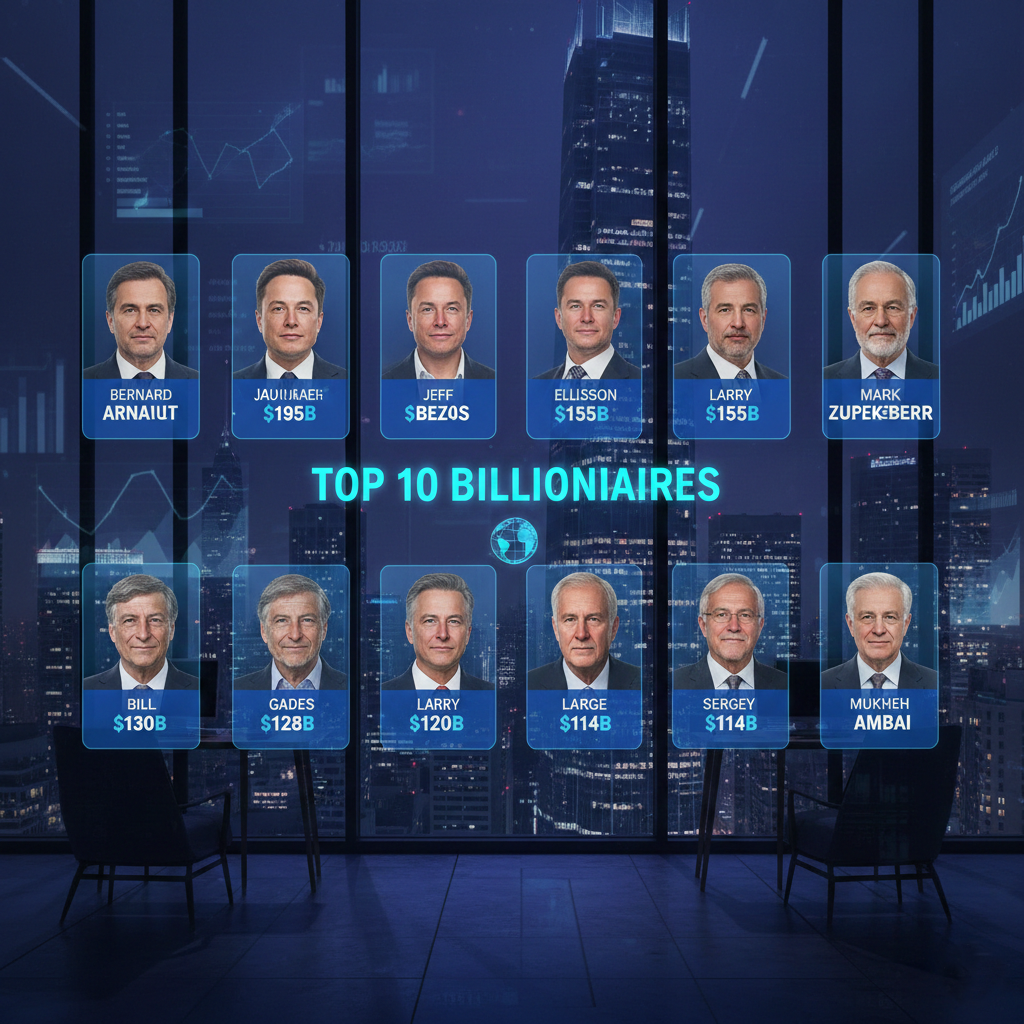
According to the most recent global rankings, as of late 2025 / early 2026, the top 10 individuals with the highest net worth are:
| Rank | Name | Approx. Net Worth* | Primary Source of Wealth / Industry |
|---|---|---|---|
| 1 | Elon Musk | ~ US$ 480–500 billion | Electric Vehicles, Space Tech, Tech Ventures (Tesla, SpaceX, AI & other tech firms) |
| 2 | Larry Ellison | ~ US$ 290–300 billion | Enterprise Software & Cloud (Oracle) |
| 3 | Jeff Bezos | ~ US$ 240–255 billion | E-commerce, Cloud, Logistics, Tech Investments (Amazon, other businesses) |
| 4 | Larry Page | ~ US$ 230–260 billion | Internet Search, Ads, Tech & AI (Alphabet / Google) |
| 5 | Sergey Brin | ~ US$ 210–240 billion | Co-founder of Google / Alphabet — Tech, AI, Cloud, Investments |
| 6 | Mark Zuckerberg | ~ US$ 210–230 billion | Social Media, AI & Tech (Meta Platforms — Facebook, Instagram, etc.) |
| 7 | Bernard Arnault | ~ US$ 178–190 billion | Luxury Goods & Fashion (LVMH and related luxury brands) |
| 8 | Jensen Huang | ~ US$ 160–165 billion | Semiconductors, Hardware & AI Chips (NVIDIA and related tech) |
| 9 | Steve Ballmer | ~ US$ 150–155 billion | Software, Technology, Investments (ties with former roles and investments) |
| 10 | Warren Buffett | ~ US$ 145–150 billion | Investments, Diversified Holdings (Berkshire Hathaway, long-term investing) |
* Net worth estimates fluctuate daily due to changing stock prices, exchange rates and asset valuations. The figures above reflect recent published estimates (late 2025).
📈 What Their Wealth Reveals: Key Patterns & Trends
1. Technology & Innovation Dominate Global Wealth
More than half of the top 10 — including Musk, Page, Brin, Zuckerberg, Huang, Ellison — built their fortunes in technology: from electric vehicles, artificial intelligence, cloud computing, internet services, to semiconductors. This underlines how 2020s wealth creation is tied strongly to digital transformation, AI, and tech-driven disruption. The rise of AI-powered platforms, demand for digital infrastructure, and global tech adoption have all played a key role.
2. Diversification — Not Just Tech But Luxury, Retail, Investments
Not everyone in the top 10 is a tech founder. Luxury-goods industry (Bernard Arnault), long-term diversified investing (Warren Buffett), enterprise software (Larry Ellison), and legacy business/tech hybrids (Steve Ballmer) also hold top positions. This suggests diversification across industries — luxury, retail, legacy business, investments — remains a stable recipe for enduring wealth.
3. Global Economic Inequality and Concentration of Wealth
With over 3,000 individuals holding billionaire status and a combined net worth of $16.1 trillion, global wealth concentration remains staggering. The richest 10 among them alone control massive economic power, influence, and investment capital — highlighting the gap between ultra-wealthy elites and average global citizens.
4. Volatility & Rapid Wealth Changes — Thanks to Market & Tech Dynamics
Many of these billionaires’ fortunes are tied to stock prices, tech performance, and global market conditions. For example, surges in AI-sector valuations (like for NVIDIA) can rapidly elevate someone’s net worth (e.g., Jensen Huang), while market downturns or regulatory pressure could sharply reduce valuations. The rapid rise and fluctuation of fortunes reflect the volatile but high-reward nature of tech-led wealth.
🌍 What Top Billionaires Mean for Global Economy & Trends
💡 Innovation Push — Funding & Driving Global Tech Progress
With such concentrated wealth in tech, billions of dollars are invested in research, innovation, and startups. Companies led by these billionaires — from space exploration to cloud, AI, and renewable energy — define global technological direction. Their ventures often create new industries, jobs, and global growth opportunities.
🌐 Global Markets & Capital Flows
Massive personal fortunes impact global capital flows, stock markets, investment climates, and startup funding. For emerging markets (India, Southeast Asia, Africa), foreign investments and interest from this ultra-rich cohort can fuel growth, innovation, and economic development — though the benefits may not be equally distributed.
📈 Influence on Policy, Markets & Industry — Both Positive & Risky
Wealthy individuals often influence policy, market sentiment, investments, philanthropy, and global business norms. But high wealth concentration also raises concerns: wealth inequality, influence over media & governance, economic disparity, and risk of social imbalance.
🌱 Wealth & Social Responsibility Trends
Many of the world’s richest are increasingly visible in philanthropy, sustainability initiatives, and social causes. Given their resources, their decisions — about climate tech, green investment, AI ethics, global health — can shape global priorities and outcomes across society and economy.
🔎 What Emerging Entrepreneurs & Investors Can Learn
If you’re not part of the billionaire club — but an entrepreneur, investor, or professional — there are some key lessons from these wealth leaders:
- Think globally, build for global demand. Many top billionaires created global-scale products/services — not local or national only.
- Leverage technology & innovation. Tech, AI, cloud computing, digital infrastructure — these are high-growth verticals shaping the future.
- Diversify portfolio across sectors. Relying solely on one industry can be risky; blending investments across sectors gives stability.
- Long-term thinking pays off. Some richest wealth is tied to holdings in businesses, long-term investments, not short-term gains.
- Focus on disruptive ideas & scalability. Many top fortunes come from businesses that disrupt traditional markets and scale globally.
⚠️ Criticisms & Challenges Around Extreme Wealth Concentration
While top billionaires create jobs, innovation, and wealth — there are valid critiques and social concerns:
- Economic inequality and wealth gap — massive disparity between richest and average citizens.
- Market influence and power concentration — a few individuals can sway markets, shape industries, influence policy, and manipulate media/economy.
- Wealth volatility — tech-driven wealth fluctuates rapidly; fortunes can rise or fall dramatically with market cycles.
- Ethical questions about wealth generation — issues like labor policies, environmental impact, monopolistic practices, tax planning, and corporate responsibility come under scrutiny.
- Social imbalance and instability — growing gap can cause social unrest, political pressures, regulatory backlash, demand for wealth taxes or redistribution.
🔮 What to Watch in 2026–2030: Will New Billionaires Emerge or Status Quo Hold?
- AI & Tech Revolution: Continued growth of AI, cloud, biotech, green-tech is likely to spawn new billionaires. Companies in emerging sectors may challenge incumbents.
- Economic & Geopolitical Shifts: As economies evolve, new wealth hubs could emerge beyond US/Europe — bringing diversification in global billionaire demographics.
- Regulation & Wealth Redistribution: Global pressure for wealth tax, corporate tax reforms, regulation on monopolies — could reshape how wealth accumulates or is taxed.
- Innovation + ESG + Sustainability: Billionaires focusing on climate, renewable energy, social good — their ventures could redefine profitable business models.
- Globalization of Capital & Startups: With remote work, digital markets — even individuals from Asia, Africa, Latin America may build global-scale wealth, challenging traditional wealth centers.
🔎 Final Thoughts: The Billionaire List Is More Than Just Numbers
The list of world’s richest people is not just a rank of who is richest — it’s a snapshot of where global money flows, which sectors dominate, where innovation is happening, and how economic power is distributed worldwide.
These top 10 individuals — whether building electric cars, launching rockets, shaping the internet, selling luxury goods — collectively influence global business, technology, culture, and social dynamics. Their fortunes reflect global patterns: rapid tech adoption, globalization, financialization, and wealth concentration.
For anyone watching global trends — entrepreneurs, investors, policymakers, or students — the stories of these billionaires offer a lesson: build with vision, scale globally, embrace innovation — but also remember the social responsibility and power that comes with extreme wealth.
