

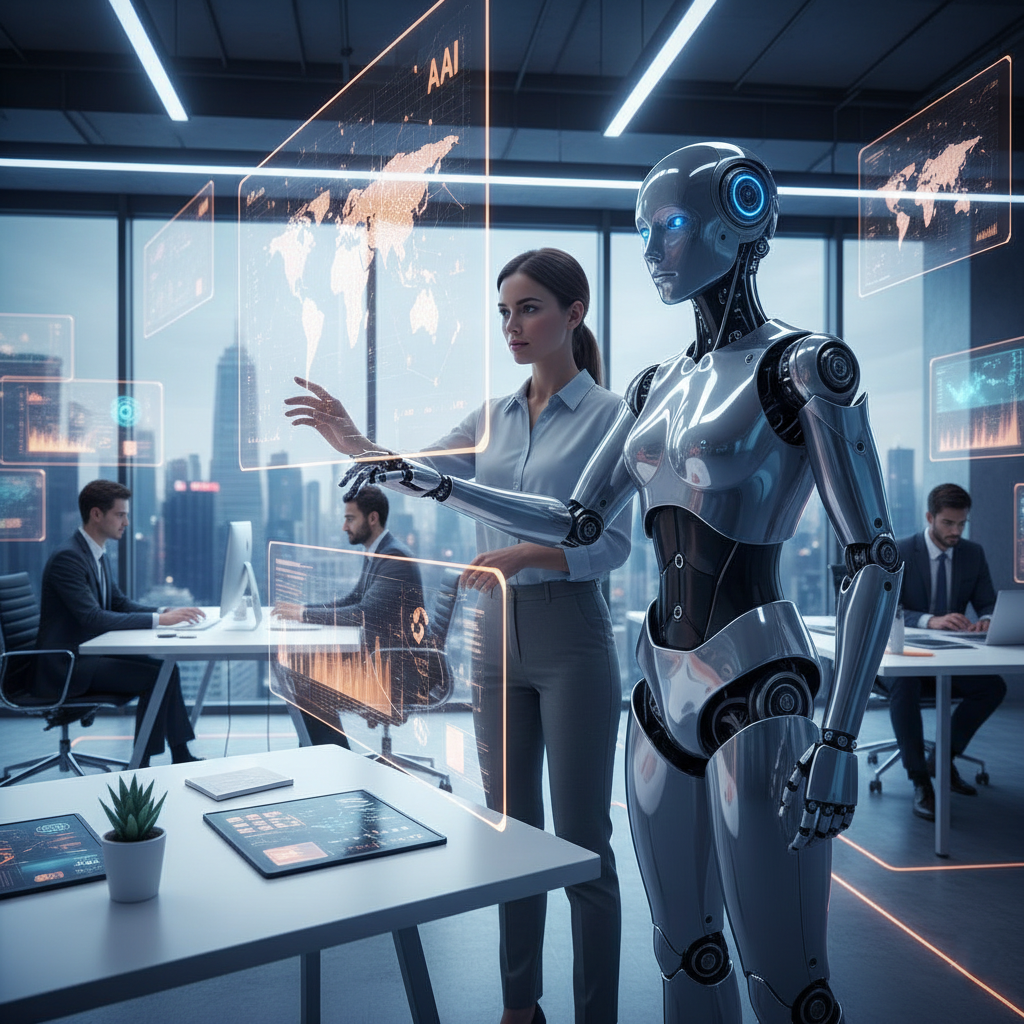
The year 2025 has become the turning point for global industries as AI-powered robots officially enter mainstream workplaces. What once looked like a science-fiction fantasy—robots answering customers, assembling products, assisting doctors, managing warehouses, or even writing code—is now a global reality.
AI robots are no longer basic machines restricted to repetitive tasks. They are intelligent, adaptive, self-learning systems capable of performing complex operations faster, safer, and more accurately than humans in many industries.
From Amazon’s automated warehouses to Tesla’s Optimus robots, from AI assistants in hospitals to smart service robots in airports, we are witnessing a new industrial revolution—one that blends AI + robotics + automation into a single powerful workforce.
1. The Rise of AI Robots in 2025–2026
AI robots today combine three major technologies:
1. Artificial Intelligence
Algorithms that help robots learn, predict, analyze, and make decisions.
2. Robotics Engineering
Mechanical design, sensors, and movement systems that give robots physical capability.
3. Automation & Deep Learning
Systems that allow robots to adapt, self-correct, and improve continually.
Major tech companies leading the revolution include:
- Tesla Optimus Gen-3 – humanoid robots capable of multi-tasking
- Boston Dynamics – robotics for logistics, defense, and construction
- Google DeepMind – AI reasoning integrated into robotic control
- OpenAI – general-purpose AI models integrated into physical robots
- Foxconn & BYD – automated assembly-line robots
- NVIDIA – AI chips powering robot decision-making
- Honda Asimo successors – service robots for public interactions
Why 2025 is a breakthrough year?
Because robots are no longer “programmed”—
they are trained, like humans.
Thanks to advanced AI models, robots can:
- understand voice commands
- analyze data
- adapt to new tasks
- cooperate with humans
- identify objects
- detect risks
- make decisions in real-time
This means robots are now entering workplaces as real co-workers.
2. Industries Where AI Robots Are Replacing or Assisting Humans
AI robots are spreading across almost every industry. Let’s break them down one by one.
A. Manufacturing & Assembly
This sector saw automation first, but today’s robots go far beyond repetitive tasks.
Robots are now capable of:
- assembling complex electronics
- precision welding
- micro-level soldering
- quality inspection using AI vision
- packaging & supply-chain coordination
Example:
Tesla’s Optimus robots are being trained to assemble vehicles and manage internal logistics.
B. Healthcare & Hospitals
The most surprising rise is in medical robots.
AI robots can now assist with:
- patient monitoring
- medicine delivery
- disinfection
- administrative work
- robotic surgery (with 1–2 mm accuracy)
AI robots reduce human errors and work 24/7 without fatigue.
C. Retail & Customer Service
Robots are being used in:
- supermarkets
- malls
- airports
- hotels
- restaurants
They greet customers, answer questions, suggest products, manage billing, and deliver orders.
Japan, UAE, and South Korea are early adopters.
D. Logistics & Warehousing
Amazon, DHL, and Alibaba lead with robots for:
- picking
- sorting
- inventory management
- autonomous forklifts
- packing automation
Robots work 3x faster with zero breaks.
E. Farming & Agriculture
AI robots are solving labor shortages in agriculture:
- crop monitoring
- AI-based watering
- automated harvesting
- soil analysis
- pesticide spraying
This leads to higher food production with lower cost.
F. Defence, Drones & Security
AI robots are used for:
- surveillance
- bomb defusal
- battlefield assistance
- drone navigation
- patrolling
These reduce human risk in dangerous environments.
G. Office & Corporate Work
AI humanoids and virtual AI agents can now:
- schedule meetings
- analyze reports
- manage CRM
- handle customer emails
- generate documents
- automate backend operations
AI employees don’t sleep, don’t make typos, and work 10x faster.
3. Benefits of AI Robots in the Workplace
1. High Efficiency & 24/7 Productivity
Robots work day and night without breaks, increasing output significantly.
2. Higher Accuracy & Zero Human Errors
AI robots follow instructions perfectly and avoid fatigue errors.
3. Reduction in Operational Costs
Fewer human employees may be needed for repetitive work, saving money.
4. Handling Dangerous Jobs
Robots can work in toxic, risky, or high-temperature environments.
5. Better Customer Experience
Instant responses, personalized interactions, and seamless service.
6. Faster Decision-Making
AI robots analyze millions of data points instantly for better outcomes.
7. No Emotional Bias
Robots operate based purely on logic and data.
4. Challenges & Risks of AI Robots in Workplaces
Despite benefits, AI robots come with serious challenges.
A. Job Displacement
This is the biggest global fear.
Repetitive roles like:
- data entry
- cashier jobs
- warehouse work
- inspection jobs
- assembly line tasks
are being replaced fast.
However, new jobs will also be created in robot management, AI training, supervision, and maintenance.
B. High Initial Cost
Robots require:
- installation
- training
- maintenance
- updates
- security
Not all companies can afford them initially.
C. Cybersecurity Risks
AI robots connected to networks can be hacked or manipulated.
A compromised robot can cause physical and financial damage.
D. Ethical & Privacy Concerns
Robots collecting data raise:
- surveillance issues
- employee privacy concerns
- ethical dilemmas
New policies will be needed to regulate them.
E. Dependency Issues
Over-reliance on robots could weaken human skills and decision-making.
5. AI Robots vs Human Workers: Who Will Win?
AI robots will not “replace humans entirely.”
Instead, workplaces will shift to a hybrid model:
Humans handle:
- creativity
- emotional intelligence
- strategy
- leadership
- negotiation
- complex decision-making
Robots handle:
- repetitive tasks
- dangerous jobs
- high-precision work
- data-heavy analysis
The future is human + AI, not human vs AI.
6. The Future: What Will Workplaces Look Like in 2026–2030?
✅ Hybrid teams (humans + robots)
✅ AI assistants for every employee
✅ Autonomous offices
✅ Robot managers for simple operations
✅ AI-driven hiring
✅ Robotic HR for onboarding
✅ Smart warehouses
✅ AI-powered factories
✅ Humanoid robots working on floors
By 2030, experts predict:
- 1 in every 5 jobs will involve working with a robot
- 70% of companies will use automation
- $500 billion global savings due to AI robots
- AI robotics market will reach $300 billion
7. How People Can Prepare for This Transformation
1. Learn AI & automation tools
Knowing how to operate AI systems will be essential.
2. Develop soft skills
Robots cannot replace creativity, communication, or emotional intelligence.
3. Upskill in technical areas
- robotics
- data analysis
- cybersecurity
- AI tools
- programming
4. Adapt to hybrid workflows
Working with robots will become normal.
5. Move towards strategy, leadership & creative roles
These will be the safest from automation.
Conclusion: A New Era Begins
AI robots entering workplaces is no longer a prediction—
it’s today’s reality.
They bring speed, accuracy, and efficiency but also raise concerns about job loss, ethics, and dependency. The world is moving toward intelligent hybrid workplaces, where humans and robots collaborate.
The businesses and workers who adapt early will dominate the future.
By 2026 and beyond, AI robots will be as common in workplaces as computers are today.
