

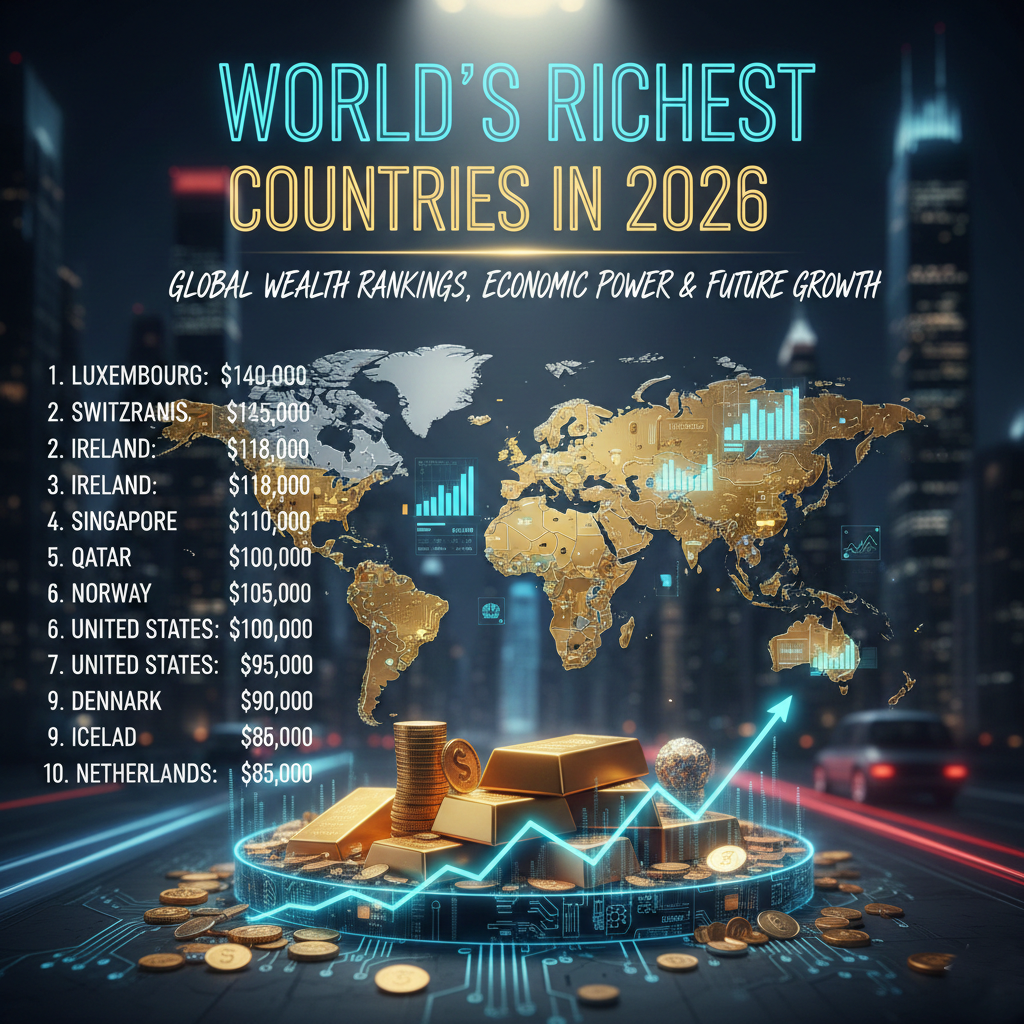
The global economy in 2026 is more dynamic, competitive, and interconnected than ever before. Rapid digitalization, AI innovation, energy transitions, and geopolitical realignments have reshaped how nations grow, trade, invest, and build wealth. As we step deeper into the decade, the world’s richest countries are strengthening their positions through high GDP per capita, advanced technology ecosystems, financial resilience, and strong global influence.
This extensive 2000–2500-word report explores the richest countries in the world in 2026, using a combination of GDP per capita, purchasing power, economic stability, innovation strength, and long-term competitiveness. From small but wealthy European nations to tech-powered Asian hubs and resource-rich Middle Eastern economies — the global wealth landscape is undergoing a powerful transformation.
Let’s break down the global rankings, economic profiles, industry strengths, and insights shaping the world’s richest nations.
Understanding How “Richest Countries” Are Measured
Determining the richest countries requires more than just looking at total GDP. For example, India has one of the largest GDPs globally but a lower GDP per capita.
Key indicators used in this ranking:
1. GDP per Capita (Nominal)
Measures average wealth per person in US dollars.
2. GDP per Capita (PPP)
Adjusts for cost of living. PPP shows real purchasing power.
3. Economic Complexity
How advanced and diversified a country’s industries and exports are.
4. Innovation & Technology
Nations leading in AI, robotics, biotech, renewable energy, and digital transformation rank higher.
5. Financial Stability
Debt levels, currency strength, central bank policy, and resilience to global shocks.
6. Human Development
Education, healthcare, income distribution, and quality of life.
7. Infrastructure & Global Competitiveness
Logistics, connectivity, business environment, and access to global markets.
These factors give a realistic understanding of economic wealth and living standards.
Top 15 Richest Countries in the World (2026 Ranking)
Below are the world’s richest nations, combining nominal GDP per capita, PPP data, and economic strength.
1. Luxembourg – The Wealth Capital of the World
GDP Per Capita (2026 est): $130,000+
Luxembourg continues to dominate global wealth rankings thanks to its robust financial sector, low tax environment, and high-value industries.
Why Luxembourg is #1
- World-class banking and investment hub
- Stable governance and strong EU ties
- High wages and low unemployment
- Strong real estate and asset management sectors
- Highly skilled workforce
Despite its small size, Luxembourg consistently maintains one of the highest standards of living on earth.
2. Switzerland – Europe’s Technology & Banking Powerhouse
GDP Per Capita: ~$105,000
Switzerland remains an economic giant with its mix of finance, pharmaceuticals, precision engineering, and luxury goods.
Key strengths
- Home to top global banks
- Massive pharmaceutical industry (Novartis, Roche)
- High-tech manufacturing and robotics
- Strong currency (Swiss Franc)
- Political neutrality and stability
Switzerland also benefits from strong education, low corruption, and exceptional innovation.
3. Ireland – Europe’s Corporate Headquarters
GDP Per Capita: ~$100,000
Ireland continues to rise due to its status as the preferred European base for global tech giants.
Why Ireland is so rich
- Headquarters for Google, Meta, Apple, Microsoft, Amazon
- Intellectual property income boosts national GDP
- Young and highly skilled workforce
- Strong export economy
Ireland’s unique tax structure attracts international business, giving it one of the highest GDP per capita levels globally.
4. Norway – The Energy & Sovereign Wealth Giant
GDP Per Capita: ~$90,000
Norway’s wealth comes from decades of oil management and its trillion-dollar sovereign wealth fund — the largest in the world.
Key drivers
- Oil and natural gas exports
- Renewable energy, especially hydropower
- World-class public services
- High income equality
Norway remains a global model for economic planning and resource management.
5. Singapore – Asia’s Richest Nation
GDP Per Capita: ~$85,000–90,000
Singapore is Asia’s wealth leader, thanks to its strategic location, financial sector, and tech-driven economy.
Economic pillars
- Global trade hub
- Top financial & banking center
- Smart city innovation
- High-value manufacturing
- Biotechnology and AI development
Singapore remains the most competitive business environment in Asia and one of the most advanced societies in the world.
6. Qatar – Middle East’s Wealth Champion
GDP Per Capita: ~$80,000
Qatar remains extremely wealthy due to LNG (liquefied natural gas) exports and global investments.
Strengths
- World’s 3rd largest natural gas reserves
- Massive energy exports
- Growing finance and logistics sectors
- High-quality living standards
Qatar continues diversifying into education, sports, and technology.
7. United Arab Emirates (UAE) – The Middle East Business Hub
GDP Per Capita: ~$65,000–70,000
UAE, especially Dubai and Abu Dhabi, is transforming into a non-oil economy driven by technology, tourism, logistics, and finance.
Key factors
- No income tax policy
- World’s busiest travel hub (Dubai)
- Booming startup ecosystem
- Renewable energy investment (Masdar City)
- Digital-first government
UAE’s rapid diversification puts it among the world’s richest nations.
8. United States – The World’s Largest Economy
GDP Per Capita: ~$75,000
While the US has a massive population, its GDP per capita remains very high due to its advanced industries.
Economic giants
- Technology (Apple, Google, Nvidia, OpenAI)
- Finance (Wall Street)
- Healthcare & biotech
- Manufacturing
- Energy
The US remains the center of global innovation and venture capital.
9. Denmark – The Nordic Innovation Leader
GDP Per Capita: ~$70,000
Denmark’s wealth comes from high productivity, renewable energy, wind turbine technology, and strong welfare systems.
Highlights
- Global leader in wind energy
- High digitalization
- Advanced manufacturing
- Clean-tech innovation
Denmark remains one of the happiest and richest nations globally.
10. Iceland – Small Population, High Wealth
GDP Per Capita: ~$68,000
Iceland benefits from tourism, clean energy, and a highly educated population.
Strengths
- Geothermal energy
- Fishing industry
- Renewable-powered data centers
- Stable economy
Iceland’s economic model is admired for sustainability and innovation.
11. Australia – Asia-Pacific Wealth Titan
GDP Per Capita: ~$65,000
Australia combines resource wealth with education, services, and a strong immigration-driven workforce.
Key sectors
- Minerals & mining
- Education exports
- Finance
- Technology startups
- Real estate
Australia remains one of the most stable economies globally.
12. Netherlands – Europe’s Logistics & Innovation Hub
GDP Per Capita: ~$63,000
The Netherlands is a global trade gateway and agricultural technology pioneer.
Economic advantages
- Rotterdam: Europe’s largest port
- High-tech agriculture
- Major logistics hub
- Strong financial sector
- Robust innovation ecosystem
The Dutch economy is a blend of creativity, technology, and global trade.
13. Sweden – The Tech Startup Powerhouse
GDP Per Capita: ~$62,000
Sweden has produced global giants like Spotify, Klarna, IKEA, and Volvo.
Key strengths
- Massive startup culture
- Advanced manufacturing
- Strong welfare state
- Renewable energy
- High R&D investment
Sweden balances innovation with equality.
14. Germany – Europe’s Industrial Engine
GDP Per Capita: ~$55,000
Germany is the 4th largest economy globally and Europe’s manufacturing leader.
Core strengths
- Engineering & automotive (BMW, Mercedes, Volkswagen)
- High-tech manufacturing
- Industrial robotics
- Renewable energy expansion
Germany’s innovation and industrial power keep it among the world’s richest.
15. Canada – Natural Resources + Modern Economy
GDP Per Capita: ~$54,000
Canada continues to thrive due to its natural wealth, stable governance, and welcoming immigration policies.
Economic highlights
- Energy & mining
- Technology hubs (Toronto, Vancouver)
- Education sector
- Manufacturing
- Healthcare & biotech
Canada’s economic strength grows consistently year after year.
Emerging Wealth Leaders to Watch in 2026
1. South Korea
Rapid AI, robotics, and semiconductor leadership.
2. Saudi Arabia
Vision 2030 diversifying economy beyond oil.
3. China
High economic output, growing tech capability.
4. India
Fastest-growing major economy, rising middle class.
5. Vietnam
Manufacturing boom and global supply chain shift.
Each of these countries will reshape global economic power by 2030.
Key Factors Behind the Wealth of the Richest Countries
1. Technology & Innovation
AI, robotics, biotech, and automation are engines of wealth.
2. Strong Education Systems
Countries with top universities & skilled workforce perform better.
3. Diversified Economies
Nations relying on multiple industries stay resilient.
4. Political Stability
Stable governance attracts investment.
5. Strategic Global Position
Trade-friendly locations boost economic influence.
Future Predictions: Which Countries Will Dominate by 2030?
Likely top richest countries in 2030
- Luxembourg
- Switzerland
- Singapore
- Norway
- Ireland
- UAE
- Qatar
- United States
Rising economies
- India
- China
- South Korea
- Saudi Arabia
- Vietnam
Technology, energy transition, and digital globalization will define future wealth.
Conclusion: The World’s Richest Countries Reflect a Changing Global Economy
The richest countries in 2026 reveal a clear trend — nations with:
- Strong digital infrastructure
- Skilled workforces
- Advanced technology
- Innovation ecosystems
- Stable governance
- Sustainable policies
are the ones dominating global wealth.
From Luxembourg’s financial strength to Singapore’s tech-driven rise, from the US innovation engine to Norway’s sovereign wealth success — the world’s richest nations are shaping the economic future of the planet.
