
As the global economy recovers — albeit unevenly — several countries around the world are posting exceptionally high GDP growth rates. While many major economies struggle with inflation, geopolitical pressures, and slow growth, a group of emerging and resource-rich nations are surging ahead.
This blog explores which countries are growing the fastest in 2025–2026, the factors driving their growth, risks and sustainability challenges, and what this means for global economic dynamics in the coming years.
📈 What Does “Fastest GDP Growth” Really Mean?
Before diving into the list, it’s important to clarify how economists define and measure “fastest-growing economies”:
- Real GDP growth rate — the annual percentage change in inflation-adjusted Gross Domestic Product. This shows how much a country’s economic output is expanding in real terms.
- Base effect / Starting point — smaller and lower-income economies often register high growth percentages because modest absolute gains over a lower base produce large percentage changes.
- Volatility & structural factors — some high-growth readings reflect commodity exports, oil revenues, post-conflict reconstruction, or natural-resource booms, which may fluctuate sharply.
- Sustainability & diversification — long-term growth depends on diversified economies, stable governance, investment in infrastructure & human capital — not just short-term commodity windfalls.
In short: high growth numbers are noteworthy — but meaningful long-term growth depends on stability, structural reforms, and inclusive development.
🌍 Who’s Growing the Fastest in 2025: Top GDP Growth Nations
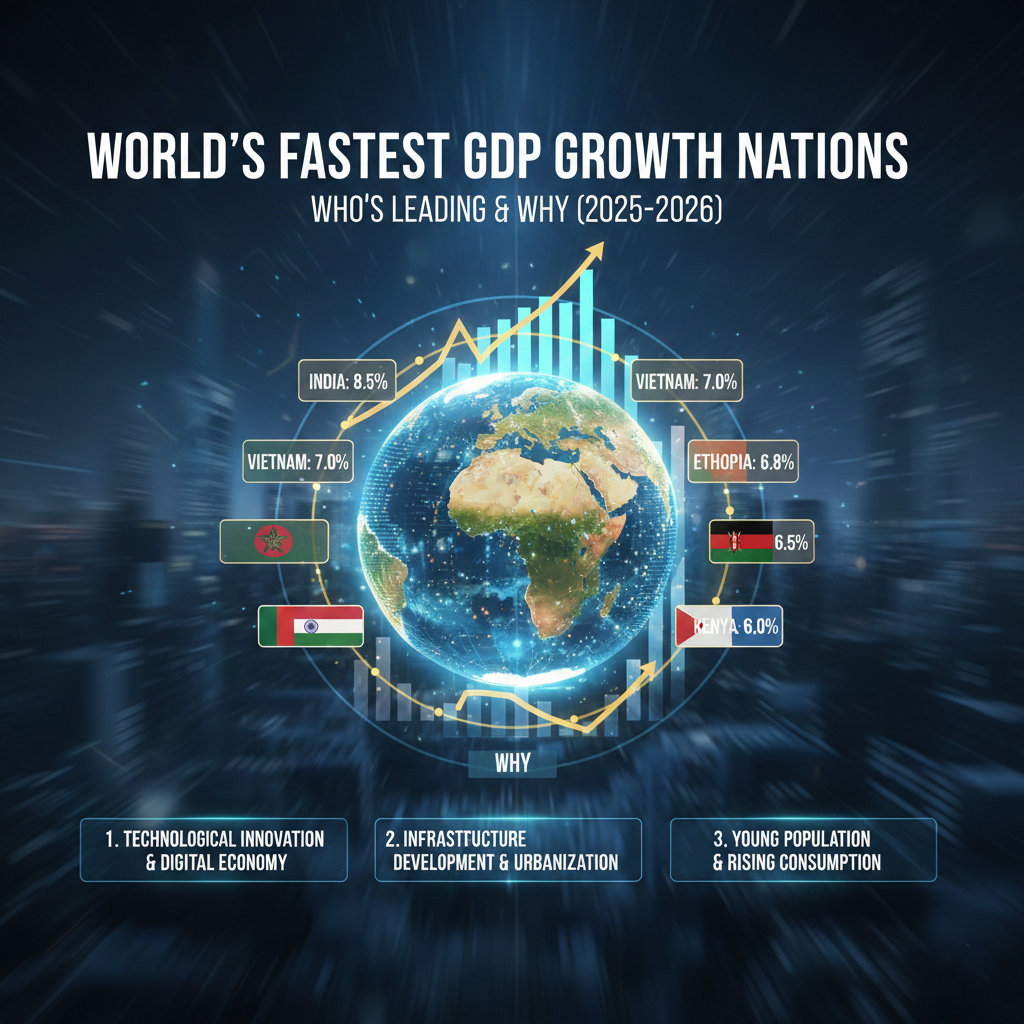
Based on the latest projections (2025), here are some of the countries expected to lead global growth. Visual Capitalist+2World ranking sites+2
| Rank / Country | Projected Real GDP Growth (2025) | Region / Key Driver |
|---|---|---|
| 1. South Sudan | 24.3% | Sub-Saharan Africa — oil resumption, post-reconstruction |
| 2. Libya | ~15–16% | North Africa — recovery, oil exports surge |
| 3. Guyana | ~10.3% | Latin America / Caribbean — oil & resource boom |
| 4. Ireland | ~9.1% | Europe (advanced) — investment, corporate activity, favorable business environment |
| 5. Kyrgyz Republic (Kyrgyzstan) | ~8.0% | Central Asia — regional recovery, reforms |
| 6. Tajikistan | ~7.5% | Central Asia — remittances, regional stability |
| 7. Guinea | ~7.2% | Sub-Saharan Africa — commodity exports, natural resource demand |
| 8. Georgia | ~7.2% | Europe / Eurasia — reforms, strategic transit & trade |
| 9. Ethiopia | ~7.2% 1 | Africa — infrastructure investment, demographic dividend |
| 10. Rwanda | ~7.1% | Africa — stability, reforms, investment in services & infrastructure |
Also notable (just outside top 10): Countries like Vietnam, India, Uganda, Benin, Djibouti, Niger etc — many showing 6–7% growth.
🔎 What’s Driving These High Growth Numbers?
1. Natural Resources & Commodity Boom
- In countries like South Sudan, Libya, Guyana, Guinea — oil or mineral resources dominate. When commodity prices rise or new extraction begins, GDP can spike dramatically.
- Example: Guyana’s growth is closely tied to offshore oil wealth.
2. Post-Conflict or Post-Crisis Recovery
- Nations recovering from conflict or political instability often post high growth due to reconstruction, inflows, and pent-up economic activity (South Sudan, Libya). But these rebounds can be volatile and dependent on political stability.
3. Structural Reforms & Investment in Infrastructure
- Countries like Ethiopia, Rwanda, Georgia are investing heavily in infrastructure, reforms, and improving ease of doing business — leading to diversified growth beyond resources.
- Reformist growth often relies on attracting foreign direct investment (FDI), building human capital, improving governance, and developing sectors like services, manufacturing, agriculture.
4. Demographic Dividend & Emerging Middle-Class Consumption
- Young, growing populations (in many African and Asian nations) create a demand for housing, consumer goods, education, and services — fueling domestic demand and growth (Ethiopia, Rwanda, parts of Central Asia).
5. Favorable External Conditions — Commodity Demand, Global Trade, FDI
- Rising global demand for minerals, energy resources, agricultural commodities benefits exporting nations.
- Countries tapping into global supply chains, trade partnerships, and overseas investment can leverage external demand to boost GDP.
6. Economic Diversification and Modernization
- Some smaller or transitioning economies (like Ireland, Georgia) benefit from corporate investments, IT/tech sectors, services, trade, and favorable business policies — showing that growth isn’t only for resource-rich or developing countries.
⚠️ Why High Growth May Not Mean Long-Term Prosperity — The Risks & Challenges
High GDP growth rates — especially when driven by resources or post-conflict rebound — come with significant risks:
- Volatility from commodity prices: Prices of oil, minerals, and commodities can swing widely. An oil-price drop can devastate oil-dependent GDP.
- Dependence on a single sector — resource dependence (oil, minerals) risks “Dutch Disease,” limited resource reinvestment, and neglect of other sectors.
- Governance, corruption, and political instability — many high-growth countries have fragile governance; instability can wipe away gains.
- Inequitable growth / income inequality — growth may not translate to broad-based prosperity; wealth might remain concentrated.
- Lack of structural reforms / weak institutions — without investments in education, healthcare, governance, infrastructure, high growth may be short-lived.
- External shocks — global commodity demand, geopolitical instability, climate impacts can derail growth quickly.
- Population growth & per-capita income challenge — high GDP growth may coincide with rapid population growth, limiting per-capita gains for individuals.
Hence, sustainable long-term development requires diversification, inclusive policies, good governance, and human-capital investment.
🌐 What This Means for Global Economy, Investment & Geopolitics
✅ New Investment & Trade Hubs Emerge
- Investors and global companies increasingly look beyond traditional markets (US, Europe, China) — African, Central Asian, and smaller economies become attractive for resource, infrastructure, and manufacturing investment.
- Trade patterns shift — demand for commodities, energy, raw materials, agricultural output from growing nations increases.
✅ Shift in Global Economic Power Balance
- As some developing nations grow rapidly, global economic center of gravity may tilt away from traditional powers, giving rise to new regional influencers.
- Emerging economies with young populations may drive global consumer markets in future decades.
✅ Opportunities & Challenges for Development
- Rapid GDP growth can improve living standards, reduce poverty, create jobs — but only if growth is managed and benefits are distributed equitably.
- Infrastructure, education, health, governance become crucial — failing those, high growth may lead to instability, inequality, or resource depletion.
✅ Diverse Portfolios for Global Investors
- Investors may seek high-growth markets for higher returns — but must hedge against volatility.
- Balanced investment strategies — combining resource-rich, high-growth emerging economies with stable developed economies — will likely yield best long-term results.
🔮 What to Watch in 2026–2030: Which Countries Could Sustain or Breakout
Based on current trends and structural factors, these scenarios are worth watching:
Possible Long-Term Performers
- Countries prioritizing diversified economies, reforms, infrastructure, human capital — e.g. Rwanda, Ethiopia, Georgia.
- Nations balancing resource wealth with good governance — e.g. Guyana (if manages oil wealth well), select African countries diversifying beyond commodities.
- Emerging manufacturing/ export hubs — e.g. some Central Asian countries, parts of Africa, Southeast Asia — especially with global supply-chain realignment post-pandemic.
Potential for New Entrants
- Countries not currently top 10 but with strong reform momentum, young population, and resource or strategic advantages could rise rapidly (if policy, investment and stability align).
- If global conditions — commodity demand, climate resilience, trade — shift, previously underperforming nations may catch up.
Risks for Current High-Growth Economies
- Over-reliance on commodities and external demand — making them vulnerable to global shocks.
- Political instability or weak institutions may undo gains (especially post-conflict states).
- Environmental and climate change pressures — resource depletion, climate shocks — could hinder sustainable growth.
🧠 What Fast-Growing Economies Need to Do to Sustain Growth
For countries currently leading in GDP growth or aiming to:
- Diversify economy — don’t depend solely on resources; invest in manufacturing, services, agriculture, tech, human capital.
- Strengthen institutions & governance — anti-corruption, stable policies, transparency, rule of law.
- Invest in human capital — education, vocational training, health, digital skills for the population.
- Build infrastructure & connectivity — transport, energy, internet, logistics — make economy resilient.
- Promote inclusive growth — ensure that growth reaches rural areas, marginalized communities, reduces inequality.
- Manage natural resources responsibly — sustainable extraction, environmental protections, benefit-sharing.
- Engage globally — trade, partnerships, FDI, export diversification — connect to global markets, reduce dependency on one commodity.
✅ Final Thoughts
The list of the world’s fastest-growing economies shows a clear signal: growth is shifting to emerging markets — often resource-rich, reform-focused, or rebuilding nations. Countries like South Sudan, Libya, Guyana, Rwanda, Ethiopia, and several in Central Asia and Africa are promising high growth. Even small advanced economies like Ireland show that with the right policies, rapid growth is possible without being resource-dependent.
But fast growth ≠ guaranteed prosperity. For long-term success — stable, inclusive, sustainable development — nations must pair their growth numbers with structural reforms, investments in people, and responsible governance.
For investors, policymakers, global businesses, and citizens — this is an era of opportunities and risks. The next decade could reshape the global economic landscape.
