

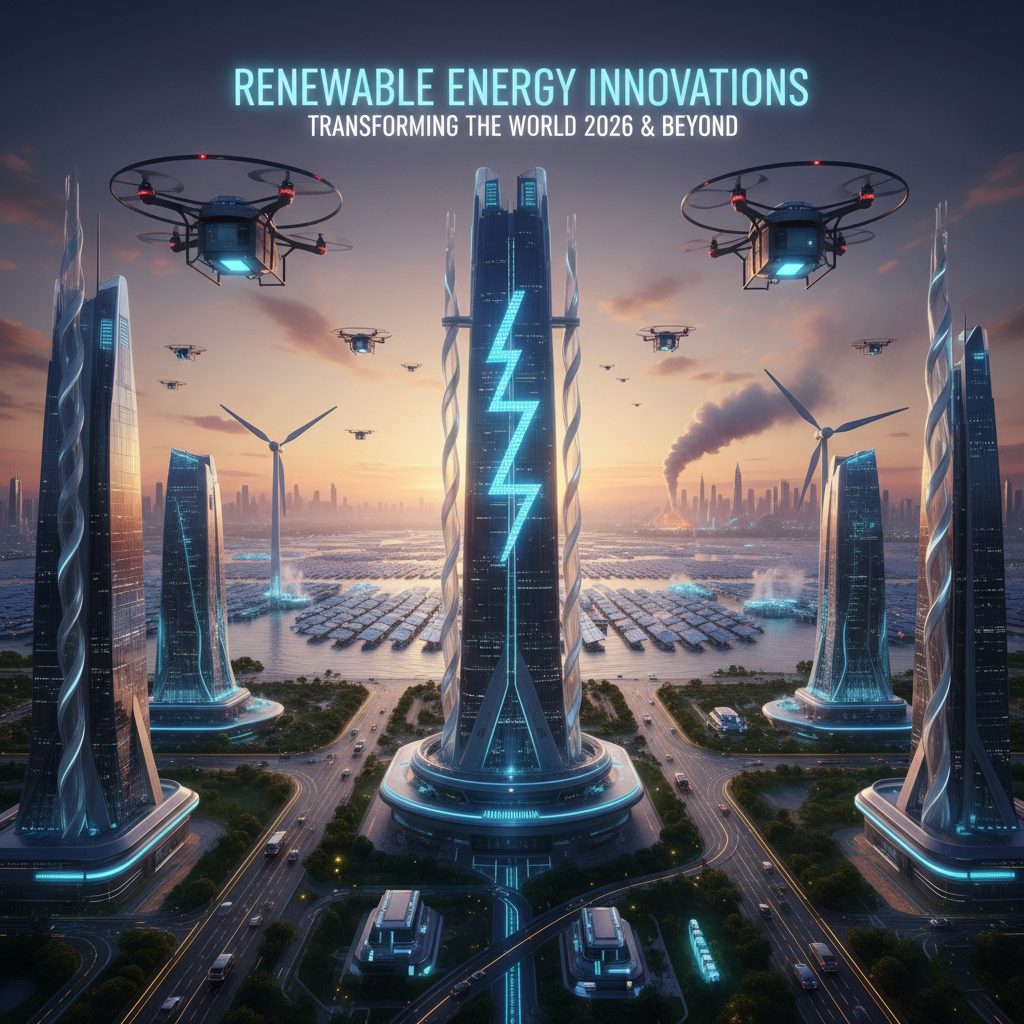
The global energy landscape is undergoing its fastest transformation in history. With climate change accelerating, fossil fuel costs fluctuating, and governments committing to net-zero targets, renewable energy is no longer an alternative — it is rapidly becoming the primary power source for the world.
From next-generation solar cells and wind turbines to hydrogen, AI-powered grids, and futuristic storage systems, innovation is reshaping how the world generates, stores, and consumes energy. As of 2026, renewable energy has grown into a multi-trillion-dollar industry with startups, governments, and tech giants all competing to develop the next breakthrough.
1. Why Renewable Energy Is the Future
The shift toward renewables has gained unstoppable momentum due to five major factors:
1.1 Climate change urgency
Climate change is no longer a distant threat. Extreme heatwaves, rising sea levels, and severe storms are increasing pressure on governments and industries to shift from fossil fuels to clean energy.
1.2 Cheaper renewable technology
Solar and wind are now cheaper than coal, gas, or oil in most countries.
The cost of solar power has dropped over 90% in the last decade, and wind power costs have fallen by more than 70%.
1.3 Energy security
Countries want to reduce dependence on imported oil and gas. Renewable energy — solar, wind, hydro, hydrogen — can be produced domestically, reducing geopolitical risk.
1.4 Rapid investment growth
Governments and private investors are pouring money into clean energy:
- Trillions of dollars of green bonds
- Global climate investment funds
- Regional clean energy alliances
- Corporate net-zero commitments
1.5 Advances in technology
Innovations in storage, smart grids, AI, IoT, and new materials are multiplying the efficiency of renewable energy systems.
2. The Biggest Renewable Energy Innovations in 2026
Let’s explore the cutting-edge technologies reshaping the global energy sector.
2.1 Next-Generation Solar Power Innovations
Solar energy remains the fastest-growing renewable source in the world. As of 2026, new technologies are emerging that dramatically boost efficiency and reduce costs.
● Perovskite Solar Cells
Perovskite is a breakthrough material that can exceed 30% efficiency, much higher than traditional silicon panels.
Benefits include:
- Lower manufacturing cost
- Flexible and lightweight
- Higher efficiency in low light
- Faster production
They can be printed like ink and applied on windows, cars, backpacks, rooftops, and even clothes.
● Solar Skin Technology
These are customizable solar panels with printed designs that match rooftops or advertisements — blending aesthetics with energy production.
● Agrivoltaics
This combines agriculture with solar farms. Plants grow underneath elevated solar panels, producing both energy and food.
Benefits:
- Higher crop yield
- Reduced water evaporation
- Dual land use for farmers
● Solar Roads
Pilot projects in Europe and Asia have introduced solar panels embedded into road surfaces capable of generating electricity as vehicles pass over them.
2.2 Wind Energy Innovations
Wind technology has evolved far beyond traditional turbines.
● Offshore Floating Wind Farms
Traditional turbines are fixed to the ocean floor — but floating turbines allow installation in deeper waters where winds are stronger.
Advantages:
- More stable power production
- Larger installation area
- Less visual impact on coastlines
● Vertical-Axis Wind Turbines (VAWTs)
These smaller, quieter turbines are ideal for cities and urban rooftops.
● Bladeless Wind Turbines
Resembling tall, oscillating poles, they generate power by vibrating in the wind — making them extremely silent and bird-friendly.
● Airborne Wind Energy (AWE) Systems
Drones or kites fly at high altitudes (300–600 meters) to capture stronger winds.
2.3 Hydrogen: The Fuel of the Future
Hydrogen is gaining global momentum as a clean, zero-carbon fuel. When used, it produces only water vapor as emission.
● Green Hydrogen
Made from renewable energy via electrolysis, green hydrogen is considered the most sustainable fuel.
Applications:
- Heavy industry (steel, cement, fertilizers)
- Shipping and aviation
- Energy storage
- Powering factories and trucks
● Hydrogen Fuel Cells
Vehicles powered by fuel cells offer longer ranges than electric batteries and refuel in minutes.
Countries leading this sector:
- Japan
- South Korea
- Germany
- Saudi Arabia
● Hydrogen Pipelines
Large-scale pipelines are being built to transport hydrogen across countries, similar to natural gas.
2.4 Hydropower Innovations
Hydropower is evolving with eco-friendly and modern designs.
● Small Modular Hydropower
These compact turbines can be deployed in rivers and streams without dams, preserving ecosystems.
● Pumped Hydro Storage
Acts as a giant natural battery by pumping water uphill during low demand and releasing it to produce power during peak demand.
● Tidal and Wave Energy
Using ocean currents and waves to generate electricity.
Benefits:
- Highly predictable
- Extremely stable and continuous
2.5 Geothermal Energy Innovations
Geothermal energy is available 24/7 and emits minimal carbon.
● Enhanced Geothermal Systems (EGS)
Artificial reservoirs are created deep underground, generating heat where natural geothermal sources are absent.
● Geothermal for Heating and Cooling
Homes use geothermal heat pumps that reduce energy consumption by up to 70%.
2.6 Battery Storage Innovations
Energy storage is the heart of the renewable energy revolution.
● Solid-State Batteries
Deliver:
- Higher power density
- Faster charging
- Improved safety
● Gravity Batteries
Excess energy lifts heavy weights; lowering them generates electricity later.
● Iron-Air Batteries
They store energy by rusting iron — a low-cost method suitable for large grid storage.
● Sodium-Ion Batteries
Cheaper and more abundant than lithium.
2.7 AI-Powered Smart Grids
Artificial Intelligence is revolutionizing energy distribution.
AI enables:
- Predictive maintenance
- Real-time supply-demand balancing
- Power outage prevention
- Smart home integration
AI increases grid efficiency by 10–30%, reducing energy waste and lowering costs.
3. Global Investments & Market Growth in Renewable Energy
Renewable energy is now one of the world’s fastest-growing industries.
3.1 Global Renewable Energy Investment Trends
- Massive growth in clean energy financing
- Green hydrogen contracts worldwide
- Government subsidies and tax incentives
- Investment funds specializing in solar, wind, and storage
3.2 Major Countries Leading Renewable Energy Growth
- China: World leader in solar manufacturing
- India: Massive solar parks and green hydrogen plans
- USA: Solar and wind installations at record highs
- EU: Strict climate rules driving green energy innovation
- UAE & Saudi Arabia: Large-scale clean energy transitions
4. Renewable Energy in Homes & Cities
Renewables are transforming cities into smart, sustainable ecosystems.
4.1 Smart Homes
Homes now use:
- Rooftop solar
- EV charging
- Smart meters
- Battery walls
- Automated energy management systems
4.2 Smart Cities
Cities use:
- Electric buses
- Solar-powered street lights
- Renewable microgrids
- AI traffic systems
5. Challenges Slowing Renewable Adoption
Despite rapid growth, some challenges remain.
5.1 High initial investment costs
Though long-term savings are high, initial costs can be a barrier.
5.2 Energy storage limitations
Renewables need strong storage systems to manage fluctuations.
5.3 Land and environmental concerns
Large wind and solar farms may face land availability issues.
5.4 Supply chain dependency
The world relies on China for solar panels and rare earth materials.
6. Future of Renewable Energy (2026–2035)
The next decade will be historic for clean energy.
6.1 By 2030
- Renewables projected to generate over 70% of global energy
- Solar will become the world’s cheapest electricity source
- EV sales will surpass petrol/diesel vehicles
6.2 By 2035
- Hydrogen may power major industries and cargo ships
- Fossil fuel demand may peak and decline
- Global carbon emissions could reduce significantly
- Smart grids will manage entire cities autonomously
7. Conclusion: The World Is Entering a Renewable Energy Revolution
Renewable energy innovations are not just scientific experiments — they are becoming mainstream, powering cities, homes, vehicles, and industries worldwide. The transition to clean energy is no longer optional but essential for survival.
As new technologies like perovskite solar, floating wind turbines, AI smart grids, hydrogen fuel, and next-gen batteries become mature, renewable energy will reshape the global economy, create millions of jobs, transform industries, and lead humanity toward a cleaner, healthier, and more resilient future.
The future of energy is renewable — and the future is already here.
