

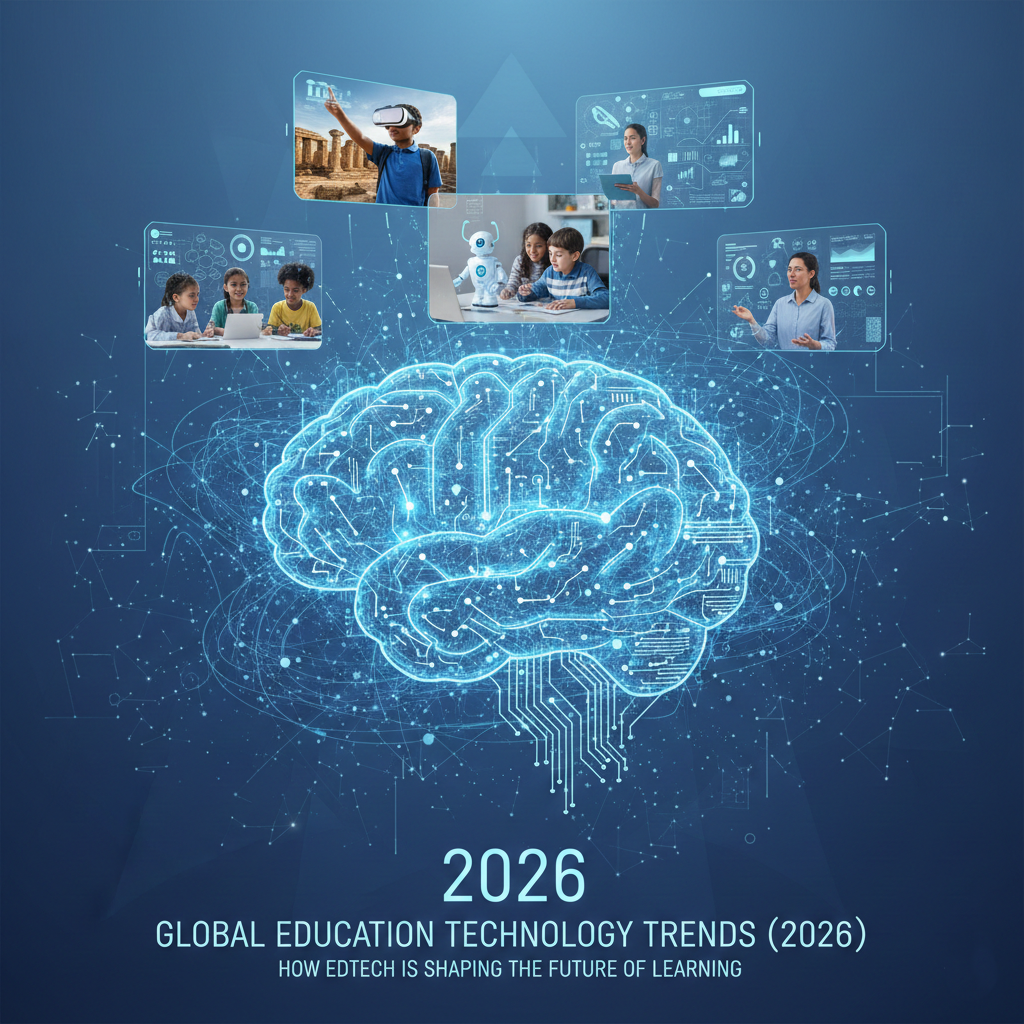
The Global EdTech Wave in 2026
Education technology — often called EdTech — has rapidly transformed how people learn, teach, and access knowledge worldwide. What once began as digital textbooks and early learning apps has become a thriving ecosystem of adaptive AI tutors, immersive virtual learning environments, online credentialing, and data-driven personalized instruction.
As we approach 2026, several trends are reshaping global education — from early childhood classrooms to corporate training and lifelong learning. The coronavirus pandemic accelerated many of these changes, but the momentum has continued because technology now offers educators and learners powerful tools for accessibility, customization, and collaborative learning.
This blog explores the top global education technology trends that are transforming learning systems and how they’ll influence the future of education at all levels.
1. Artificial Intelligence Powering Personalized Learning
Artificial intelligence has become one of the most disruptive forces in education, enabling systems that adapt to each learner’s pace, strengths, and areas of need.
What AI Does in Education
- Adaptive learning pathways: AI systems analyze student responses in real time and customize what content they see next, creating personalized learning journeys.
- Intelligent tutoring: AI tutors can explain concepts, answer questions, and even generate practice exercises tailored to student progress.
- Assessment automation: Automated grading and instant feedback help teachers focus more on instruction than clerical tasks.
- Early intervention: Predictive analytics identify learners at risk of falling behind, helping educators intervene early.
These AI-driven systems increase engagement and retention, reduce teacher workload, and support differentiated instruction at scale — even in large classrooms or institutions.
2. Immersive Learning with AR/VR and the Metaverse
Immersive technologies like augmented reality (AR), virtual reality (VR), and metaverse platforms are creating experiential learning environments where students interact with content rather than just read about it.
Examples of Immersive Learning
- Virtual field trips in history or science classes — students can explore the Great Wall of China or inner workings of a human cell in 3D.
- Simulated labs where learners perform chemistry experiments without real-world risk.
- Collaborative metaverse classrooms where students from around the world gather as avatars.
Immersive learning enhances engagement, improves spatial understanding, and supports learners who benefit from visual or experiential forms of instruction.
3. Mobile-First and On-Demand Learning
As smartphones spread globally — even in regions with limited traditional infrastructure — education is increasingly delivered through mobile platforms.
Why Mobile Learning Matters
- It enables micro-learning — short, focused modules that fit into daily routines.
- Learners can access high-quality education anywhere — from urban centers to rural areas.
- Push notifications and app features keep learners engaged and accountable.
Apps for language learning, STEM skills, professional development, and literacy now rival traditional courses in popularity and effectiveness — especially when designed with user experience in mind.
4. Blended and Hybrid Learning Models
Post-pandemic education systems have widely adopted blended learning models that mix online and in-person instruction.
How Blended Learning Works
- Students attend face-to-face classes for discussion, labs, and social learning.
- Digital platforms deliver lectures, assessments, and supplementary practice.
This model combines the strengths of both modes: human interaction and flexible, data-rich digital experiences. It is increasingly popular in K-12 schools, universities, and corporate training programs.
5. Micro-Credentials and Skills-Based Learning
Employers today prioritize skills over traditional degrees — so education is shifting to micro-credentials, digital badges, and competency-based credentials.
Key Features
- Learners earn credentials for specific skills (e.g., Python programming, data analysis, UX design).
- Credentials are stackable — students can combine them toward bigger certifications or degrees.
- These systems help learners enter or pivot to new careers quickly — especially in fast-evolving fields like artificial intelligence and cybersecurity.
This trend is reshaping higher education and corporate learning, linking learning outcomes more closely with job market needs.
6. Learning Analytics and Data-Driven Instruction
Massive amounts of learning data are generated every day — from clickstreams on learning platforms to assessment results and interaction logs. Education systems are using this data to improve outcomes.
Benefits of Learning Analytics
- Teachers can monitor student progress through dashboards.
- Administrators can identify curriculum gaps.
- AI can recommend personalized resources based on performance.
- Students gain insights into their strengths and areas for growth.
In this way, data becomes a tool for evidence-based decision making, not just record keeping.
7. Equity and Accessibility Empowerment
One of the most important global education trends is a renewed focus on equity — using technology to bridge learning gaps.
Equity Initiatives Include
- Open educational resources (OER) that are free and available globally.
- Adaptive tools for learners with disabilities (speech-to-text, visual navigation, etc.).
- Offline learning apps that work without internet connectivity.
- Localization of content in native languages.
These innovations ensure that education — especially high-quality, technology-enabled education — is more inclusive and accessible than ever before.
8. Collaboration and Social Learning Platforms
Learning is social by nature, and technology is expanding opportunities for collaborative learning across borders.
Examples of Social Learning Features
- Group projects on learning platforms with real-time collaboration tools.
- Peer review and feedback systems powered by AI.
- International virtual events and student exchanges.
- Discussion forums that reinforce learning communities.
By giving learners tools to work together regardless of location, EdTech is redefining classroom walls as global networks of learners.
9. Parental Engagement Tools in K-12 EdTech
Especially in K-12 education, technology is enhancing how parents stay connected with student progress.
Features Parents Now Use
- Real-time dashboards of grades and assignments
- Messaging and communication tools with teachers
- Push notifications for attendance and performance
- Resources for at-home learning support
This trend aligns family involvement with student success and encourages supportive learning environments beyond school hours.
10. AI-Powered Tutoring and Writing Assistants
One of the fastest-growing EdTech innovations involves AI writing assistants, math helpers, and language tutors that give instant explanations, feedback, and examples.
How These Tools Help
- Students get step-by-step problem guidance.
- Learners practice skills with instant, detailed feedback.
- Teachers leverage AI to assign personalized practice.
These tools empower self-directed learning and reduce wait times for help.
11. Blockchain for Credentials and Academic Records
Blockchain — the same technology behind cryptocurrencies — is increasingly used to:
- Securely store academic transcripts
- Verify credentials instantly
- Provide immutable proof of achievement
Students and employers alike benefit from tamper-proof digital records that make academic validation simple and secure.
12. Teacher Upskilling Through EdTech
As education technology evolves, teachers are receiving more and better professional development tools.
Support for Teachers Includes
- AI-enabled lesson planning tools
- Professional learning communities online
- Micro-courses for new instructional strategies
- On-demand feedback and analytics
Empowering teachers with tech makes the learning ecosystem stronger from within.
13. Gamification for Motivation and Engagement
Gamification — adding game-like elements to learning — continues to boost engagement.
Common Features
- Badges and leaderboards
- Interactive quests and missions
- Instant feedback with rewards
- Adaptive challenges that match learner level
Gamified elements have shown measurable increases in learner motivation, especially in early education and language learning.
14. Workforce Development and Lifelong Learning Platforms
Education is no longer concentrated at one age or place — it’s a lifelong pursuit.
Global Workforce EdTech Includes
- Retraining platforms for automation-displaced workers
- Upskilling programs for digital fluency
- Partnerships between tech companies and universities
- Employer-sponsored learning ecosystems
This trend reflects a world where job requirements change rapidly, and education is the bridge to sustained career success.
Challenges Facing Global EdTech Adoption
While EdTech is rapidly growing, there are ongoing challenges:
1. Digital Divide
Not all regions have equal internet access or hardware resources, leading to inequality in access.
2. Teacher Training
Some educators struggle with integrating technology meaningfully into the classroom.
3. Standards and Quality Control
As learning platforms proliferate, ensuring content meets educational standards remains a challenge.
4. Data Privacy and Security
Protecting student data from misuse is both a technical and regulatory priority.
Despite these challenges, innovations continue to push global education forward.
Future Outlook: What’s Next for EdTech
As 2026 unfolds, several emerging developments are likely to expand the impact of education technology even further:
🔮 AI + Human Hybrid Teaching Models
Future classrooms may integrate AI “co-teachers” that handle repetitive tasks while human educators focus on mentoring, empathy, and critical thinking.
🔮 Neuro-Educational Interfaces
Early research suggests that future EdTech may even integrate brain-computer tools for personalized pacing and cognitive support — although widespread adoption is still years away.
🔮 Global Learning Markets
Cross-border education platforms and credentialing will grow, allowing learners to access courses from institutions around the planet.
🔮 Eco-Learning and Sustainability Education
Curricula powered by technology will help students understand complex global challenges like climate change and sustainability.
Conclusion
Education technology is no longer optional — it is a central pillar of how people learn, teach, and grow in a connected world. The trends driving EdTech today show a future where learning is:
- Personalized through AI
- Immersive through AR and VR
- Mobile and on-demand
- Community-oriented globally
- Skill-focused and career-aligned
- Data-informed and equitable
Whether you’re an educator, learner, parent, policymaker, or technologist, understanding these trends matters because they show where education is headed — and how technology is making learning more accessible, flexible, and impactful than ever before.
