

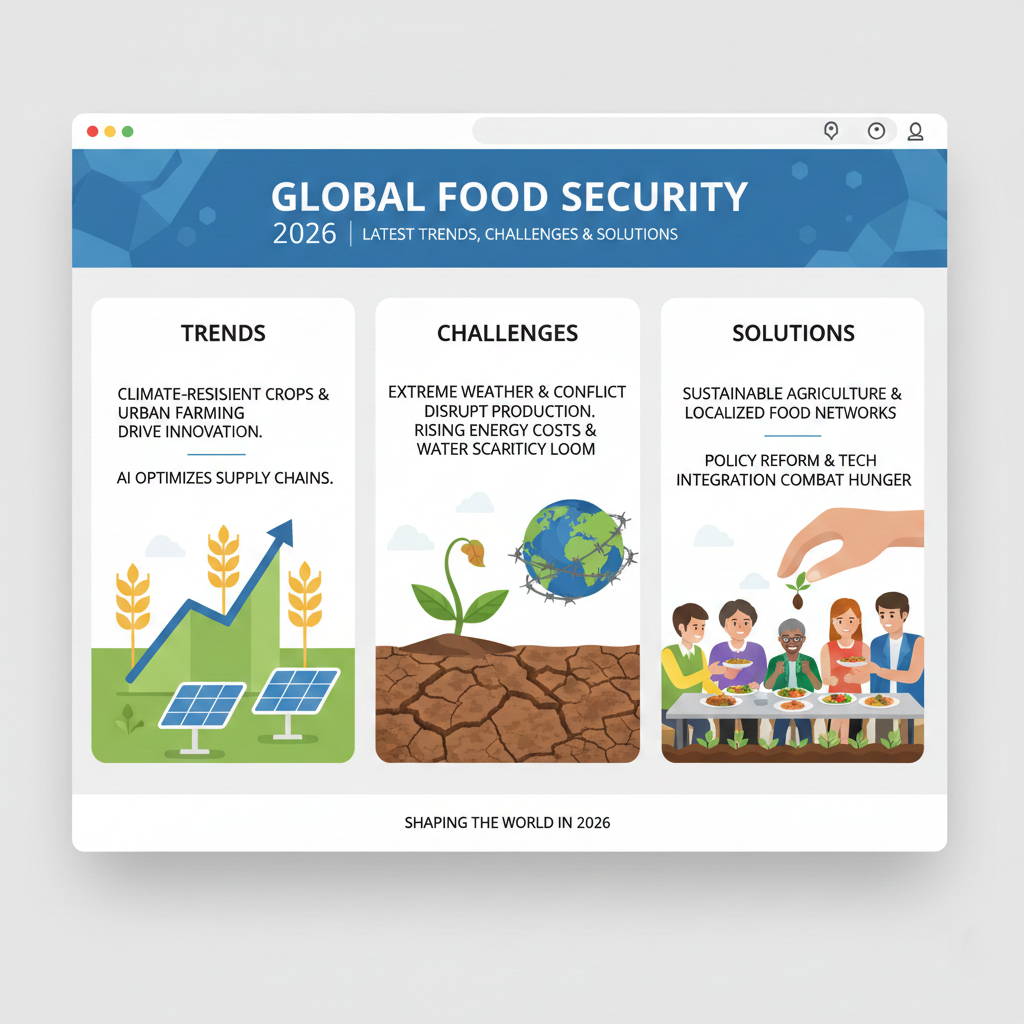
Why Global Food Security Headlines Matter Now More Than Ever
Global food security headlines in 2026 reflect a complex mix of climate disruptions, geopolitical tensions, rising food prices, agricultural innovation, and global hunger emergencies. As climate change accelerates, supply chains shift, and technology transforms farming, the world is facing critical questions: Will we have enough food? Will it be affordable? Will it be nutritious?
This comprehensive article breaks down the top global food security trends, urgent challenges, and real-world solutions, offering a high-authority, easy-to-read guide designed for professionals, students, policymakers, and everyday readers who want to understand what shapes the world’s food future.
Global Food Security Headlines: The Top Issues Dominating 2026
Rising Global Food Prices and Inflation Pressures
One of the strongest global food security headlines today centers around rising prices. According to major economic forecasts, the combination of droughts, energy volatility, and supply chain disruptions is pushing global food inflation to its highest sustained levels in a decade.
Key triggers include:
- Increased fertilizer costs
- Extreme weather affecting crops
- Conflicts that interrupt trade routes
- Currency volatility in emerging economies
Countries in Africa, South Asia, and parts of Latin America face the sharpest increases, putting vulnerable populations at significant risk.
Extreme Climate Events Threatening Global Crop Yields
Climate change remains the biggest long-term threat to food security. From heatwaves in Europe to floods in Asia and droughts in Africa, climate events are reducing agricultural productivity.
Major climate-related impacts include:
- Reduced wheat and maize yields due to heat stress
- Declining groundwater affecting rice production
- Ocean warming disrupting fisheries
- Desertification increasing across arid regions
As climate headlines dominate global media, food systems are becoming more fragile and unpredictable.
Global Conflicts Disrupting Food Supply Chains
Geopolitical tensions continue to affect global food trade. Conflict-driven blockages in major export routes—especially grain, vegetable oils, and fertilizer—remain a leading cause of price instability.
Examples include:
- Port closures delaying grain shipments
- Sanctions disrupting fertilizer exports
- Regional unrest interrupting seasonal harvesting
As wars and political instability rise, secure access to food becomes an even more urgent global concern.
Technological Innovations Changing Global Food Security
AI-Powered Farming and Precision Agriculture
Technology headlines are increasingly shaping global food security. From AI-powered farm management tools to satellite crop monitoring, precision agriculture is helping countries boost productivity while using fewer resources.
Benefits include:
- Optimized irrigation and fertilizer use
- Real-time soil health monitoring
- Predictive analytics for crop yield forecasting
- Automation reducing labor shortages
These innovations are helping farmers—especially in developing countries—grow more food sustainably.
Vertical Farming and Urban Agriculture Expanding Rapidly
Cities worldwide are embracing vertical farming, hydroponics, and rooftop agriculture to reduce dependence on long-distance supply chains.
Advantages:
- Year-round production
- Minimal land use
- Reduced water consumption
- Fresher, local produce
Countries like Singapore, UAE, Japan, and the Netherlands lead the transition toward climate-resilient indoor farming technologies.
Breakthroughs in Climate-Resilient Crops
To combat extreme weather, scientists are developing improved crop varieties that withstand heat, drought, and pests.
Examples:
- Drought-resistant maize
- Salt-tolerant rice and wheat
- Pest-resistant genetically edited crops
These climate-smart crops are becoming essential in regions hit hardest by warming temperatures.
Global Hunger Trends and Humanitarian Responses
Global Hunger Rising Despite Economic Recovery
Even with economic rebounds in many regions, hunger levels remain painfully high. According to global estimates, over 735 million people face chronic undernourishment.
Leading causes:
- Conflict and displacement
- Economic inequality
- Climate disasters
- Food price surges
Food shortages also push millions towards migration in search of stability and nutrition.
Humanitarian Food Aid Programs Scaling Up
Global organizations like the World Food Programme (WFP), FAO, and UNICEF are expanding emergency assistance programs.
Most supported areas:
- East Africa (drought + conflict)
- Middle East regions affected by war
- South Asia flood zones
- Small island nations facing rising sea levels
Humanitarian aid remains essential, but experts warn it cannot replace long-term reforms.
Major Global Food Production and Export Highlights
Top Food-Producing Countries in 2026
Below is a quick overview of global leaders in essential crops:
| Crop | Leading Producers | Key Notes |
|---|---|---|
| Wheat | China, India, Russia | Weather variability affecting yields |
| Rice | India, China, Indonesia | Strong domestic consumption |
| Maize | USA, Brazil, China | High demand for feed & biofuels |
| Soybeans | Brazil, USA, Argentina | Brazil’s production expanding fast |
| Potatoes | China, India, Russia | Key staple for food security |
These countries significantly influence global food availability and prices.
Major Food Import-Dependent Countries
Some nations rely heavily on imports for essential food items.
High-dependence regions:
- Gulf countries
- Singapore
- North African nations
- Small island nations
These countries are most vulnerable to global supply disruptions.
Food Waste Reduction Becomes a Top Global Priority
Why Food Waste Is Now a Key Food Security Issue
One-third of all food produced globally is lost or wasted. Reducing food waste is now recognized as one of the fastest ways to improve food security without increasing production.
Major sources of waste:
- Poor storage infrastructure
- Inefficient supply chains
- Retail overstocking
- Household waste
Governments are investing in cold storage, smart logistics, and awareness campaigns.
Sustainable Agriculture and Global Policy Shifts
New Government Policies Supporting Food Security
Around the world, countries are adopting new policy frameworks to strengthen supply chains and improve food access.
Policy trends include:
- Subsidies for climate-smart farming
- Investments in irrigation and drought systems
- Support for farmers adopting digital tools
- Mandatory grain stockpiles
- Stronger import diversification strategies
Countries are also improving early warning systems for food shortages.
Consumer Trends Influencing Global Food Security
The Shift Toward Plant-Based Diets
Plant-based foods are becoming mainstream, reducing pressure on global livestock systems and lowering carbon footprints.
Benefits:
- More sustainable resource use
- Greater affordability
- Reduced emissions
Plant-based alternatives help countries strengthen nutrition at lower costs.
Organic and Clean-Label Demand Rising
Consumers are prioritizing:
- Organic foods
- Chemical-free produce
- Transparent sourcing
- Sustainable packaging
This shift pushes companies to adopt greener, more responsible food production methods.
Key Global Food Security Stats for 2026
- 735 million people face chronic hunger
- 2.4 billion people experience moderate to severe food insecurity
- Climate change may reduce major crop yields by up to 20% by 2050
- Food demand is expected to grow by over 60% by 2050
- Over 30% of global food is wasted annually
These figures highlight the urgency of global action.
FAQs on Global Food Security Headlines
Q1. What is the biggest threat to global food security right now?
Climate change remains the biggest long-term threat, followed closely by conflict, supply chain disruptions, and rising food prices.
Q2. Which regions are most affected by food insecurity in 2026?
East Africa, South Asia, the Middle East, and parts of Latin America face severe challenges due to droughts, conflicts, and economic stress.
Q3. How does technology support global food security?
AI farming, precision agriculture, drought-resistant crops, and vertical farming help increase production and reduce waste.
Q4. Why are global food prices rising?
Extreme weather, fertilizer shortages, political instability, and higher energy costs drive price increases worldwide.
Q5. What role do governments play in improving food security?
Governments invest in agriculture, support farmers, improve storage and logistics, diversify imports, and promote sustainable practices.
Conclusion: Securing the Global Food Future
Global food security headlines in 2026 show that the world faces major challenges—but also unprecedented opportunities. With innovative technologies, climate-smart agriculture, smarter policies, and global cooperation, it is possible to build a future where everyone has access to safe, nutritious, and affordable food.
To stay informed about global food trends, agricultural innovations, and sustainability news, keep following updated global food security reports and expert insights.
