
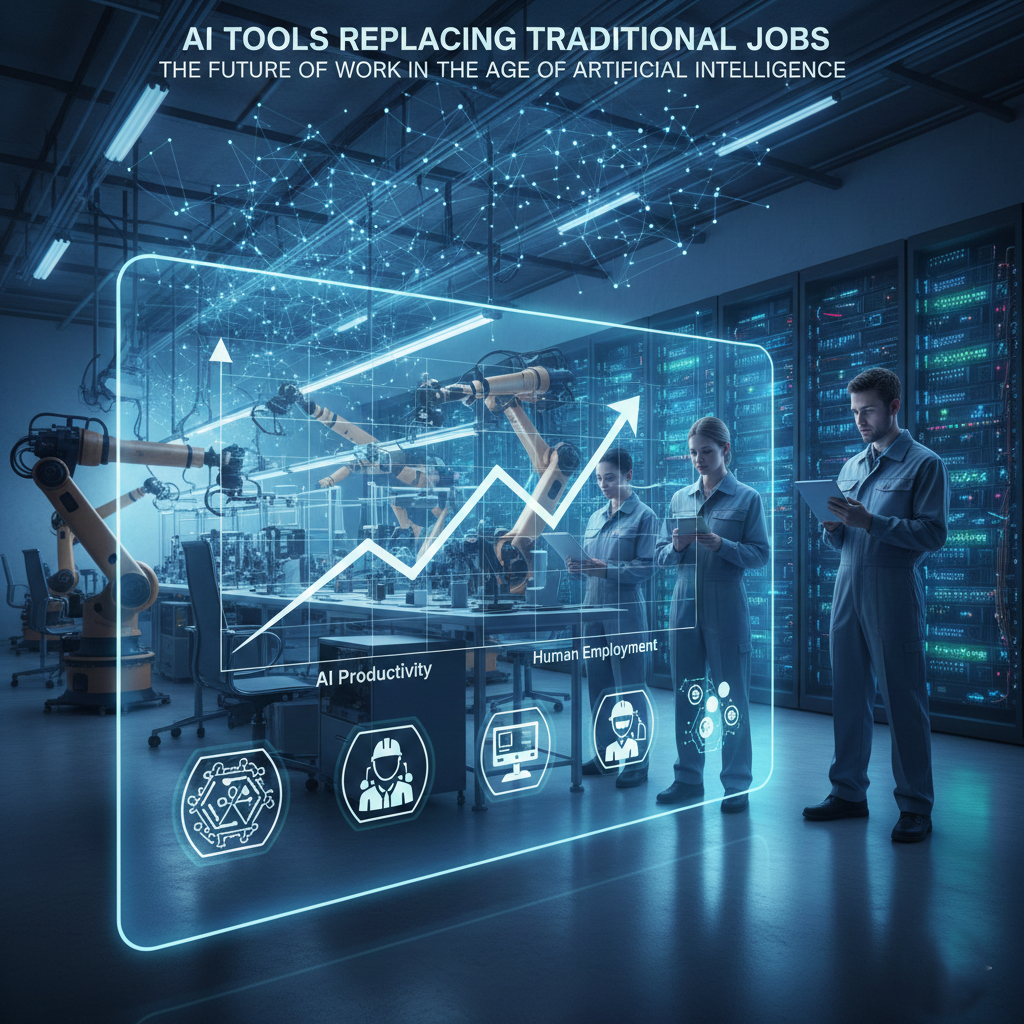
AI Tools Are Changing How We Work
Artificial Intelligence is no longer a futuristic concept—it is already transforming how businesses operate and how people work. From AI-powered chatbots handling customer service to automation tools replacing repetitive office tasks, AI tools replacing traditional jobs has become one of the most discussed topics in the global workforce.
Companies are adopting AI to increase efficiency, reduce costs, and improve accuracy. As a result, many traditional roles are being redefined, automated, or completely replaced. However, this shift is not just about job loss—it’s also about job evolution, new opportunities, and smarter ways of working.
In this in-depth article, we’ll explore how AI tools are replacing traditional jobs, which roles are most affected, real-world examples, statistics, benefits, risks, and how individuals and businesses can adapt to the AI-driven future.
What Does “AI Tools Replacing Traditional Jobs” Really Mean?
AI replacing jobs does not always mean humans are being eliminated. In most cases, AI tools are taking over specific tasks, not entire professions.
Traditional jobs usually involve:
- Repetitive manual tasks
- Rule-based decision-making
- High-volume data processing
AI excels at these activities, making it ideal for automation.
Key Types of AI Tools Used in Job Automation
- Machine learning algorithms
- Robotic Process Automation (RPA)
- Natural Language Processing (NLP) tools
- Computer vision systems
- Generative AI tools (text, image, video)
These tools can work 24/7, make fewer errors, and process information faster than humans.
Why Companies Are Replacing Traditional Jobs with AI Tools
Businesses are rapidly adopting AI tools for several strategic reasons.
Cost Efficiency and Scalability
AI tools reduce long-term labor costs and scale instantly without hiring more staff.
Speed and Accuracy
Tasks that take hours for humans can be completed in seconds by AI with high accuracy.
Data-Driven Decision Making
AI analyzes massive datasets to deliver insights that humans may overlook.
Competitive Advantage
Companies using AI gain an edge in productivity, customer experience, and innovation.
Traditional Jobs Most Affected by AI Tools
AI adoption is not uniform across all industries. Some jobs are more vulnerable than others.
Administrative and Office Jobs
- Data entry operators
- Office clerks
- Payroll processors
AI tools used: RPA software, document automation tools
Customer Support and Call Centers
- Call center agents
- Email support executives
AI tools used: AI chatbots, voice assistants, conversational AI
Manufacturing and Factory Jobs
- Assembly line workers
- Quality inspectors
AI tools used: Industrial robots, computer vision systems
Retail and Sales Roles
- Cashiers
- Inventory managers
AI tools used: Self-checkout systems, demand forecasting AI
Content and Media Roles
- Basic content writers
- Image editors
- Video editors
AI tools used: Generative AI, AI design tools, automated editing software
Jobs That Are Evolving, Not Disappearing
While some roles are declining, many traditional jobs are evolving with AI.
Marketing Professionals
AI helps with:
- Keyword research
- Content optimization
- Ad targeting
Human creativity and strategy are still essential.
HR and Recruitment
AI screens resumes and schedules interviews, but final hiring decisions remain human-led.
Finance and Accounting
AI automates bookkeeping and reports, while humans handle compliance and strategy.
Comparison Table: Traditional Jobs vs AI-Powered Roles
| Traditional Job | AI Tool Replacing Tasks | Human Role After AI |
|---|---|---|
| Data Entry Clerk | RPA Automation | Data Analysis |
| Call Center Agent | AI Chatbot | Customer Relationship Manager |
| Accountant | AI Accounting Software | Financial Advisor |
| Content Writer | Generative AI Tools | Content Strategist |
| Factory Worker | Industrial Robots | Machine Supervisor |
Industries Where AI Job Replacement Is Growing Fastest
IT and Software Development
AI tools assist in:
- Code generation
- Bug detection
- Testing automation
Developers now focus more on architecture and innovation.
Healthcare
AI supports:
- Medical imaging analysis
- Patient scheduling
- Predictive diagnostics
Doctors and nurses use AI as a support system, not a replacement.
Banking and Finance
AI is used for:
- Fraud detection
- Credit scoring
- Automated trading
Human oversight remains critical for ethical and regulatory reasons.
Education
AI tools offer:
- Personalized learning
- Automated grading
- Virtual tutors
Teachers shift towards mentorship and guidance roles.
Statistics: How AI Is Impacting Jobs Globally
- Over 40% of routine jobs are expected to be automated by 2030
- 85 million jobs may be displaced, but 97 million new roles will be created
- Companies using AI report up to 30% productivity growth
- AI adoption is highest in IT, finance, healthcare, and retail sectors
These numbers show that AI job replacement is also creating new opportunities.
Benefits of AI Replacing Traditional Jobs
Increased Productivity
AI handles repetitive work, allowing humans to focus on higher-value tasks.
Better Work-Life Balance
Automation reduces workload pressure and overtime.
New Career Opportunities
New roles such as:
- AI trainers
- Prompt engineers
- Data analysts
- Automation consultants
Improved Accuracy and Safety
AI reduces human errors, especially in critical sectors like healthcare and manufacturing.
Risks and Challenges of AI Job Replacement
Job Displacement
Low-skill and repetitive roles face the highest risk.
Skill Gap
Workers without digital skills may struggle to adapt.
Ethical Concerns
Bias in AI decision-making can impact fairness.
Overdependence on Technology
Excessive automation may reduce human judgment.
How to Future-Proof Your Career Against AI
Adapting to AI is no longer optional—it’s essential.
Learn AI-Related Skills
- Data analysis
- AI tools usage
- Basic machine learning concepts
Focus on Human Skills AI Can’t Replace
- Creativity
- Emotional intelligence
- Leadership
- Critical thinking
Upskill and Reskill Continuously
Online courses, certifications, and hands-on projects are key.
Work With AI, Not Against It
Use AI as a productivity partner rather than a competitor.
How Businesses Can Use AI Responsibly
- Combine AI automation with human oversight
- Invest in employee reskilling programs
- Use ethical AI frameworks
- Focus on augmentation, not elimination
Responsible AI adoption builds trust and long-term success.
Common Myths About AI Replacing Jobs
“AI Will Take All Jobs”
False. AI replaces tasks, not all professions.
“Only Low-Skill Jobs Are Affected”
Not true. Even high-skill jobs are evolving with AI tools.
“AI Has No Errors”
AI systems can make mistakes and require human supervision.
FAQs: AI Tools Replacing Traditional Jobs
Will AI completely replace human workers?
No. AI will automate tasks, but humans will remain essential for creativity, strategy, and emotional intelligence.
Which jobs are safest from AI replacement?
Jobs requiring creativity, leadership, empathy, and complex decision-making are least likely to be replaced.
How soon will AI replace traditional jobs?
The process is gradual. Significant changes are expected between 2025 and 2035.
Can AI create more jobs than it replaces?
Yes. History shows that technology creates new roles while transforming old ones.
Should students be worried about AI?
Students should prepare by learning future-ready skills and adapting to AI-based work environments.
The Future of Work: Human + AI Collaboration
The future is not humans versus AI—it is humans with AI. Organizations that embrace collaboration between AI tools and human intelligence will lead the next era of innovation.
Workers who adapt, upskill, and leverage AI will remain highly valuable in the job market.
Conclusion: Embrace the Change, Don’t Fear It
AI tools replacing traditional jobs is a reality—but it’s not the end of employment. It’s the beginning of a smarter, more efficient, and more innovative workforce.
The key is adaptation. Whether you’re a student, professional, business owner, or entrepreneur, understanding AI and learning how to work alongside it will define your success in the coming years.
