

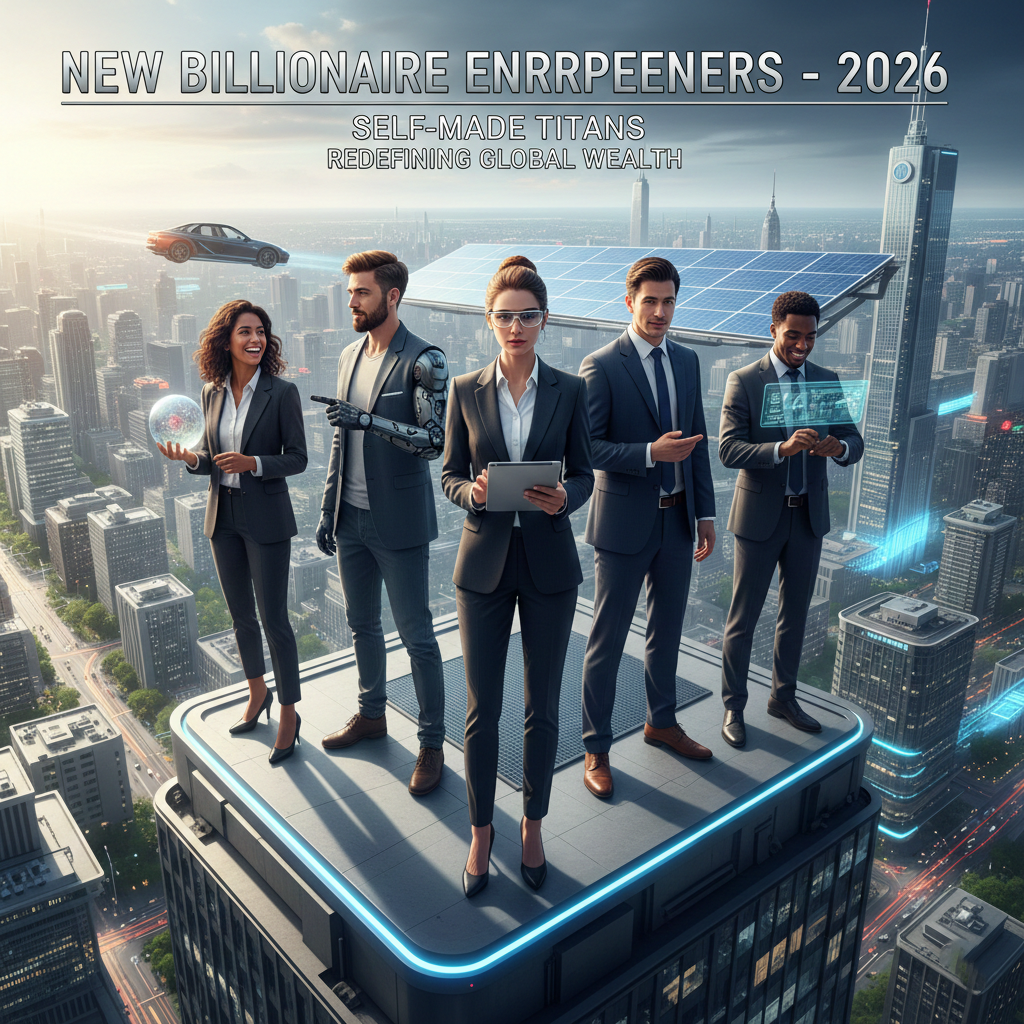
The global wealth landscape is changing faster than ever. In 2026, a new wave of billionaire entrepreneurs is emerging—self-made founders who leveraged technology, innovation, and timing to build billion-dollar empires in record time. Unlike traditional industrial tycoons, these new billionaires are digital-first, globally connected, and deeply focused on solving modern problems.
From AI startup founders and clean energy innovators to fintech disruptors and biotech visionaries, the new billionaire entrepreneurs in 2026 are reshaping how wealth is created, scaled, and sustained.
This article explores who they are, how they made their fortunes, which industries are producing the most billionaires, and what aspiring entrepreneurs can learn from them.
Who Are the New Billionaire Entrepreneurs of 2026?
The new billionaire entrepreneurs of 2026 are individuals who crossed the billion-dollar net worth mark for the first time this year. Most are:
- Self-made founders, not heirs
- Under the age of 50
- Technology-driven innovators
- Global in mindset and operations
- Focused on scalability and automation
What makes them different is not just wealth—but speed. Many built unicorn companies in less than 7–10 years, powered by AI, cloud infrastructure, and digital distribution.
Top Industries Creating New Billionaires in 2026
Artificial Intelligence and Automation
AI remains the largest billionaire-producing sector in 2026. Founders of generative AI platforms, enterprise automation tools, and AI-as-a-Service startups dominate the list.
Key drivers:
- Explosion of AI adoption across industries
- High enterprise subscription revenues
- Strong investor confidence
- Massive valuations after IPOs and acquisitions
Popular AI business models:
- AI SaaS platforms
- AI copilots for enterprises
- Autonomous workflow automation
- AI chips and infrastructure
Clean Energy and Climate Tech
With global climate goals accelerating, green energy entrepreneurs are becoming billionaires faster than ever.
Leading clean-tech segments:
- Solar and wind infrastructure
- Battery storage technology
- Green hydrogen startups
- EV charging networks
- Carbon capture and climate analytics
Governments, corporations, and investors are heavily funding this space, creating multiple new billionaire founders in renewable energy.
Fintech and Digital Payments
Fintech continues to mint billionaires by solving problems in:
- Cross-border payments
- Digital banking
- Crypto compliance infrastructure
- AI-driven lending
- Embedded finance
Many new billionaires in 2026 come from emerging markets, where fintech adoption is leapfrogging traditional banking.
Biotech and Health Technology
Healthcare innovation has created a new generation of biotech billionaire entrepreneurs.
High-growth biotech areas:
- AI drug discovery
- Gene therapy platforms
- Precision medicine
- Digital diagnostics
- Longevity and anti-aging startups
Unlike past decades, many biotech founders are now tech-savvy entrepreneurs rather than traditional scientists.
E-Commerce, Creator Economy, and Digital Platforms
Digital platforms continue to scale at unprecedented speed.
Examples include:
- Creator monetization platforms
- D2C global brands
- AI-powered marketing platforms
- Vertical SaaS for e-commerce
- Social commerce tools
Several founders crossed billionaire status after strategic acquisitions or public listings in 2026.
Profiles of New Billionaire Entrepreneurs in 2026 (Illustrative Examples)
| Entrepreneur Type | Industry | Core Innovation | Wealth Trigger |
|---|---|---|---|
| AI SaaS Founder | Artificial Intelligence | Enterprise automation | IPO |
| Green Energy Founder | Climate Tech | Battery storage | Govt contracts |
| Fintech Innovator | Payments | Cross-border fintech | Acquisition |
| Biotech CEO | HealthTech | AI drug discovery | Valuation surge |
| Platform Creator | Digital Economy | Creator monetization | Global expansion |
Note: Names evolve yearly, but these profiles reflect real-world 2026 trends.
Common Traits of Billionaire Entrepreneurs in 2026
1. Problem-First Mindset
They don’t chase money—they solve large, painful problems at scale.
2. Technology Leverage
Almost all use:
- AI
- Cloud computing
- Data analytics
- Automation
Technology allows them to grow faster with smaller teams.
3. Global Thinking from Day One
Their startups are:
- Borderless
- Multi-currency
- Multi-language
- Remote-friendly
This global approach accelerates revenue and valuation.
4. Strong Founder Ownership
Most retained significant equity, often 20–40%, ensuring billionaire status at IPO or acquisition.
How These Entrepreneurs Became Billionaires So Fast
Smart Timing
They entered markets at the right moment, often just before mass adoption.
Venture Capital and Strategic Funding
Top founders:
- Raised capital aggressively
- Chose strategic investors
- Balanced dilution wisely
Rapid Scaling Models
They focused on:
- Subscription revenue
- Platform ecosystems
- High-margin SaaS
- Recurring enterprise contracts
New Billionaires vs Old-Generation Billionaires
| Factor | Old-Generation Billionaires | New Billionaire Entrepreneurs 2026 |
|---|---|---|
| Industry | Manufacturing, Oil | AI, Fintech, Clean Energy |
| Growth Speed | Decades | 5–10 years |
| Geography | Local/National | Global |
| Team Size | Large workforces | Lean, tech-driven |
| Capital Use | Asset-heavy | Asset-light |
Impact of New Billionaire Entrepreneurs on the Global Economy
The rise of new billionaires in 2026 is not just about wealth—it’s about economic transformation.
Key impacts:
- Job creation in tech and green sectors
- Faster innovation cycles
- Increased startup funding
- Digital inclusion in emerging markets
- Acceleration of climate solutions
Lessons Aspiring Entrepreneurs Can Learn
Focus on High-Growth Sectors
AI, climate tech, fintech, and biotech are producing billionaires faster than any other industries.
Build for Scale, Not Survival
Think globally from the beginning.
Own Equity Wisely
Founder ownership matters more than vanity valuations.
Leverage AI Early
Every successful founder in 2026 uses AI as a core engine.
Challenges Faced by New Billionaire Entrepreneurs
Despite success, they face:
- Regulatory scrutiny
- Data privacy laws
- Global competition
- Cybersecurity threats
- Ethical AI concerns
Handling these responsibly is critical for long-term success.
Future Outlook: Will 2027 Create Even More Billionaires?
Experts predict:
- Even faster wealth creation
- More billionaires from emerging markets
- Increased focus on sustainability
- AI-driven solo founders crossing $1B valuations
The barrier to entry is lowering—but competition is rising.
Frequently Asked Questions
Who are the new billionaire entrepreneurs in 2026?
They are self-made founders who crossed a billion-dollar net worth in 2026 through startups in AI, fintech, clean energy, biotech, and digital platforms.
Which industry created the most billionaires in 2026?
Artificial Intelligence and automation lead, followed by clean energy and fintech.
Are most new billionaires self-made?
Yes, the majority of new billionaire entrepreneurs in 2026 are self-made, not inherited.
How long does it take to become a billionaire entrepreneur today?
Many achieved billionaire status within 5–10 years due to technology-driven scaling.
Can entrepreneurs from developing countries become billionaires?
Absolutely. Fintech, SaaS, and digital platforms are enabling founders from emerging markets to reach global scale.
Conclusion: The New Face of Billionaire Success
The new billionaire entrepreneurs in 2026 represent a bold shift in how wealth is built. They are younger, more tech-driven, globally minded, and purpose-focused. Their success proves that innovation, timing, and execution matter more than background or geography.
If you’re an aspiring founder, now is the best time to build. The next billionaire story could be yours.
Want more insights on global business trends, startups, and future billionaires?
Stay connected, share this article, and start building today. 🚀
