

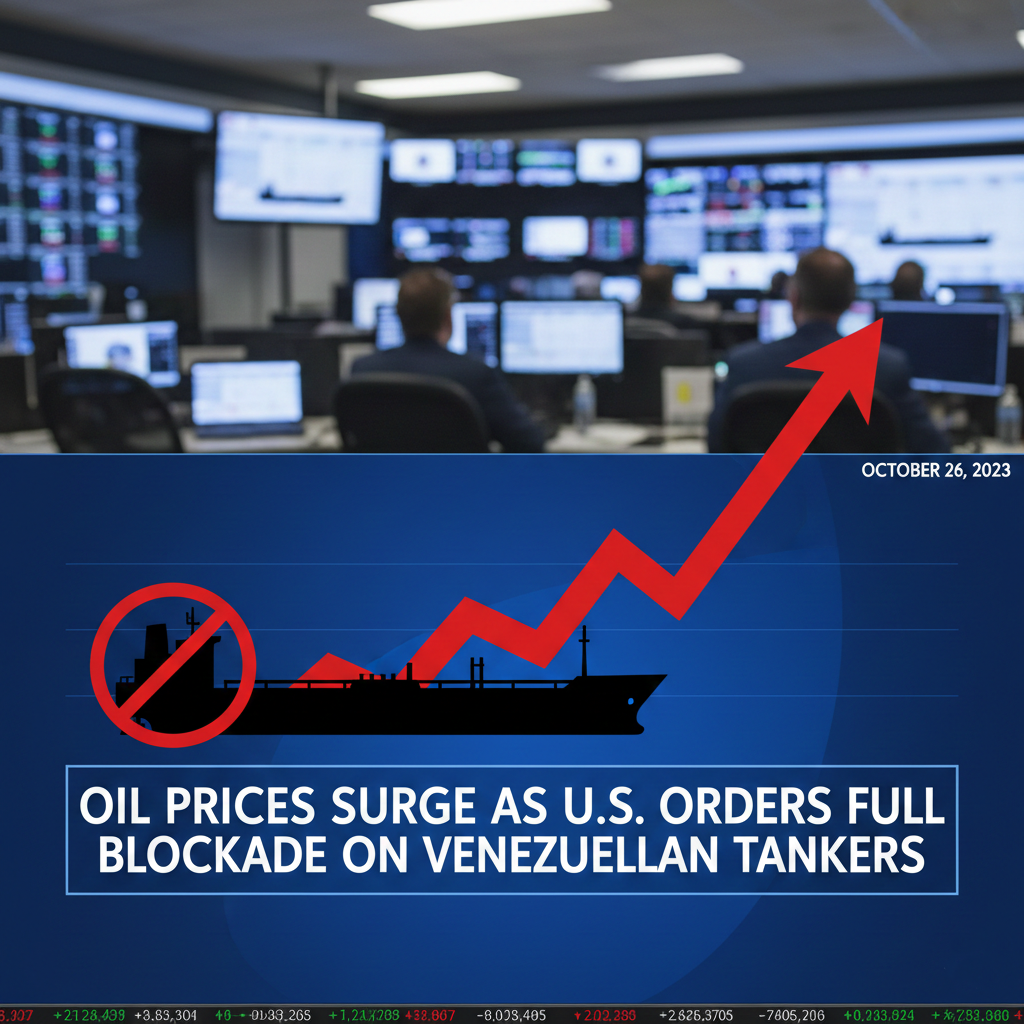
Global oil prices have surged dramatically after the United States ordered a complete blockade on sanctioned Venezuelan oil tankers, triggering fresh geopolitical tensions, supply concerns, and heightened energy market volatility. The move has sent shockwaves through crude oil markets, with Brent and WTI prices reacting instantly as traders reassessed global supply risks.
This decisive action by Washington signals a tougher stance on energy sanctions enforcement, particularly against countries accused of bypassing international restrictions. As Venezuela remains one of the world’s largest proven oil reserve holders, any disruption to its exports carries significant implications for global oil supply, fuel prices, inflation, and economic stability—especially for energy-importing nations.
In this in-depth analysis, we break down why oil prices jumped, what the blockade means for Venezuela, how global markets are reacting, and what lies ahead for crude oil investors, governments, and consumers.
Why Oil Prices Jumped After the U.S. Blockade Decision
The immediate spike in oil prices reflects market fears of supply disruptions, not just from Venezuela but across the broader sanctions-sensitive oil trade network.
Key reasons behind the oil price surge
- Complete interdiction of sanctioned tankers, reducing Venezuelan export capacity
- Rising geopolitical risk premium in oil futures
- Fear of retaliation or escalation involving other oil-producing nations
- Tighter global crude supply amid already constrained production
- Speculative trading and hedge fund positioning
Even though Venezuelan oil exports have been limited for years due to sanctions, enforcement has often been inconsistent. This new order marks a zero-tolerance approach, significantly altering market expectations.
Understanding the U.S. Blockade on Venezuelan Oil Tankers
The U.S. blockade is not a traditional naval blockade but a comprehensive enforcement action aimed at stopping sanctioned vessels from transporting Venezuelan crude.
What the blockade includes
- Tracking and interception of sanctioned Venezuelan tankers
- Penalizing shipping companies, insurers, and port operators
- Monitoring ship-to-ship transfers often used to bypass sanctions
- Restricting access to international maritime insurance and financing
- Diplomatic pressure on countries facilitating Venezuelan oil trade
This approach tightens loopholes that previously allowed Venezuelan crude to reach global markets through indirect channels.
Venezuela’s Role in the Global Oil Market
Despite years of sanctions and underinvestment, Venezuela remains strategically important.
Key facts about Venezuelan oil
| Metric | Data |
|---|---|
| Proven oil reserves | Largest in the world |
| Primary crude type | Heavy & extra-heavy |
| Pre-sanctions output | Over 3 million barrels/day |
| Current output | Significantly reduced |
| Main buyers | Asia-focused intermediaries |
Venezuelan oil is particularly suited for heavy crude refineries, meaning disruptions can disproportionately affect certain refining markets.
Impact on Global Crude Oil Supply and Demand
Supply-side pressure intensifies
The blockade further tightens a market already dealing with:
- OPEC+ production discipline
- Limited spare capacity
- Declining output in some mature oil fields
- Geopolitical risks in multiple regions
While Venezuelan volumes alone may not dominate global supply, marginal barrels matter in a finely balanced oil market.
Demand remains resilient
Despite economic slowdown concerns, oil demand has remained relatively strong due to:
- Transportation fuel consumption
- Industrial recovery in emerging markets
- Aviation demand growth
- Strategic stockpiling by governments
This imbalance between constrained supply and steady demand fuels upward price momentum.
Geopolitical Tensions and Energy Security Concerns
The blockade intensifies existing geopolitical fault lines.
Broader geopolitical implications
- Heightened U.S.–Latin America tensions
- Strained relations with countries importing Venezuelan oil
- Increased alignment among sanctioned energy exporters
- Greater fragmentation of global energy trade
Energy security is increasingly becoming a geopolitical weapon, and markets are pricing in long-term instability rather than short-term disruptions.
Market Volatility: How Traders and Investors Are Reacting
Oil markets thrive on certainty—and this move has done the opposite.
Immediate market reactions
- Sharp jump in Brent and WTI crude prices
- Increased volatility in oil futures contracts
- Rising implied volatility in energy options
- Higher trading volumes across commodities
Investor behavior trends
- Hedge funds increasing long positions
- Airlines and refiners boosting hedging activity
- Energy stocks outperforming broader indices
- Increased interest in commodities as inflation hedges
The blockade has reinforced oil’s status as a geopolitical asset, not just a commodity.
Impact on Fuel Prices and Inflation
Higher crude prices inevitably filter down to consumers.
Potential economic consequences
- Rising petrol and diesel prices
- Increased transportation and logistics costs
- Inflationary pressure on goods and services
- Central banks facing policy challenges
Energy-importing countries are particularly vulnerable, as currency depreciation can amplify the impact of rising oil prices.
How This Affects Emerging and Developing Economies
Emerging markets face a double challenge: higher energy costs and tighter financial conditions.
Key risks for developing nations
- Widening trade deficits
- Increased subsidy burdens
- Pressure on foreign exchange reserves
- Slower economic growth
For many economies, oil price shocks translate directly into social and political stress.
Winners and Losers in the Energy Sector
Potential winners
- Major oil exporters outside sanctions
- Energy companies with strong upstream exposure
- Oilfield services providers
- Commodity traders and shipping insurers (non-sanctioned)
Potential losers
- Oil-importing nations
- Airlines and transport companies
- Heavy manufacturing sectors
- Sanctioned producers and intermediaries
This redistribution of gains and losses adds another layer of complexity to global energy markets.
Comparison with Past Sanctions-Driven Oil Price Spikes
History shows that sanctions often create short-term price spikes but long-term structural changes.
Key comparisons
| Event | Market Impact |
|---|---|
| Iran oil sanctions | Sustained price volatility |
| Russia energy restrictions | Structural trade shifts |
| Libya production outages | Sharp but temporary spikes |
| Venezuelan blockade | High volatility with global ripple effects |
Unlike past cases, today’s market faces multiple overlapping risks, making price stability harder to achieve.
Long-Term Outlook for Oil Prices
The future path of oil prices depends on several variables.
Key factors to watch
- Duration and enforcement of the blockade
- Diplomatic negotiations involving Venezuela
- OPEC+ production decisions
- Global economic growth trends
- Energy transition pace
While short-term volatility is likely, long-term prices will hinge on whether geopolitical risks become entrenched or resolved.
What This Means for the Energy Transition
Ironically, higher oil prices can both accelerate and delay the energy transition.
Positive effects
- Increased investment in renewables
- Improved economics for clean energy
- Stronger policy momentum
Negative effects
- Higher costs for renewable infrastructure
- Inflation-driven policy delays
- Continued reliance on fossil fuels for energy security
The blockade highlights how geopolitics still dominates energy realities, despite long-term decarbonization goals.
Frequently Asked Questions (FAQs)
Why did oil prices rise after the U.S. blocked Venezuelan tankers?
Oil prices jumped due to fears of reduced global supply, increased geopolitical risk, and tighter enforcement of sanctions affecting oil flows.
Does Venezuela still export oil despite sanctions?
Yes, but through limited and often indirect channels. The blockade significantly restricts these routes, reducing export volumes.
Will fuel prices increase for consumers?
Higher crude prices often lead to increased fuel costs, though the impact varies by country, taxes, and subsidies.
Is this blockade permanent?
The duration depends on geopolitical negotiations, compliance, and U.S. foreign policy objectives.
How does this affect global inflation?
Rising oil prices can push inflation higher by increasing transportation, production, and energy costs across economies.
Conclusion: A New Chapter of Oil Market Uncertainty
The U.S. decision to impose a complete blockade on sanctioned Venezuelan oil tankers has injected fresh uncertainty into already fragile energy markets. The resulting surge in oil prices underscores how geopolitics, sanctions, and supply risks continue to dominate global energy dynamics.
For investors, policymakers, and consumers alike, this development is a reminder that oil remains deeply intertwined with international power struggles. As markets brace for continued volatility, staying informed and adaptive will be critical in navigating the evolving energy landscape.
Stay ahead of global energy trends. Follow the latest oil market insights, geopolitical updates, and economic analysis to make informed decisions in a rapidly changing world.
