

Starting a business in India is no longer complicated or time-consuming. With digital government portals, simplified compliance, and startup-friendly policies, business registration in India can now be completed in just a few days—sometimes even hours.
Whether you’re a freelancer, startup founder, small trader, or planning a large company, registering your business legally is the first and most important step. It gives you credibility, protects your brand, helps you open a business bank account, and allows you to raise funds or work with government and corporate clients.
In this detailed guide, you’ll learn how to register a business in India step by step, which business structure is best for you, required documents, costs, timelines, and common mistakes to avoid—all explained in simple, human-friendly language.
Why Business Registration in India Is Important
Many people start working without registering their business, but that often creates problems later. Legal registration provides long-term benefits.
Key Benefits of Registering a Business
- Legal identity and protection
- Increased trust with customers and vendors
- Ability to open a current bank account
- Eligibility for government schemes and MSME benefits
- Easier access to loans, funding, and investors
- Brand protection and trademark eligibility
- Better tax compliance and savings
According to the Ministry of Corporate Affairs, India registers over 15 lakh new businesses every year, showing strong entrepreneurial growth.
Types of Business Structures in India
Before you register, you must choose the right business structure. This decision affects taxes, compliance, liability, and scalability.
Common Business Types in India
| Business Type | Best For | Owners | Liability | Compliance |
|---|---|---|---|---|
| Sole Proprietorship | Small traders, freelancers | 1 | Unlimited | Low |
| Partnership Firm | Family businesses | 2+ | Unlimited | Low |
| LLP (Limited Liability Partnership) | Professionals, startups | 2+ | Limited | Medium |
| Private Limited Company | Funded startups | 2–200 | Limited | High |
| One Person Company (OPC) | Solo founders | 1 | Limited | Medium |
How to Choose the Right Business Structure
Choosing the wrong structure can increase costs and compliance burden. Ask yourself these questions:
- Will I work alone or with partners?
- Do I want limited liability protection?
- Am I planning to raise funding in the future?
- What is my expected annual turnover?
Quick Recommendation
- Freelancers & small shops → Sole Proprietorship
- Professionals & service startups → LLP
- Tech startups & scalable businesses → Private Limited Company
- Solo founders wanting company benefits → OPC
Documents Required for Business Registration in India
While documents vary by structure, most registrations require similar basics.
Common Documents Needed
- PAN card of owner(s)
- Aadhaar card of owner(s)
- Passport-size photographs
- Address proof (electricity bill, rent agreement)
- Business address proof
- Digital Signature Certificate (DSC)
- Email ID and mobile number
For companies and LLPs, additional documents like MOA, AOA, and partner agreements are required.
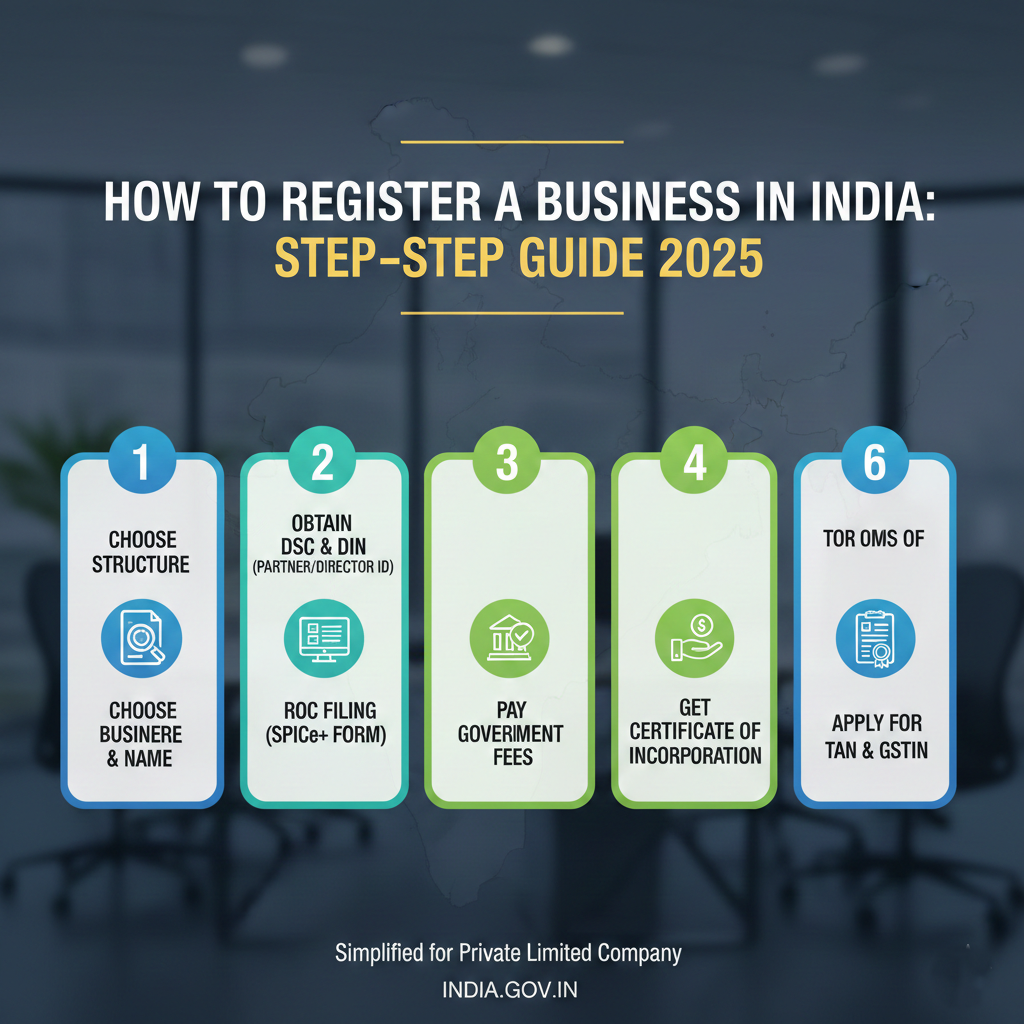
Step-by-Step Process to Register a Business in India
Let’s break down the process in a simple, practical way.
Step 1: Decide Your Business Name
Your business name should be:
- Unique
- Easy to remember
- Relevant to your services
- Not trademarked by another entity
For companies and LLPs, name approval is done via the MCA portal.
Step 2: Get Digital Signature Certificate (DSC)
A DSC is mandatory for online filing.
Who Needs DSC?
- Directors of companies
- Partners of LLPs
DSC is issued by government-approved certifying authorities and is usually valid for 2 years.
Step 3: Apply for Director Identification Number (DIN)
DIN is required for anyone becoming a director in a company.
- Applied through SPICe+ form
- Allotted by MCA
- Lifetime validity
Step 4: Register on MCA Portal
For Private Limited Company, OPC, and LLP, registration is done on the Ministry of Corporate Affairs (MCA) portal.
Key Forms Used
- SPICe+ (Company registration)
- RUN (Name reservation)
- FiLLiP (LLP registration)
Step 5: Draft MOA and AOA
- MOA (Memorandum of Association): Defines business objectives
- AOA (Articles of Association): Internal rules and management
These are digitally submitted during incorporation.
Step 6: Get Certificate of Incorporation
Once approved, MCA issues:
- Certificate of Incorporation
- Company Identification Number (CIN)
- PAN and TAN
This confirms your business is legally registered.
Registering a Sole Proprietorship in India
Sole proprietorship does not have a single registration law, but it is recognized through licenses.
Ways to Register a Sole Proprietorship
- GST Registration
- MSME (Udyam) Registration
- Shop & Establishment License
- Current Account Opening
This is the easiest and cheapest way to start a business in India.
GST Registration for Businesses in India
GST registration is mandatory if:
- Turnover exceeds ₹20 lakh (₹10 lakh for special states)
- You sell online
- You do inter-state trade
Benefits of GST Registration
- Input tax credit
- Legal invoicing
- Better business credibility
MSME (Udyam) Registration
Udyam registration is free and provides government benefits.
MSME Benefits
- Subsidized loans
- Lower interest rates
- Priority in government tenders
- Protection against delayed payments
Cost of Business Registration in India
Costs depend on business type and professional fees.
| Business Type | Approx Cost (₹) |
|---|---|
| Sole Proprietorship | 1,000 – 3,000 |
| Partnership Firm | 3,000 – 6,000 |
| LLP | 7,000 – 15,000 |
| Private Limited Company | 8,000 – 25,000 |
Government fees may vary by state and capital amount.
Time Required for Business Registration
| Business Type | Time Required |
|---|---|
| Sole Proprietorship | 1–3 days |
| Partnership | 3–5 days |
| LLP | 7–10 days |
| Private Limited Company | 7–12 days |
Common Mistakes to Avoid During Registration
- Choosing wrong business structure
- Using a trademarked name
- Incorrect documents or address proof
- Ignoring GST and compliance needs
- Not opening a separate business bank account
Avoiding these mistakes saves time, money, and legal trouble.
Compliance After Business Registration
Registration is just the beginning.
Ongoing Compliance Includes
- GST returns
- Income tax returns
- Annual ROC filings
- Accounting and bookkeeping
- Renewals of licenses
Using professional help ensures compliance and peace of mind.
Online vs Offline Business Registration
Online Registration Advantages
- Faster processing
- Transparent tracking
- Lower cost
- No physical visits
Offline registration is mostly outdated and used only in specific cases.
FAQs: Business Registration in India
Is business registration mandatory in India?
Yes, if you want legal recognition, tax compliance, and long-term growth.
Can I register a business from home?
Yes, home address can be used as business address.
Can foreigners register a business in India?
Yes, subject to FDI rules and approvals.
Do I need GST for a small business?
Only if turnover crosses threshold or business falls under mandatory GST category.
What is the cheapest business to register?
Sole proprietorship is the cheapest and fastest.
Conclusion: Start Your Business the Right Way
Registering a business in India is no longer complex, but choosing the right structure and completing proper registration is critical for success.
Whether you’re starting small or planning big, legal registration:
- Builds trust
- Protects your brand
- Enables growth
If you’re serious about entrepreneurship, don’t delay business registration. Start today, follow the right steps, and build a legally strong foundation for your future.
👉 Need help with business registration, GST, or compliance? Consult a professional and register your business hassle-free today.
