

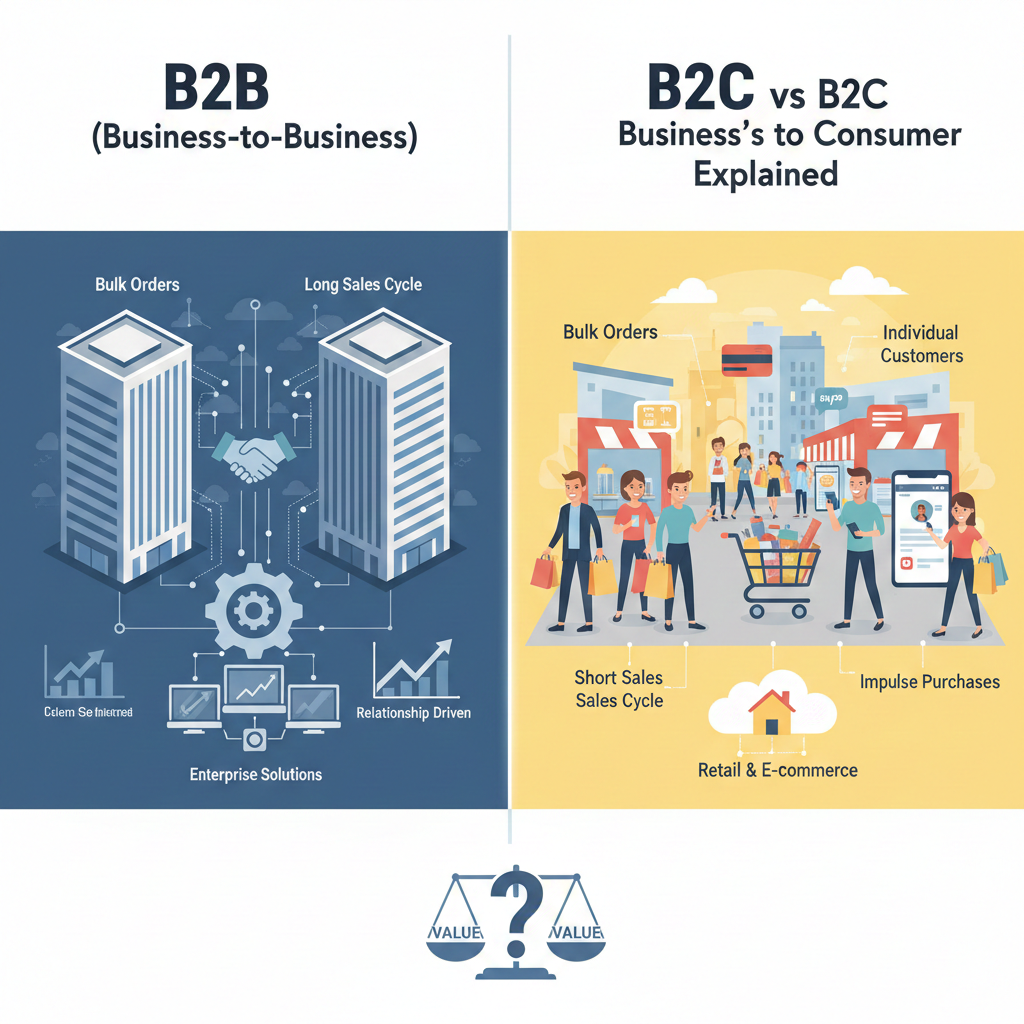
Choosing the right business model is one of the most important decisions any entrepreneur or company can make. Whether you’re launching a startup, scaling an existing company, or simply trying to understand how modern businesses work, the debate around B2B vs B2C business models is impossible to ignore.
At its core, the difference is simple:
- B2B (Business-to-Business) sells products or services to other businesses.
- B2C (Business-to-Consumer) sells directly to individual customers.
But in practice, the differences go far deeper—covering sales cycles, marketing strategies, customer behavior, pricing, relationships, and long-term growth potential.
In this in-depth guide, we’ll break down B2B vs B2C business models in a clear, human, and practical way. By the end, you’ll understand how each model works, their advantages and challenges, real-world examples, and how to decide which model is right for your business.
What Is a B2B Business Model?
A B2B (Business-to-Business) business model involves selling products or services from one business to another business. The buyer is not an individual consumer but an organization, company, or institution.
B2B companies usually focus on solving operational, financial, or strategic problems for other businesses.
Common B2B Examples
- Software companies selling ERP, CRM, or accounting tools
- Marketing agencies serving brands and enterprises
- Manufacturers supplying raw materials or components
- IT service providers working with government or corporate clients
- Wholesalers supplying retailers
Well-known B2B brands include Salesforce, Microsoft, SAP, IBM, Oracle, and HubSpot.
How B2B Businesses Operate
B2B transactions are typically:
- High-value
- Long-term
- Relationship-driven
- Logic-based rather than emotional
Decision-making often involves multiple stakeholders such as managers, finance teams, procurement officers, and executives.
What Is a B2C Business Model?
A B2C (Business-to-Consumer) business model focuses on selling products or services directly to individual consumers for personal use.
This is the most familiar business model, as it includes everyday purchases made by people around the world.
Common B2C Examples
- E-commerce stores selling fashion, electronics, or groceries
- Food delivery and ride-hailing apps
- Streaming platforms and mobile apps
- Retail brands and D2C startups
- Online education platforms
Popular B2C brands include Amazon, Netflix, Apple, Flipkart, Swiggy, Nike, and Spotify.
How B2C Businesses Operate
B2C transactions are usually:
- Lower in value per transaction
- High in volume
- Emotion-driven
- Fast decision-making
Customers often make buying decisions quickly, influenced by branding, pricing, convenience, and emotional appeal.
Core Differences Between B2B and B2C Business Models
Understanding the differences between B2B and B2C helps clarify why marketing, sales, and growth strategies vary so much.
Target Audience
- B2B: Companies, enterprises, institutions
- B2C: Individual consumers
Decision-Making Process
- B2B: Rational, data-driven, multi-level approvals
- B2C: Emotional, impulse-driven, individual choice
Sales Cycle Length
- B2B: Long (weeks to months)
- B2C: Short (minutes to days)
Purchase Motivation
- B2B: ROI, efficiency, scalability, problem-solving
- B2C: Desire, lifestyle, comfort, price, brand trust
B2B vs B2C Comparison Table
| Factor | B2B Business Model | B2C Business Model |
|---|---|---|
| Customer Type | Businesses & organizations | Individual consumers |
| Sales Cycle | Long and complex | Short and quick |
| Purchase Value | High-value contracts | Lower-value purchases |
| Marketing Focus | Logic, ROI, expertise | Emotion, brand, offers |
| Customer Relationship | Long-term partnerships | Short-term or repeat buys |
| Pricing Strategy | Negotiated, customized | Fixed or promotional |
| Volume | Low volume, high value | High volume, low value |
B2B Marketing Strategy Explained
B2B marketing is all about trust, authority, and long-term value. Businesses don’t buy impulsively—they research, compare, and evaluate thoroughly.
Key B2B Marketing Channels
- Content marketing (blogs, whitepapers, case studies)
- LinkedIn marketing and professional networks
- Email marketing and lead nurturing
- Webinars and product demos
- SEO for high-intent keywords
What Works Best in B2B Marketing
- Educational content that solves problems
- Clear value propositions and ROI explanations
- Proof through case studies and testimonials
- Personalized communication
B2B buyers want to know:
“How will this help my business make or save money?”
B2C Marketing Strategy Explained
B2C marketing focuses on emotion, attention, and instant gratification. Consumers want quick answers and compelling reasons to buy now.
Key B2C Marketing Channels
- Social media marketing (Instagram, Facebook, YouTube)
- Influencer marketing
- Paid ads and retargeting
- Email and SMS campaigns
- Brand storytelling
What Works Best in B2C Marketing
- Eye-catching visuals and videos
- Emotional storytelling
- Discounts, offers, and urgency
- Simple messaging and fast checkout
B2C buyers often think:
“I like this. I want this. I’ll buy this.”
Pricing Strategies in B2B vs B2C
Pricing is another major difference between the two models.
B2B Pricing Approach
- Customized pricing
- Contract-based billing
- Subscription or licensing models
- Volume discounts
- Long-term agreements
B2B pricing reflects value, scale, and long-term impact.
B2C Pricing Approach
- Fixed pricing
- Competitive discounts
- Psychological pricing (₹999 instead of ₹1000)
- Seasonal sales and flash deals
B2C pricing focuses on affordability and perception.
Customer Relationships and Retention
B2B Customer Relationships
B2B businesses prioritize:
- Account management
- Long-term retention
- Dedicated support teams
- Regular performance reviews
Losing one B2B client can mean a significant revenue drop, so relationships matter deeply.
B2C Customer Relationships
B2C relationships are:
- Transaction-based
- Brand-loyalty driven
- Influenced by experience and convenience
Retention strategies include loyalty programs, offers, and personalized recommendations.
Advantages of the B2B Business Model
- Higher average order value
- Predictable and recurring revenue
- Strong customer loyalty
- Lower churn when trust is built
- Easier upselling and cross-selling
B2B businesses scale steadily and sustainably when done right.
Advantages of the B2C Business Model
- Large customer base
- Faster sales cycles
- Strong brand recognition potential
- Easier market entry
- High scalability through digital platforms
B2C businesses can grow rapidly with the right marketing and product-market fit.
Challenges in B2B and B2C Models
Common B2B Challenges
- Long sales cycles
- Complex decision-making
- High customer acquisition cost
- Customization demands
Common B2C Challenges
- Intense competition
- Low customer loyalty
- Price sensitivity
- High marketing spend
Understanding these challenges helps businesses prepare better strategies.
Can a Business Be Both B2B and B2C?
Yes, many companies successfully operate in both B2B and B2C models.
Hybrid Business Model Examples
- Software companies offering enterprise plans and personal subscriptions
- Manufacturers selling to wholesalers and directly to consumers
- Education platforms serving institutions and individual learners
A hybrid model increases revenue streams but requires clear segmentation and strategy.
How to Choose Between B2B and B2C
Ask yourself these questions:
- Who is my ideal customer?
- Is my product solving a business problem or a personal need?
- Do I prefer long-term contracts or quick sales?
- What is my marketing budget and sales capacity?
Your answers will naturally guide you toward the right model.
Future Trends in B2B and B2C Business Models
- AI-driven personalization
- Subscription-based pricing growth
- Omnichannel customer experience
- Data-driven decision-making
- Blurred lines between B2B and B2C
Digital transformation is reshaping both models faster than ever.
Frequently Asked Questions (FAQs)
What is the main difference between B2B and B2C?
The main difference is the target customer. B2B sells to businesses, while B2C sells directly to individual consumers.
Which business model is more profitable?
Both can be profitable. B2B offers higher deal values and stability, while B2C offers scalability and volume-based profits.
Is B2B harder than B2C?
B2B is more complex due to longer sales cycles and multiple decision-makers, but it often results in stronger long-term relationships.
Can startups succeed in B2B?
Absolutely. Many successful startups begin as B2B companies by solving specific industry problems.
Which model is better for online businesses?
Both work well online. SaaS and services thrive in B2B, while e-commerce and apps excel in B2C.
Conclusion: Which Business Model Is Right for You?
There is no universal winner in the B2B vs B2C business models debate. Each model serves different purposes, audiences, and growth strategies.
If you enjoy building long-term relationships, solving complex problems, and working with organizations, B2B may be the perfect fit.
If you prefer fast-paced markets, creative branding, and mass audiences, B2C could be your ideal path.
The key is understanding your product, your customer, and your long-term vision.
Ready to choose the right business model or scale your existing one?
Start with clarity, invest in the right strategy, and build value that truly solves real problems.
