

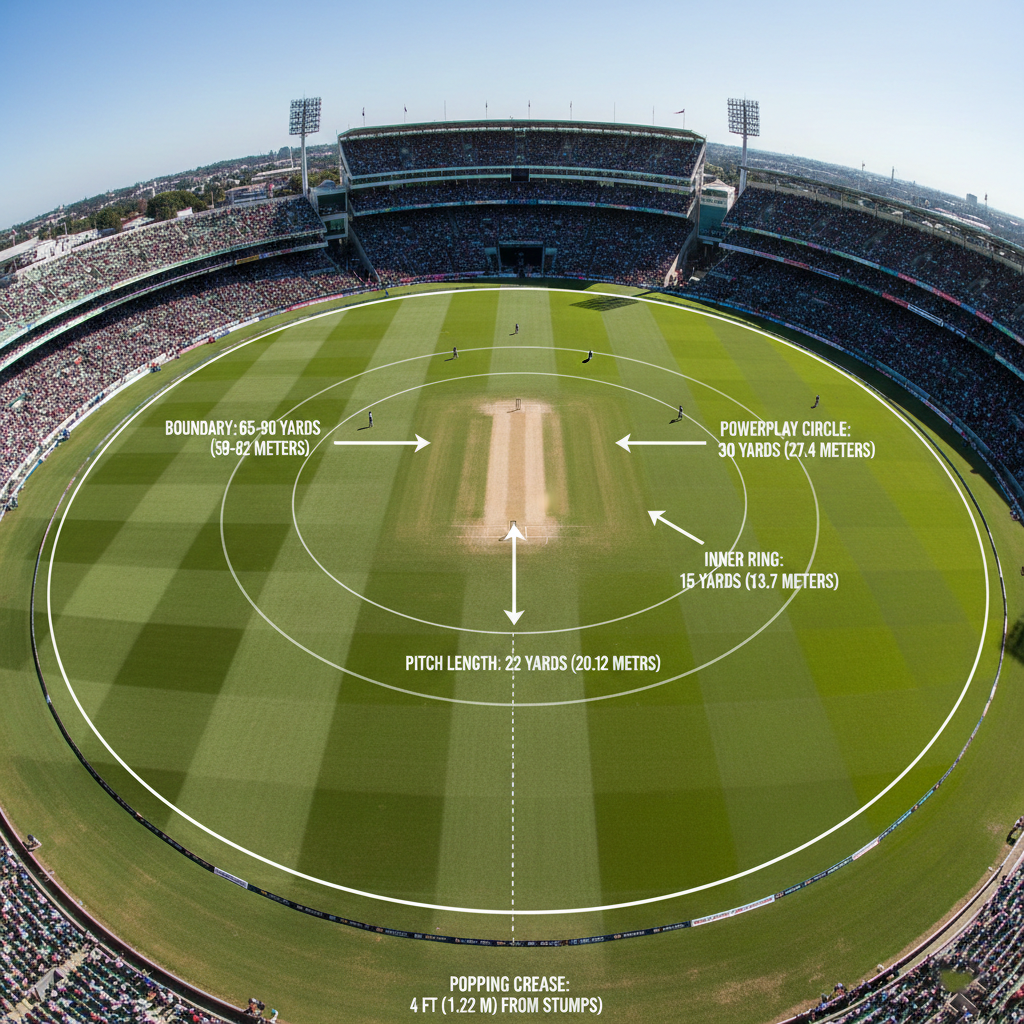
Cricket is a sport loved by millions worldwide, but have you ever wondered about the dimensions of a cricket ground and why they matter? Whether you’re a player, coach, or just a fan, understanding the layout of the field, boundary size, and pitch measurements is crucial for both gameplay and strategy. In this guide, we’ll break down everything you need to know about cricket ground dimensions in an easy-to-understand, professional, and SEO-friendly way.
Standard Cricket Ground Dimensions
The size of a cricket ground can vary depending on the level of play – international, domestic, or local clubs – but the International Cricket Council (ICC) provides guidelines for standard dimensions.
Boundary and Field Size
- Overall field diameter: 137–150 meters (450–490 feet)
- Boundary distance from pitch center: 59.43–82.29 meters (65–90 yards)
- Playing area shape: Usually oval, but can be circular depending on the stadium
| Feature | Standard Measurement |
|---|---|
| Pitch length | 22 yards (20.12 meters) |
| Pitch width | 10 feet (3.05 meters) |
| Inner circle (fielding) | 30-yard radius (27.43 meters) |
| Outer circle (fielding) | 50-yard radius (45.72 meters) |
| Boundary rope distance | 65–90 yards (59–82 meters) |
Tip: Ground dimensions impact strategies like hitting boundaries and bowling placements. Smaller grounds favor batsmen, while larger grounds give bowlers more room to control scoring.
Cricket Pitch Dimensions: The Heart of the Game
The cricket pitch is the central strip where the action happens. Its size and preparation can change the dynamics of a match.
Pitch Length and Width
- Length: 22 yards (20.12 meters)
- Width: 10 feet (3.05 meters)
- Material: Grass or synthetic surfaces, depending on level
Crease Markings
The pitch also features crucial lines known as creases:
- Bowling crease: The line where bowlers must deliver the ball.
- Popping crease: Determines if a batsman is in or out of the crease.
- Return crease: Guides the bowler’s delivery path.
| Crease Type | Distance from Bowling Stump |
|---|---|
| Bowling crease | 4 feet 0 inches |
| Popping crease | 4 feet in front of stumps |
| Return crease | 4 feet 4 inches from bowling crease |
Boundary Dimensions and Their Impact
The boundary distance is critical for scoring sixes and fours.
- Minimum boundary: 59.43 meters (65 yards)
- Maximum boundary: 82.29 meters (90 yards)
How boundary size affects the game:
- Smaller grounds → higher run rates, more sixes
- Larger grounds → bowlers dominate, batsmen rely on timing and placement
Fun fact: The Melbourne Cricket Ground (MCG) has a playing area of 160 meters by 141 meters, making it one of the largest international stadiums.
Oval vs Circular Cricket Grounds
Cricket grounds are usually oval, but some are circular. The shape impacts how players strategize:
Oval Grounds
- Longer boundaries on straight hits, shorter on sides
- Batsmen may target square areas for easier boundaries
Circular Grounds
- Equidistant boundaries make hitting consistently challenging
- Bowlers can set uniform field placements
Comparison Table:
| Feature | Oval Ground | Circular Ground |
|---|---|---|
| Boundary variation | High | Low |
| Strategy impact | Bowler vs batsman | Balanced |
| Common examples | Lord’s, Eden Gardens | Some club grounds |
How Pitch Orientation Affects Play
Pitch orientation isn’t random; it impacts sunlight, wind, and moisture, influencing the game:
- North-South orientation: Reduces sun glare for batsmen
- East-West orientation: Can cause visibility challenges in early or late hours
Tip: Stadium planners consider local weather, sun trajectory, and drainage while setting pitch orientation.
Domestic vs International Cricket Ground Standards
International stadiums follow strict ICC rules, whereas domestic or club grounds may adjust dimensions based on space and resources.
| Level | Field Diameter | Pitch Type | Notes |
|---|---|---|---|
| International | 137–150 m | Natural grass | Must meet ICC regulations |
| Domestic | 120–150 m | Grass or synthetic | Flexible boundaries |
| Club/School | 100–130 m | Mostly synthetic or turf | Adaptable to available space |
Frequently Asked Questions (FAQs)
Q1: What is the standard size of a cricket pitch?
A: A cricket pitch is 22 yards (20.12 meters) long and 10 feet (3.05 meters) wide, with creases clearly marked for gameplay.
Q2: How big is an international cricket ground?
A: Typically, the diameter ranges from 137 to 150 meters, with boundaries 59.43 to 82.29 meters from the pitch center.
Q3: Can cricket grounds be any shape?
A: Yes, but most international grounds are oval, while some club grounds may be circular or irregular depending on space.
Q4: Do pitch dimensions affect player performance?
A: Absolutely. Shorter pitches favor fast scoring, while longer or wider grounds benefit bowlers and fielders.
Q5: Why is the pitch orientation important?
A: Orientation affects sun glare, wind, and moisture, influencing visibility and ball movement for both batsmen and bowlers.
Conclusion
Understanding cricket ground dimensions is essential for players, coaches, and fans. From pitch length and boundary size to ground shape and orientation, every measurement influences strategy, gameplay, and scoring potential. Whether you’re designing a new ground or playing in one, knowing these details gives you an edge.
Ready to take your cricket knowledge further? Explore our expert guides on stadium design, pitch preparation, and boundary strategy to dominate the game both on and off the field!
