

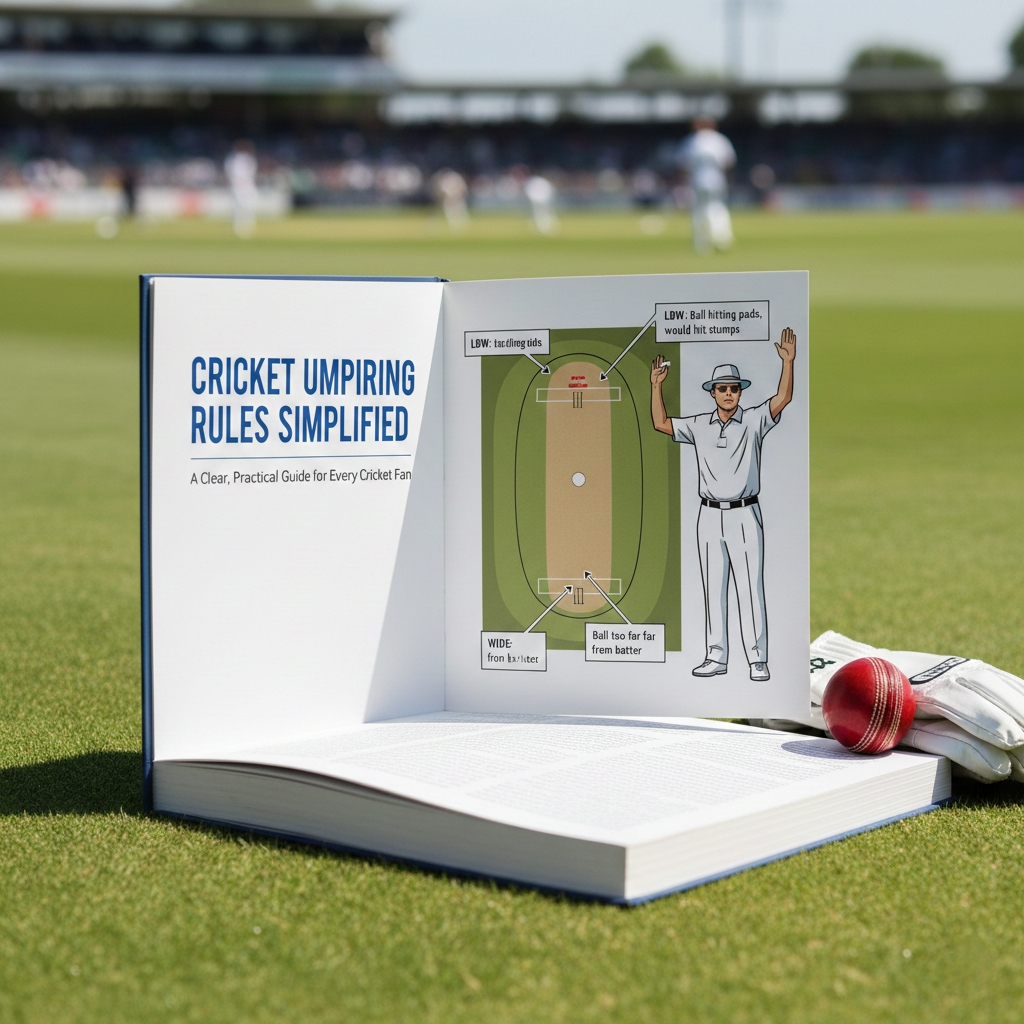
Understanding Cricket Umpiring Without the Confusion
Cricket is a game of skill, patience, and strategy—but for many fans and beginners, cricket umpiring rules can feel confusing and complex. Why was that out given? How is a no-ball different from a wide? What exactly does the third umpire check?
This article on Cricket Umpiring Rules Simplified breaks everything down in plain English. Whether you’re a casual viewer, a budding cricketer, a school coach, or someone preparing for umpire exams, this guide will help you understand how umpires think, judge, and make decisions—without jargon or unnecessary complexity.
We’ll walk through on-field rules, off-field technology, common signals, and modern updates like DRS, all in an easy-to-read, mobile-friendly format.
What Is the Role of an Umpire in Cricket?
An umpire is the official authority responsible for ensuring fair play and enforcing the Laws of Cricket during a match.
Core Responsibilities of a Cricket Umpire
- Apply the Laws of Cricket accurately
- Make decisions on dismissals
- Monitor fair delivery (no-balls, wides)
- Control player conduct and game flow
- Ensure safety and spirit of the game
In professional cricket, umpires are trained, certified, and assessed regularly to maintain high standards.
Types of Umpires in Modern Cricket Matches
Cricket today uses a team of officials, not just one or two umpires.
On-Field Umpires
- Two umpires stand on the field
- One at the bowler’s end
- One at square leg
- They make most real-time decisions
Third Umpire
- Off-field official with video access
- Assists with close calls
- Uses slow motion, zoom, and multiple angles
Fourth Umpire
- Manages off-field duties
- Handles player equipment, drinks, substitutions
- Acts as reserve umpire
Match Referee (Not an Umpire)
- Oversees discipline and match conduct
- Ensures rules and code of conduct are followed
Basic Cricket Umpiring Rules Everyone Should Know
Let’s simplify the most common and important rules that umpires enforce during a match.
Legal and Illegal Deliveries Explained Simply
What Is a Legal Ball?
A legal delivery must:
- Be bowled with a straight arm
- Not exceed waist height (full toss)
- Stay within the pitch and crease limits
- Not bounce more than once before reaching the batter
What Is a No-Ball?
A no-ball is an illegal delivery. Common reasons include:
- Front foot crossing the popping crease
- Full toss above waist height
- Dangerous short-pitched bowling
- Throwing (bent arm)
Penalty:
- 1 extra run
- Free hit in limited-overs formats
What Is a Wide Ball?
A wide is called when the ball is too far from the batter to play a normal cricket shot.
Key Wide Ball Judging Factors
- Batter’s position at delivery
- Format of the game (ODI, T20 stricter)
- Line of delivery (off-side or leg-side)
Penalty:
- 1 extra run
- Ball must be re-bowled
Understanding Dismissal Rules in Simple Language
There are 10 official ways a batter can be out. Here are the most common ones umpires deal with.
Bowled
- Ball hits the stumps
- Bails are dislodged
- Simple and undisputed
Caught
- Ball touched by the bat or glove
- Fielder catches it cleanly
- No bounce before the catch
Leg Before Wicket (LBW) – Made Easy
LBW is often the most confusing decision.
LBW Is Given When:
- Ball hits the pad first
- Ball would hit the stumps
- Impact is in line with stumps (or off-stump)
- Batter is not offering a genuine shot (outside off)
Technology now helps umpires with LBW decisions through DRS.
Run Out
- Batter is outside the crease
- Wicket is broken by the fielding side
- Ball does not need to hit the bat
Stumped
- Batter steps out of crease
- Misses the ball
- Wicketkeeper breaks the stumps
Role of the Third Umpire and Technology
Modern cricket relies heavily on technology to support umpiring decisions.
When the Third Umpire Is Used
- Run-out checks
- Stumping decisions
- Boundary confirmations
- Catch fairness
- No-ball foot faults (in international cricket)
Decision Review System (DRS) Simplified
DRS allows teams to challenge on-field umpire decisions.
Tools Used in DRS
| Technology | Purpose |
|---|---|
| Hawk-Eye | Ball tracking (LBW) |
| UltraEdge | Detects bat-pad contact |
| Hot Spot | Heat detection |
| Slow Motion | Visual confirmation |
Review Rules
- Limited reviews per innings
- Umpire’s call stands if marginal
- Used only for dismissals
Common Umpire Signals and Their Meanings
Understanding umpire signals enhances the viewing experience.
Important Cricket Umpire Signals
- Out: Raised index finger
- No-ball: Arm stretched horizontally
- Wide: Both arms extended
- Six: Both arms raised straight
- Four: Arm waved horizontally
- Dead Ball: Crossed arms
Code of Conduct and Player Discipline
Umpires also enforce discipline during the match.
What Umpires Monitor
- Excessive appealing
- Verbal abuse
- Slow over rates
- Ball tampering
- Unsporting behavior
Penalties can include warnings, penalty runs, or reporting to the match referee.
Differences Between On-Field and TV Decisions
Sometimes viewers feel umpires are “wrong,” but real-time decisions differ from TV replays.
Why This Happens
- Umpires judge in real speed
- TV viewers see slow motion
- Laws favor on-field calls in close cases
- “Umpire’s Call” protects original decision
Umpiring Rules Across Formats (Test, ODI, T20)
While the core laws remain the same, application varies.
| Rule Area | Test Cricket | ODI | T20 |
|---|---|---|---|
| DRS | Limited | Limited | Limited |
| Wide Lines | Lenient | Moderate | Strict |
| Over Rate | Relaxed | Penalized | Highly strict |
| Free Hit | No | Yes | Yes |
How to Become a Cricket Umpire (Brief Overview)
If you’re interested in umpiring:
- Learn Laws of Cricket
- Join local cricket association
- Clear written and practical exams
- Start with school or club matches
- Gain experience and certification
FAQs: Cricket Umpiring Rules Simplified
Who has the final authority in a cricket match?
The on-field umpires have the final authority. Third umpire and technology assist but do not replace them.
Can umpires change their decision?
Yes, if they receive new information immediately (e.g., from the other umpire or third umpire).
What is umpire’s call in DRS?
If technology shows a marginal decision, the original on-field call remains unchanged.
Are umpiring rules same at school and international level?
The core laws are the same, but technology usage and strictness vary.
Why do umpires sometimes ignore player appeals?
Appeals do not decide dismissals. Umpires rely on their judgment and the laws.
Conclusion: Why Understanding Umpiring Rules Makes You a Smarter Cricket Fan
Cricket umpiring is not about guesswork—it’s about precision, consistency, and fairness. By understanding cricket umpiring rules in a simplified way, you gain deeper respect for the officials and enjoy the game with better clarity.
Whether you’re watching a high-pressure international match or a local school game, knowing how umpires think and decide adds a whole new layer to your cricket experience.
Want more easy-to-understand cricket guides, rules, and insights?
Bookmark this page, share it with fellow cricket lovers, and explore more expert-written sports content to stay ahead of the game. 🏏
