
Why the Global Economy Is Slowing Down
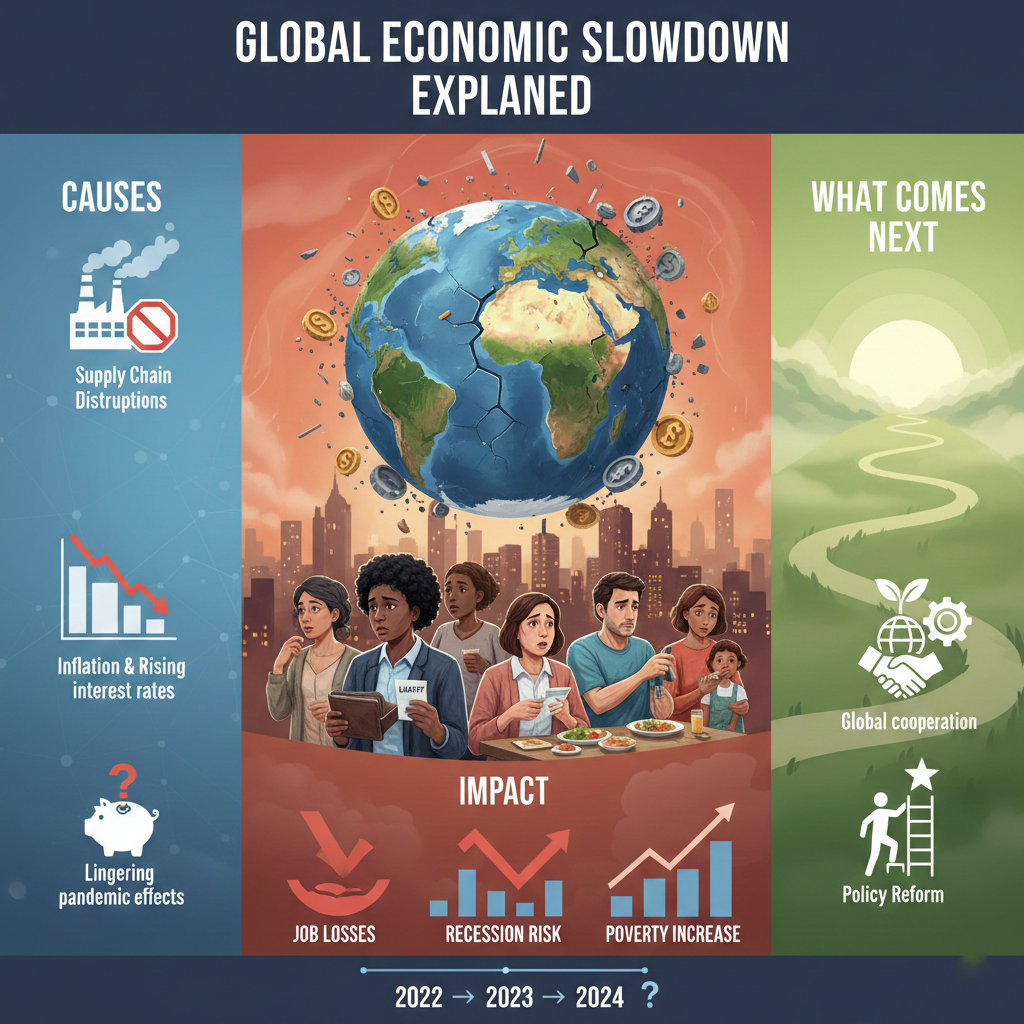
The global economic slowdown is no longer just a headline—it’s something people feel in daily life. Rising prices, job uncertainty, weaker business growth, and cautious spending are clear signs that the world economy is under pressure.
From the United States and Europe to Asia and emerging markets, growth has slowed across major economies. While recessions are nothing new, the current slowdown is unique because it is driven by multiple overlapping crises—inflation, geopolitical tensions, high interest rates, and post-pandemic disruptions.
In this article, we’ll break down the global economic slowdown in clear, human language. You’ll understand what’s happening, why it matters, how it affects you, and what may come next.
What Is a Global Economic Slowdown?
A global economic slowdown refers to a broad and sustained reduction in economic growth across multiple countries. It does not always mean a full recession, but it signals weaker production, lower trade activity, slower job creation, and reduced consumer spending worldwide.
Key characteristics of an economic slowdown
- GDP growth falls below long-term averages
- Businesses delay investments and hiring
- Consumer confidence weakens
- Trade volumes decline
- Governments face fiscal pressure
Unlike a recession, which is often sharp and sudden, a slowdown can be gradual but long-lasting.
Major Causes of the Global Economic Slowdown
The current slowdown is not caused by a single event. Instead, it is the result of several interconnected global forces.
High Inflation Across Major Economies
Inflation surged after the COVID-19 pandemic due to:
- Supply chain disruptions
- Excess liquidity from stimulus packages
- Rising energy and food prices
Even as inflation cools in some countries, prices remain much higher than pre-pandemic levels, reducing purchasing power.
Aggressive Interest Rate Hikes
To fight inflation, central banks raised interest rates rapidly.
| Central Bank | Peak Rate Trend |
|---|---|
| US Federal Reserve | Multi-decade highs |
| European Central Bank | Fastest hikes in history |
| Bank of England | Tight monetary stance |
| Emerging Markets | Defensive rate increases |
Higher interest rates:
- Make loans expensive
- Reduce housing and business investment
- Slow consumer spending
Geopolitical Conflicts and Global Uncertainty
Wars and political tensions disrupt global trade and energy markets.
Key impacts include:
- Higher oil and gas prices
- Sanctions affecting global supply chains
- Reduced foreign investment
- Increased defense spending over development
Economic confidence weakens when uncertainty rises.
Weak Global Trade and Manufacturing
Global trade growth has slowed significantly due to:
- Protectionist policies
- Reduced demand in developed economies
- Shifting supply chains away from efficiency to security
Manufacturing-heavy economies feel the impact first, but services follow.
Debt Pressure in Developing and Advanced Economies
Public and private debt levels are at historic highs.
- Governments face higher borrowing costs
- Corporations struggle to refinance debt
- Developing nations face currency pressure
This limits spending on infrastructure, healthcare, and social programs.
How the Global Economic Slowdown Affects Different Regions
United States
The US economy remains resilient but slower.
- Consumer spending is moderating
- Job growth is cooling
- Housing activity remains weak
- Businesses are cautious on expansion
While a deep recession may be avoided, growth is clearly decelerating.
Europe
Europe faces stronger headwinds due to:
- Energy dependency
- Aging population
- Tighter financial conditions
Several European economies are flirting with stagnation or mild recession.
China
China’s slowdown has global implications.
- Weak property sector
- Lower export demand
- Slowing consumer confidence
As the world’s manufacturing hub, China’s performance directly impacts global supply chains.
Emerging Markets
Emerging economies face mixed outcomes.
Challenges
- Currency depreciation
- High external debt
- Capital outflows
Opportunities
- Domestic consumption growth
- Digital transformation
- Manufacturing diversification
Impact on Businesses and Industries
Small and Medium Businesses
SMEs are among the most affected.
- Higher borrowing costs
- Reduced customer demand
- Cash flow pressure
Many delay hiring or expansion plans.
Large Corporations
Even large firms are tightening budgets.
- Cost-cutting initiatives
- Hiring freezes
- Reduced capital expenditure
Profit margins are under pressure across sectors.
Sector-wise Impact
| Sector | Impact Level |
|---|---|
| Technology | Moderate to high |
| Real Estate | High |
| Manufacturing | High |
| Healthcare | Low |
| Energy | Mixed |
| FMCG | Moderate |
How the Slowdown Impacts Jobs and Income
A global economic slowdown often leads to labor market softening.
Employment trends
- Slower hiring
- Rise in contract and gig work
- Reduced wage growth
While mass layoffs may not happen everywhere, job security becomes weaker.
Income pressure
- Real wages struggle to keep up with inflation
- Household savings decline
- Lifestyle expenses increase
This reduces discretionary spending, creating a feedback loop that slows growth further.
Effect on Inflation, Interest Rates, and Cost of Living
Inflation outlook
Inflation may fall, but not return quickly to old lows.
- Food and energy remain volatile
- Services inflation stays sticky
- Housing costs remain elevated
Interest rate future
Central banks are cautious.
- Rate cuts may come slowly
- Financial conditions remain tight
- Borrowing stays expensive
Cost of living reality
Consumers face:
- Higher grocery bills
- Rising healthcare costs
- Expensive education and housing
Global Economic Slowdown vs Global Recession
| Factor | Slowdown | Recession |
|---|---|---|
| Growth | Low but positive | Negative |
| Duration | Longer, gradual | Shorter, sharper |
| Employment | Weak growth | Job losses |
| Consumer sentiment | Cautious | Pessimistic |
A slowdown can turn into a recession if shocks intensify.
How Governments and Central Banks Are Responding
Monetary policy actions
- Slowing rate hikes
- Monitoring inflation trends
- Liquidity support if needed
Fiscal policy measures
- Targeted subsidies
- Infrastructure spending
- Support for vulnerable groups
However, high debt limits aggressive government action.
What Can Individuals Do During an Economic Slowdown?
Smart financial moves
- Build emergency savings
- Reduce unnecessary debt
- Avoid risky investments
Career strategies
- Upskill in demand areas
- Maintain job flexibility
- Build multiple income streams
Business adaptation
- Focus on efficiency
- Strengthen customer relationships
- Control operating costs
Future Outlook: How Long Will the Slowdown Last?
Most economists expect the global economic slowdown to persist for the next 12–24 months, though severity will vary by region.
Positive signals
- Inflation gradually easing
- Supply chains stabilizing
- Technological innovation
Risk factors
- New geopolitical conflicts
- Financial market shocks
- Climate-related disruptions
The recovery is likely to be slow and uneven, not a quick rebound.
Frequently Asked Questions (FAQs)
What is the main reason for the global economic slowdown?
The slowdown is caused by high inflation, rising interest rates, geopolitical tensions, weak trade, and high global debt levels.
Is a global recession coming?
A global recession is possible but not guaranteed. Many economies are slowing but still growing modestly.
How does a global economic slowdown affect common people?
It leads to higher living costs, slower job growth, reduced income growth, and cautious spending.
Which countries are most affected?
Europe, China, and heavily indebted emerging markets face greater challenges, while some economies remain relatively resilient.
When will the global economy recover?
Most forecasts suggest gradual improvement over the next two years, depending on inflation control and global stability.
Conclusion: Preparing for a Slower Global Economy
The global economic slowdown is a reality shaped by complex global forces. While it brings challenges—higher costs, slower growth, and uncertainty—it also encourages smarter decision-making, efficiency, and long-term resilience.
For individuals, businesses, and policymakers, this period is about adaptation, not panic. Those who plan carefully, stay informed, and invest in skills and sustainability will be best positioned for the recovery.
Stay informed, stay prepared, and make strategic financial and career choices today to stay ahead tomorrow.
