

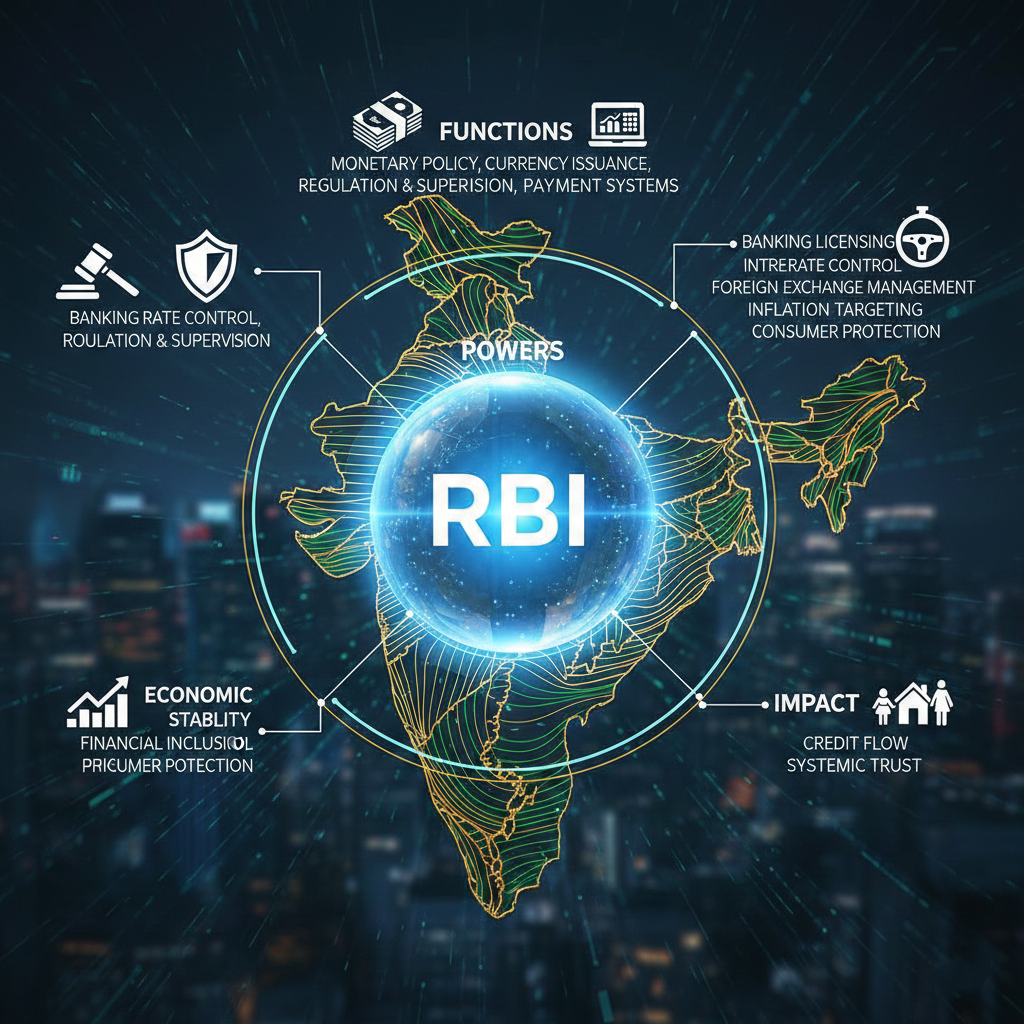
Why the RBI Matters to Every Indian
The Reserve Bank of India (RBI) plays a central role in shaping the Indian economy. Whether you are a business owner, salaried professional, student, investor, or farmer, RBI decisions directly or indirectly affect your daily life. From interest rates on loans and savings to inflation control, digital payments, and banking safety, the RBI acts as the backbone of India’s financial system.
Established in 1935, the RBI is India’s central bank and the primary authority responsible for regulating money supply, maintaining financial stability, and ensuring economic growth. In simple words, the RBI keeps the economy balanced—neither overheating nor slowing down too much.
This article explains the role of RBI in the Indian economy in a clear, human, and practical way—covering its functions, tools, impact, challenges, and future outlook.
What Is the Reserve Bank of India?
The Reserve Bank of India is the central monetary authority of the country, operating under the Reserve Bank of India Act, 1934. It started functioning on April 1, 1935, and was nationalized in 1949.
Basic Details of RBI
| Aspect | Details |
|---|---|
| Full Form | Reserve Bank of India |
| Established | 1935 |
| Headquarters | Mumbai |
| Governor | Appointed by Government of India |
| Legal Framework | RBI Act, 1934 |
| Regulator of | Banks, NBFCs, payment systems |
Core Objectives of RBI in the Indian Economy
The RBI does not work for profit. Its objectives are focused on long-term economic stability and public interest.
Main Objectives of RBI
- Price stability (controlling inflation)
- Economic growth with financial discipline
- Financial system stability
- Trust in Indian currency
- Efficient payment and settlement systems
- Financial inclusion and access to banking
These objectives guide every policy decision taken by the RBI.
RBI as the Controller of Monetary Policy
One of the most important roles of RBI in the economy is designing and implementing monetary policy.
What Is Monetary Policy?
Monetary policy refers to the actions taken by the RBI to regulate:
- Money supply
- Credit availability
- Interest rates
The goal is to control inflation while supporting economic growth.
Monetary Policy Committee (MPC)
Since 2016, monetary policy decisions are taken by the Monetary Policy Committee, which includes:
- RBI Governor (Chairperson)
- RBI officials
- External experts
The MPC meets every two months to decide key interest rates.
Tools Used by RBI to Manage the Economy
The RBI uses several monetary tools to influence liquidity and inflation.
Key Monetary Policy Instruments
Repo Rate
- Rate at which RBI lends money to commercial banks
- Lower repo rate → cheaper loans → more spending
- Higher repo rate → costlier loans → controlled inflation
Reverse Repo Rate
- Rate at which RBI borrows money from banks
- Helps absorb excess liquidity from the system
Cash Reserve Ratio (CRR)
- Portion of bank deposits kept with RBI
- Higher CRR reduces banks’ lending capacity
Statutory Liquidity Ratio (SLR)
- Percentage of deposits banks must keep in safe assets
- Ensures liquidity and stability
Open Market Operations (OMO)
- Buying or selling government securities
- Used to control money supply
RBI as the Issuer of Currency
Another vital role of RBI in the economy is issuing and managing currency.
Currency Management Functions
- Designs and issues banknotes
- Ensures adequate supply of clean currency
- Withdraws damaged and counterfeit notes
- Maintains public confidence in Indian Rupee
Note: Coins are issued by the Government of India, but RBI manages their circulation.
RBI as the Banker to the Government
The RBI acts as the banker, agent, and advisor to both the Central and State Governments.
Government Banking Functions
- Maintains government accounts
- Manages public debt
- Conducts treasury bill auctions
- Handles government payments and receipts
- Advises on economic and financial policies
This role helps the government run its finances smoothly.
RBI as the Banker’s Bank
Commercial banks depend on RBI for financial support and regulation.
Support Provided to Banks
- Acts as lender of last resort
- Provides emergency liquidity
- Offers refinance facilities
- Ensures discipline through supervision
This ensures that banks remain stable even during economic stress.
RBI as the Regulator and Supervisor of Banks
A stable banking system is critical for a strong economy. RBI ensures this through strict regulation.
RBI’s Regulatory Powers
- Licensing of banks
- Setting capital adequacy norms
- Monitoring NPAs (bad loans)
- Conducting inspections and audits
- Enforcing compliance and penalties
RBI regulates:
- Public and private sector banks
- Cooperative banks
- NBFCs
- Payment banks and small finance banks
RBI’s Role in Controlling Inflation
Inflation directly affects purchasing power. RBI plays a key role in keeping inflation under control.
Inflation Targeting Framework
- RBI follows a 4% inflation target (±2%)
- Uses interest rates and liquidity tools
- Balances growth and price stability
By controlling inflation, RBI protects:
- Savings of citizens
- Cost of living
- Economic confidence
RBI and Financial Stability
Financial crises can damage the economy for years. RBI works proactively to prevent such situations.
Measures for Financial Stability
- Stress testing of banks
- Early warning systems
- Regulation of risky lending
- Crisis management frameworks
The RBI played a critical role during:
- 2008 global financial crisis
- COVID-19 pandemic economic slowdown
RBI and Financial Inclusion in India
One of the modern roles of RBI in the economy is promoting financial inclusion.
Key Initiatives Supported by RBI
- Jan Dhan Yojana
- UPI and digital payments
- Basic savings bank accounts
- Priority sector lending
- Financial literacy programs
These efforts bring banking services to rural and underserved populations.
RBI and Digital Payments Revolution
India’s digital payment success is strongly supported by RBI.
RBI’s Role in Digital Economy
- Regulates UPI, NEFT, RTGS
- Ensures cybersecurity standards
- Oversees payment service providers
- Promotes cashless transactions
India is now among the world leaders in real-time digital payments.
RBI’s Role in Economic Growth
While controlling inflation, RBI also supports economic expansion.
Growth-Oriented Measures
- Credit flow to MSMEs
- Lower interest rates during slowdowns
- Special liquidity windows
- Support to priority sectors
RBI ensures that growth remains sustainable and inclusive.
RBI vs Government: How Are They Different?
| Aspect | RBI | Government |
|---|---|---|
| Nature | Independent authority | Political body |
| Main Role | Monetary policy | Fiscal policy |
| Controls | Money supply | Taxation & spending |
| Focus | Stability & inflation | Development & welfare |
Both work together but have clearly defined roles.
Challenges Faced by RBI in the Modern Economy
Despite its strong framework, RBI faces several challenges.
Major Challenges
- Balancing inflation and growth
- Regulating fintech and crypto risks
- Managing global economic shocks
- Banking sector stress
- Climate-related financial risks
RBI continuously updates policies to address these issues.
Future Role of RBI in India’s Economy
As India grows into a global economic power, RBI’s role will become even more important.
Expected Focus Areas
- Central Bank Digital Currency (CBDC)
- Stronger cyber security
- Climate finance regulation
- Deeper financial inclusion
- Smarter monetary tools
The RBI is evolving with the economy.
Frequently Asked Questions (FAQs)
What is the main role of RBI in the economy?
The main role of RBI is to maintain monetary stability, control inflation, regulate banks, and ensure smooth economic growth.
How does RBI control inflation?
RBI controls inflation mainly through interest rates, liquidity management, and monetary policy tools like repo rate and CRR.
Is RBI independent from the government?
Yes, RBI is operationally independent, though it works closely with the Government of India.
Who controls RBI?
RBI is governed by a Central Board of Directors and operates under the RBI Act, 1934.
Why is RBI called the banker’s bank?
Because commercial banks keep reserves with RBI and borrow from it during financial needs.
Conclusion: Why RBI Is the Pillar of India’s Economy
The role of RBI in the Indian economy is deep, dynamic, and indispensable. From managing inflation and regulating banks to supporting growth and promoting digital payments, RBI ensures economic stability and public trust.
Without RBI’s strong policies and oversight, India’s financial system would be vulnerable to crises and instability. As the economy evolves, the RBI continues to adapt, innovate, and safeguard the nation’s financial future.
