
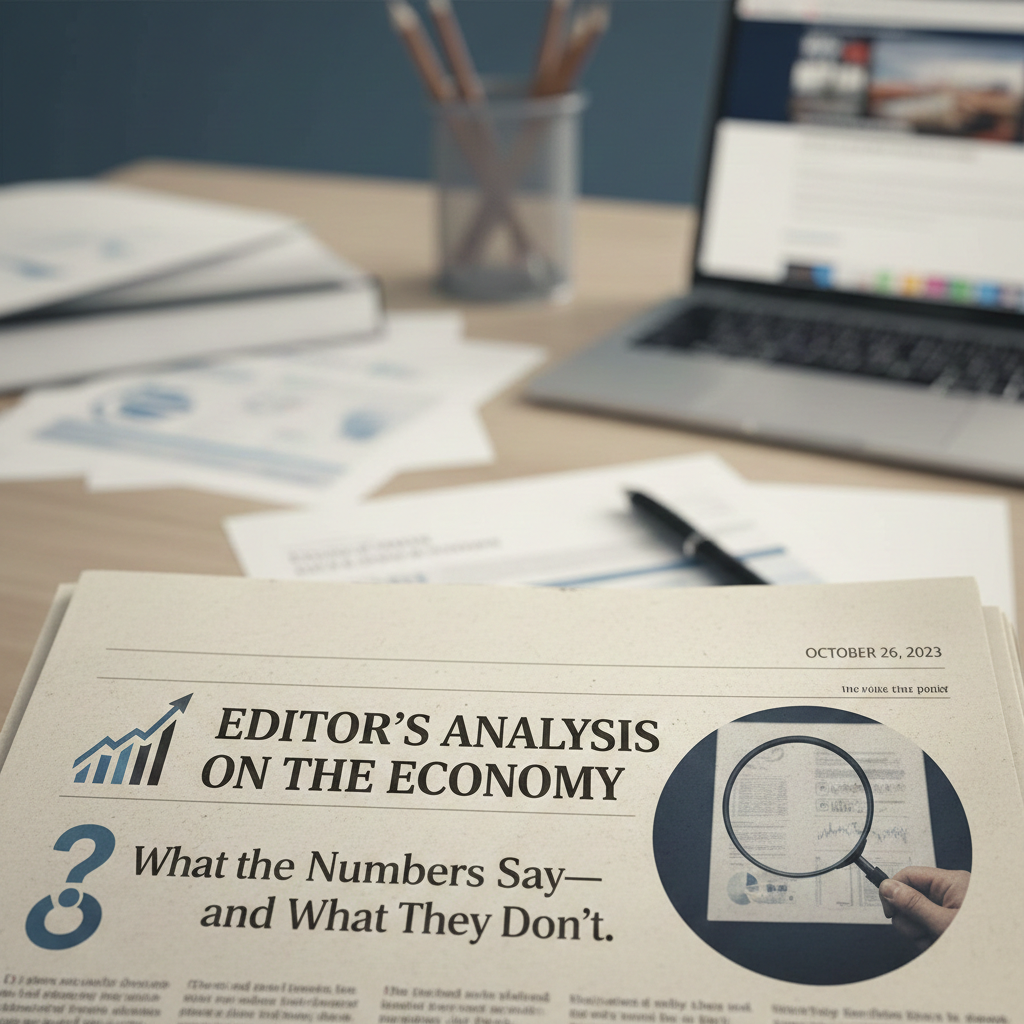
Reading the Economy Beyond the Headlines
The economy is more than GDP figures, stock market tickers, or inflation percentages flashing across news screens. It is the combined story of households managing expenses, businesses making investment decisions, governments balancing policy, and global forces reshaping trade. This editor’s analysis on the economy goes beyond surface-level data to explain what is really happening, why it matters, and where things may be heading.
In recent years, economic conversations have become louder, faster, and often more confusing. One day the economy is “booming,” the next it is “on the brink.” The truth, as always, lies somewhere in between. This analysis aims to cut through the noise with clarity, context, and grounded interpretation—written for humans who want to understand, not just skim.
The Current Economic Landscape: A Mixed Global Picture
Across the world, economic performance is uneven. Some regions are growing steadily, others are slowing, and many are caught in a phase of adjustment after years of disruption.
Growth Is Continuing—But at a Slower Pace
Most major economies are still expanding, but not at the breakneck speed seen during post-pandemic recovery. Growth today is cautious and selective.
Key observations include:
- Consumer spending remains resilient but more value-driven
- Business investments are focused on efficiency rather than expansion
- Governments are shifting from stimulus to fiscal discipline
This slower growth phase is not necessarily negative. In fact, it often reflects a more sustainable and balanced economic cycle.
Inflation Has Eased, but Pressures Remain
Inflation, once the dominant global concern, has moderated in many economies. However, prices have not returned to pre-crisis levels, which means households still feel the strain.
Core trends shaping inflation:
- Food and housing costs remain sticky
- Energy prices fluctuate due to geopolitical risks
- Services inflation stays elevated due to wage pressures
For many people, “lower inflation” does not mean “lower prices.” It simply means prices are rising more slowly.
Employment Trends: Strong Numbers, Changing Nature of Work
Job markets have shown surprising strength despite economic uncertainty. Unemployment rates in several economies remain near historic lows.
Why Employment Is Holding Up
There are structural reasons behind strong employment data:
- Aging populations reducing labor supply
- Growth in service-based industries
- Expansion of gig and contract work
However, headline job numbers do not always reflect job quality.
The Shift in Job Security and Wages
While jobs are available, concerns remain:
- Wage growth is uneven across sectors
- Job security is weaker in technology and startups
- Real income growth struggles to outpace living costs
This creates a paradox where employment is high, yet financial stress remains common.
Consumer Behavior: Cautious, Selective, and Value-Focused
Consumers are the backbone of any economy, and their behavior tells a powerful story.
Spending Patterns Are Changing
Instead of broad spending cuts, consumers are reallocating:
- Prioritizing essentials over discretionary items
- Choosing private labels and discounts
- Delaying large purchases like homes and vehicles
This shift does not signal fear—it signals adaptation.
Savings and Debt: A Delicate Balance
Many households are walking a tightrope between savings and debt.
| Indicator | Trend |
|---|---|
| Savings rates | Gradually declining |
| Credit card usage | Increasing |
| Loan defaults | Stable but rising slowly |
This balance will be critical in determining future consumer resilience.
Central Banks and Interest Rates: Walking a Tightrope
Monetary policy remains at the center of economic debate. Central banks face the difficult task of controlling inflation without stalling growth.
Interest Rates Are Higher—By Design
Higher interest rates are intentional. They aim to:
- Reduce excessive borrowing
- Cool demand-driven inflation
- Restore price stability
The downside is clear: borrowing costs for homes, businesses, and governments increase.
What Comes Next for Monetary Policy
Most analysts expect:
- Gradual rate cuts, not sharp reversals
- Policy decisions driven by data, not politics
- Increased communication to manage market expectations
The era of ultra-cheap money is unlikely to return soon.
Government Spending and Fiscal Health
Governments play a crucial role in shaping economic outcomes, especially during periods of uncertainty.
Public Spending: Necessary but Constrained
Recent years saw massive government spending. Now, fiscal realities are setting in.
Current fiscal priorities include:
- Infrastructure investment
- Social welfare and healthcare
- Defense and strategic industries
At the same time, rising debt levels limit flexibility.
Debt Sustainability Is a Growing Concern
Public debt has reached historic highs in many countries. While manageable today, long-term sustainability depends on growth, productivity, and fiscal discipline.
Global Trade and Geopolitical Influence
The global economy no longer operates in a purely free-trade environment. Geopolitics now plays a central role.
Supply Chains Are Being Rewritten
Businesses are adjusting supply chains to reduce risk:
- Nearshoring and friend-shoring strategies
- Diversification away from single-country dependence
- Higher costs in exchange for reliability
This shift improves resilience but adds inflationary pressure.
Trade Fragmentation vs. Cooperation
While globalization is not ending, it is evolving. Regional trade agreements and strategic alliances are becoming more important than global consensus.
Technology, Productivity, and the Growth Question
Long-term economic health depends on productivity growth, and technology is a key driver.
Artificial Intelligence and Automation
AI and automation offer massive potential:
- Improved efficiency across industries
- Cost reduction for businesses
- Creation of new job categories
However, the transition may be uneven, with short-term disruption for some workers.
The Productivity Puzzle
Despite technological advances, productivity growth has been modest. Unlocking its full potential requires:
- Investment in skills and education
- Modern infrastructure
- Regulatory frameworks that encourage innovation
Comparing Today’s Economy to Past Cycles
Understanding history helps put the present in perspective.
| Period | Key Characteristics |
|---|---|
| Post-2008 | Slow growth, low inflation, cheap money |
| Pandemic era | Sharp contraction, massive stimulus |
| Current phase | Moderate growth, higher rates, adjustment |
Unlike past crises, today’s economy is not defined by collapse but by recalibration.
Risks That Could Shape the Next Phase
No economic analysis is complete without acknowledging risks.
Key downside risks include:
- Escalation of geopolitical conflicts
- Sharp financial market corrections
- Unexpected inflation resurgence
- Climate-related economic shocks
At the same time, upside surprises—such as productivity breakthroughs—remain possible.
What This Means for Businesses and Individuals
Economic analysis matters most when it translates into practical insight.
For Businesses
- Focus on efficiency and cash flow
- Invest selectively, not aggressively
- Prepare for slower but steadier demand
For Individuals
- Budget with realism, not fear
- Avoid over-leveraging in high-rate environments
- Invest with a long-term perspective
Frequently Asked Questions (FAQs)
What is the overall direction of the economy right now?
The economy is growing at a moderate pace, transitioning from recovery to stabilization rather than entering a severe downturn.
Is inflation still a major concern?
Inflation has eased, but prices remain high. Cost-of-living pressure continues, especially in housing and services.
Are we heading toward a recession?
A broad recession is not the base case, but localized slowdowns in certain sectors are likely.
How do interest rates affect everyday people?
Higher rates increase loan and mortgage costs but also improve returns on savings and fixed-income investments.
What should investors focus on in this environment?
Long-term fundamentals, diversification, and risk management matter more than short-term market movements.
Conclusion: A Time for Clarity, Not Panic
This editor’s analysis on the economy points to a clear conclusion: the global economy is not collapsing, nor is it roaring ahead. It is adjusting—painfully in some areas, constructively in others.
The challenge for policymakers, businesses, and individuals is to navigate this phase with realism and patience. Understanding the economy as a living system, shaped by human behavior and structural forces, allows for better decisions and fewer emotional reactions.
Stay informed. Think long-term. Make choices based on clarity, not headlines.
If you found this analysis valuable, share it, bookmark it, and return for more insights that explain the economy as it truly is—not just how it’s reported.
