

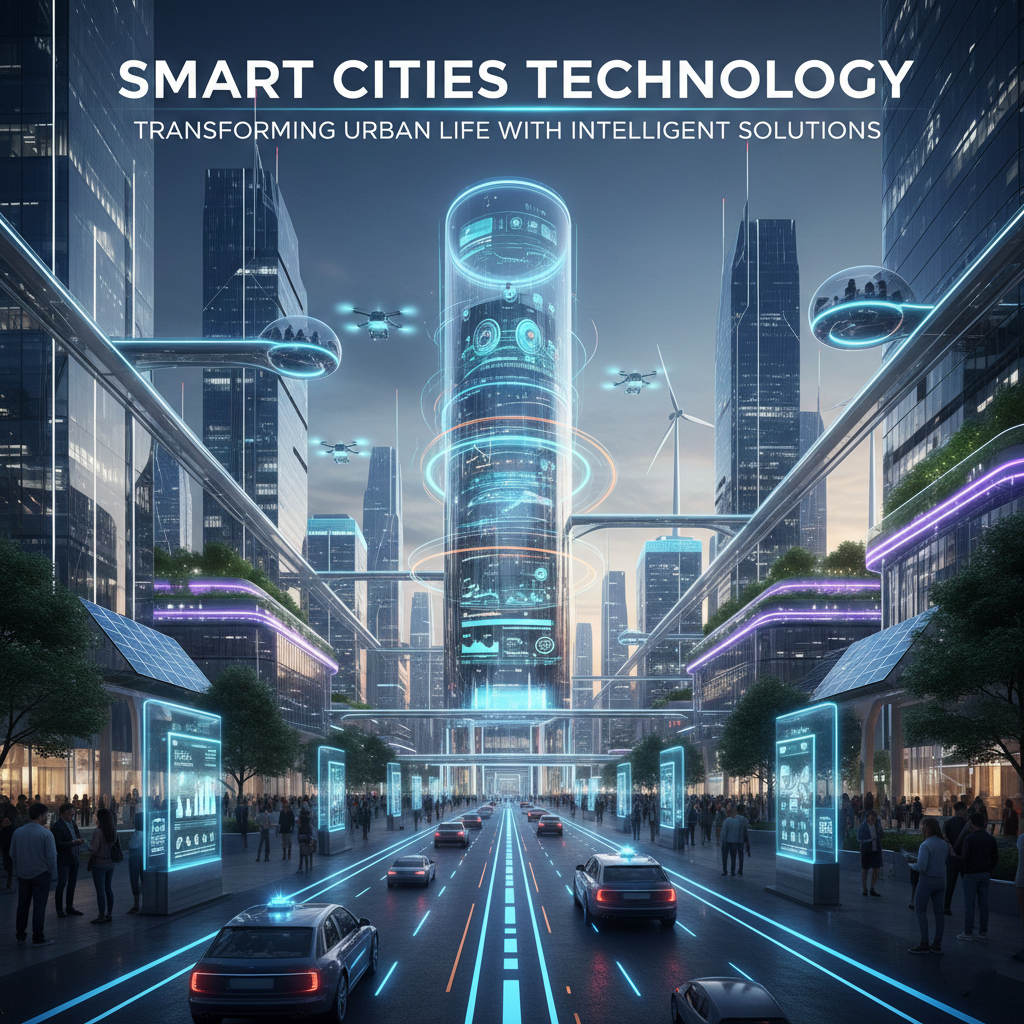
What Is Smart Cities Technology?
Smart Cities Technology is more than a buzzword—it’s the driving force behind modern urban transformation. As the world’s urban population continues to surge, cities are using cutting‑edge technologies to solve age‑old problems like congestion, pollution, energy waste, and inefficient public services. From IoT sensors to AI‑powered analytics, smart city solutions are reshaping everything from transportation and safety to healthcare and governance.
In this comprehensive guide, we’ll walk through how smart cities work, the core technologies involved, real‑world benefits, challenges, and the future of urban living. Whether you’re a policymaker, technology enthusiast, or urban resident curious about the future of cities, this article will give you clear, practical insight.
What Defines a Smart City? (H2)
A smart city is an urban area that uses digital technologies and data to enhance operational efficiency, improve public services, reduce costs, and boost quality of life for citizens. It uses connectivity, sensors, and analytics to make better decisions and optimize city functions in real time.
Here are the key components of a smart city:
Core Elements of Smart Cities (H3)
- Internet of Things (IoT) Sensors – Devices that collect real‑time data on air quality, traffic, energy usage, and more.
- Data Analytics & AI – Transform raw information into insights to improve decision‑making.
- Connectivity Infrastructure – High‑speed networks and 5G to support rapid communication across systems.
- Citizen Engagement Platforms – Apps and portals that let residents access services and provide feedback.
- Sustainable Energy Solutions – Solar grids, smart meters, and energy‑efficient buildings.
- Integrated Public Services – Unified platforms for transport, utilities, governance, and safety.
How Smart Cities Technology Works (H2)
Smart cities leverage a layered technology model:
- Data Collection – Sensors and devices gather data continuously.
- Connectivity – Networks like 5G, fiber optics, and LPWAN transmit data securely.
- Data Storage & Cloud Systems – Central repositories to store massive datasets.
- Analytics & Intelligence – AI applications identify patterns, predict issues, and optimize responses.
- Action & Automation – Smart systems trigger actions like adjusting traffic lights or dispatching emergency services.
Smart Cities Technologies That Are Changing Urban Life (H2)
Technology is the backbone of smart cities. Below are the most influential innovations transforming urban spaces:
1. Internet of Things (IoT) (H3)
IoT connects everyday physical objects to the internet, making them smarter and capable of sharing data.
Examples:
- Smart streetlights that dim when no one is present.
- Waste bins that alert sanitation teams when full.
- Sensors that monitor water quality and leakage.
Stat: According to Statista, the number of active IoT devices worldwide is expected to reach 30.9 billion by 2025. (Outbound link: https://www.statista.com/statistics/471264/iot‑number‑of‑connected‑devices‑worldwide/)
2. Artificial Intelligence (AI) & Machine Learning (H3)
AI helps cities go beyond data collection—by predicting trends, optimizing systems, and improving public services.
Use Cases:
- AI traffic systems reduce congestion by analyzing patterns.
- Predictive maintenance for public infrastructure (roads, bridges, utilities).
- AI chatbots for city help centers.
3. Big Data & Analytics (H3)
Massive amounts of city data are useless without analytics. Smart cities use data dashboards and analytics platforms to:
- Visualize city performance indicators
- Forecast demands for public services
- Monitor environmental changes
This data‑driven approach leads to smarter policies and better budgeting.
4. 5G and High‑Speed Connectivity (H3)
High‑speed internet is the circulatory system of a smart city. It allows sensors and services to communicate instantly.
Benefits of 5G:
- Ultra‑low latency
- Higher reliability
- Support for massive machine‑type communications
This ensures services like autonomous transport and real‑time health monitoring work smoothly.
5. Smart Grids & Energy Management (H3)
Smart grids modernize electrical networks by monitoring demand and supply in real time.
Advantages include:
- Reduced energy waste
- Better integration of renewable sources (solar and wind)
- Lower utility costs for residents
Key Smart City Sectors Impacted by Technology (H2)
Smart city tech isn’t one‑dimensional. It spans multiple domains:
Urban Mobility and Transportation (H3)
- Smart transit apps for best route planning
- Real‑time traffic management
- Ride‑sharing and shared mobility solutions
Example: Barcelona’s smart traffic system reduced congestion and improved commuting times dramatically.
Public Safety and Emergency Services (H3)
- Predictive policing through analytics
- Smart surveillance with privacy protections
- Faster emergency response systems
Environment and Sustainability (H3)
Smart cities drive sustainability through pollution sensors, smart waste management, and greener building tech.
Smart Cities Benefits in Numbers (H2)
Here’s a snapshot of what smart technology delivers to cities:
| Benefit Category | Impact |
|---|---|
| Traffic Congestion | Up to 30% reduction in travel time |
| Energy Savings | 10–25% reduction in utility costs |
| Public Safety | Faster emergency response times |
| Environmental Quality | Improved air and water standards |
| Cost Efficiency | Billions saved through optimized city operations |
Note: Stats based on reports from smart city initiatives worldwide. (Outbound link: https://www.smartcitiesworld.net/)
Challenges and Roadblocks (H2)
Despite enormous promise, smart city technology faces challenges:
1. Privacy and Security (H3)
- Citizens worry about how their data is used.
- Cybersecurity threats require robust safeguards.
Smart cities must adhere to strict data protection regulations (e.g., GDPR in Europe).
2. High Implementation Cost (H3)
Initial investments in infrastructure, sensors, and networks can be expensive. Long‑term planning and public‑private partnerships are essential strategies.
3. Digital Divide (H3)
Not all citizens may have equal access to smart services. Ensuring inclusive connectivity is critical.
Smart Cities Around the World: Success Stories (H2)
From Singapore to Copenhagen, cities are shining examples of smart technologies in action.
Singapore: Urban Innovation Hub (H3)
Singapore uses advanced analytics for:
- Efficient public transit
- Healthcare monitoring
- Flood control systems
Learn more about Singapore’s approach on the Smart Nation Singapore official portal.
Barcelona: Data‑Driven Urban Management (H3)
Barcelona’s integrated smart city approach includes:
- Smart parking management
- Sensor‑based waste collection
- Public Wi‑Fi access points
The city has reported notable improvements in quality of life and tourism.
Smart Cities Technology Trends to Watch (H2)
Smart city innovation continues to evolve:
- AI‑Powered Digital Twins – Virtual city replicas for simulation and planning
- Autonomous Transportation – Self‑driving buses and electric vehicles
- Blockchain for Governance – Transparent, secure public record keeping
- Edge Computing – Localized processing for low‑latency applications
These trends will further enhance scalability and citizen engagement.
How Governments & Citizens Can Benefit (H2)
Smart cities aren’t just tech experiments—they offer deep, sustainable advantages for both governments and residents.
For Governments (H3)
- Better resource allocation
- Data‑driven governance
- Increased public trust and transparency
For Citizens (H3)
- Safer, cleaner neighborhoods
- Faster public services
- Convenient access to urban systems
Explore more smart city insights at thenews.zone: thenews.zone/smart‑cities (internal link).
FAQs About Smart Cities Technology (H2)
1. What exactly makes a city “smart”?
A city is “smart” when it uses digital technologies, connectivity, and data analytics to improve everyday life—for transportation, energy, safety, and services.
2. How do smart cities help reduce pollution?
Smart cities use sensors to monitor air quality and optimize traffic and energy usage, which leads to lower emissions and cleaner environments. For global air quality standards, refer to the EPA site. (Outbound link: https://www.epa.gov/air‑quality)
3. Is citizen data secure in smart cities?
Data security depends on how well city administrators implement privacy policies and cybersecurity protections. Frameworks like GDPR set standards for data handling.
4. Can smaller cities become smart cities?
Yes. Smart city solutions are scalable—smaller cities can adopt specific technologies based on needs and budgets.
5. What technologies are most important for smart cities?
Key technologies include IoT, AI, data analytics, high‑speed connectivity (5G), and cloud computing.
Smart Cities vs. Traditional Cities (Comparison Table)
| Feature | Smart Cities | Traditional Cities |
|---|---|---|
| Traffic Management | Real‑time data & adaptive signaling | Fixed signals, limited optimization |
| Public Safety | Predictive analytics & monitoring | Reactive, manual processes |
| Public Services | App‑based, fast access | Slow, manual |
| Sustainability | Integrated environmental sensors | Reactive approaches |
Conclusion: The Future of Urban Living
Smart Cities Technology is reshaping the future of urban life — enhancing efficiency, sustainability, and quality of life for millions. As cities adopt advanced systems and data‑driven strategies, residents get safer, cleaner, and more efficient environments to live, work, and thrive.
Whether you’re part of city leadership or simply interested in the evolution of modern urban life, understanding smart city dynamics gives you a front‑row seat to this global transformation.
Ready to explore more about the technology shaping tomorrow’s cities? Visit thenews.zone for the latest insights, expert analysis, and real‑world examples.
