

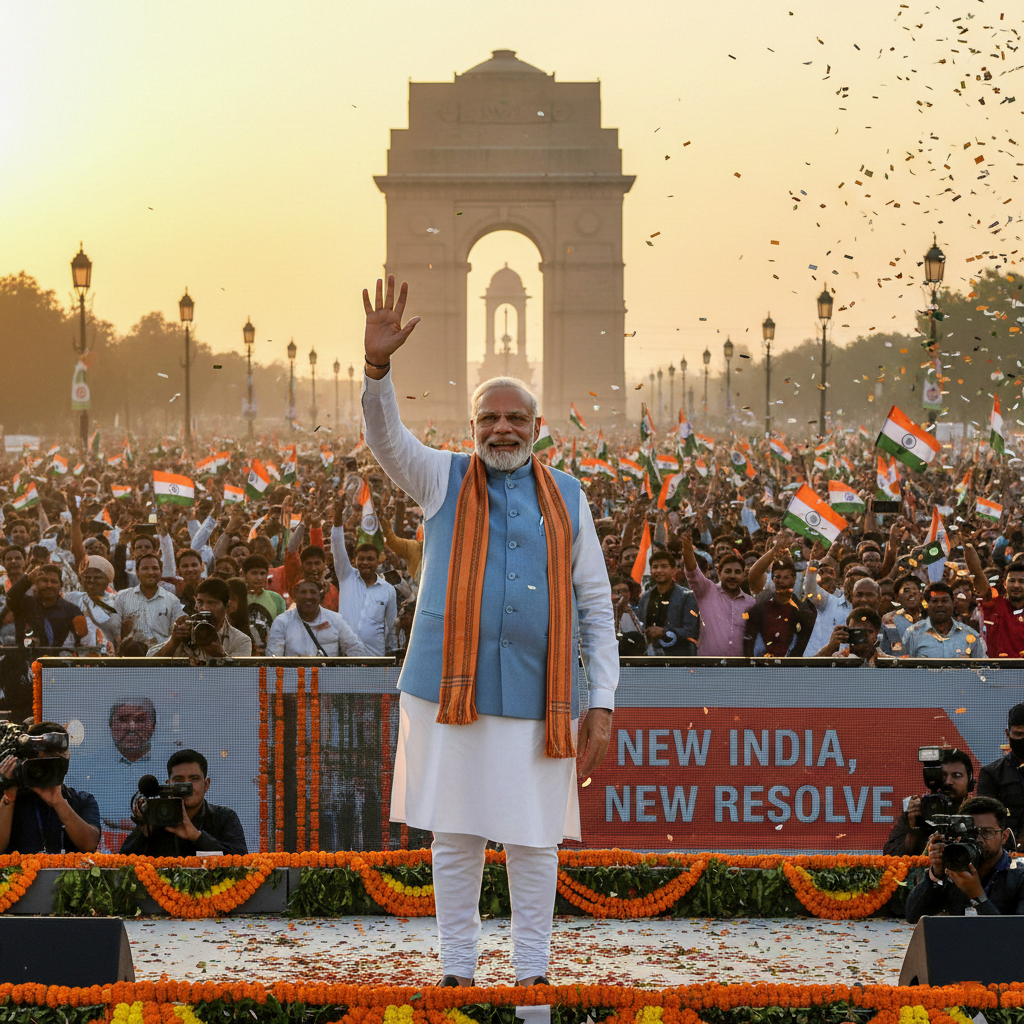
New Delhi: Understanding the Modi Ji Phenomenon in Indian Politics
Narendra Modi, popularly addressed as Modi Ji, stands as one of the most influential and closely watched political leaders in India’s contemporary history. Since assuming office as the Prime Minister of India in 2014, Modi Ji has altered the tone, structure, and expectations of governance in the country.
Loved by supporters for his decisive leadership and vision, and scrutinized by critics for his bold policy choices, Modi Ji remains a central figure in national discourse. More than a decade after emerging on the national stage, his leadership continues to shape India’s political direction, economic priorities, and global standing.
This report takes a comprehensive look at Modi Ji’s rise, governance model, achievements, challenges, and long-term impact, offering readers a clear and balanced understanding.
From Vadnagar to the Centre of Power
Narendra Damodardas Modi was born on September 17, 1950, in Vadnagar, Gujarat, into a modest family. His early life has often been cited as an example of resilience and self-made success.
Early Years and Influences
- Assisted his father at a tea stall during childhood
- Exposure to grassroots realities from a young age
- Joined the Rashtriya Swayamsevak Sangh (RSS) as a teenager
His formative years played a crucial role in shaping his worldview, discipline, and organizational skills—qualities that later defined his political career.
Unlike many national leaders, Modi Ji did not emerge from elite institutions or political dynasties. His journey was gradual, rooted in grassroots mobilization and ideological commitment.
Rise Through the Ranks: Gujarat Years
Modi Ji’s national recognition began with his tenure as Chief Minister of Gujarat, a position he held from 2001 to 2014.
Governance Model in Gujarat
During this period, Gujarat witnessed:
- Rapid infrastructure development
- Expansion of industrial corridors
- Consistent power supply and road connectivity
- Aggressive investor outreach through Vibrant Gujarat Summits
Supporters credit Modi Ji with creating a pro-development environment, while critics raised questions about inclusivity. Regardless, the Gujarat model became a reference point in national political debates.
2014 Election: A Political Turning Point
The 2014 general election marked a decisive shift in Indian politics.
Historic Mandate
- BJP secured a full majority in the Lok Sabha
- Narendra Modi became the first PM in decades to achieve this without coalition support
- Re-elected in 2019 with an even larger mandate
This electoral success reflected widespread public demand for strong leadership, policy clarity, and governance reform.
Governance Under Modi Ji: A Centralised but Active Model
Modi Ji’s governance style is often described as centralized, fast-paced, and outcome-driven.
Key Characteristics
- Strong Prime Minister’s Office (PMO)
- Frequent monitoring of flagship schemes
- Direct communication with citizens
- Emphasis on performance metrics
Programs like “Mann Ki Baat” enabled Modi Ji to bypass traditional political filters and speak directly to citizens, a strategy rarely used at this scale before.
Economic Reforms That Defined a Decade
Modi Ji’s tenure has been marked by several high-impact economic decisions.
Major Economic Policies
Goods and Services Tax (GST)
Unified India’s indirect tax structure, simplifying interstate trade.
Demonetisation (2016)
Aimed at curbing black money and promoting digital payments—controversial but transformative in intent.
Make in India
Focused on strengthening domestic manufacturing and reducing import dependence.
Startup India
Provided support to emerging entrepreneurs and innovation-driven businesses.
India’s economy has experienced both disruption and long-term structural changes under these reforms.
Welfare Governance and Social Outreach
A defining feature of Modi Ji’s leadership has been direct welfare delivery.
Flagship Schemes Impacting Millions
- Pradhan Mantri Awas Yojana – Affordable housing
- Ujjwala Yojana – LPG access for rural women
- Ayushman Bharat – Health coverage for vulnerable families
- Swachh Bharat Mission – Sanitation and hygiene push
The government emphasized Direct Benefit Transfer (DBT), reducing leakages and increasing transparency.
India’s Global Position Under Modi Ji
Foreign policy under Modi Ji has been assertive and visible.
Diplomatic Highlights
- Strengthened ties with the United States and Indo-Pacific allies
- Active role in G20 leadership
- Strategic participation in QUAD
- Outreach to the Indian diaspora worldwide
India is now positioned as a key voice in global economic and geopolitical discussions.
For official statements and policy updates, refer to the Prime Minister’s Office:
👉 https://www.pmindia.gov.in
Digital India and Governance Technology
One of the most lasting transformations has been India’s digital shift.
Technology-Led Governance
- UPI revolutionized digital payments
- Online portals improved service delivery
- Aadhaar-enabled systems streamlined welfare access
India’s digital public infrastructure is now studied globally.
Criticism, Protests, and Political Opposition
Despite electoral success, Modi Ji’s tenure has not been without opposition.
Key Areas of Debate
- Economic growth fluctuations
- Employment generation concerns
- Federalism and centre-state relations
- Social harmony and civil liberties
Opposition parties and civil society groups continue to question policy execution and institutional balance, making Modi Ji one of the most debated leaders of the era.
Modi Ji Compared to Previous Leadership
| Area | Modi Ji Era | Pre-2014 Era |
|---|---|---|
| Governance Speed | High | Moderate |
| Policy Visibility | Strong | Limited |
| Digital Adoption | Extensive | Minimal |
| Global Outreach | Aggressive | Cautious |
This contrast explains the distinct political identity Modi Ji has created.
Vision of a “New India”
Modi Ji’s repeated emphasis on Atmanirbhar Bharat (Self-Reliant India) reflects a long-term national strategy.
Core goals include:
- Domestic manufacturing growth
- Innovation-led economy
- Youth empowerment
- Strong national identity
This vision continues to guide policy priorities.
For detailed political reporting and analysis, readers can explore:
👉 https://thenews.zone
Frequently Asked Questions
Who is Modi Ji?
Modi Ji is Narendra Modi, the Prime Minister of India since 2014.
Why is Modi Ji considered influential?
Due to his decisive governance, mass connect, and impact on India’s political and economic systems.
What are his most discussed policies?
GST, Digital India, welfare schemes, and foreign policy initiatives.
How has Modi Ji changed Indian politics?
By shifting focus to centralized leadership, direct communication, and performance-based governance.
Conclusion: A Leader Who Defined an Era
Narendra Modi, widely known as Modi Ji, has emerged as a defining figure of 21st-century India. His leadership has reshaped governance models, policy expectations, and India’s global image.
Whether viewed through the lens of reform, debate, or transformation, Modi Ji’s influence on Indian politics is undeniable. As the nation continues to evolve, his decisions and vision will remain central to India’s political narrative.
👉 For continuous updates, political insights, and in-depth reporting, visit thenews.zone.
