

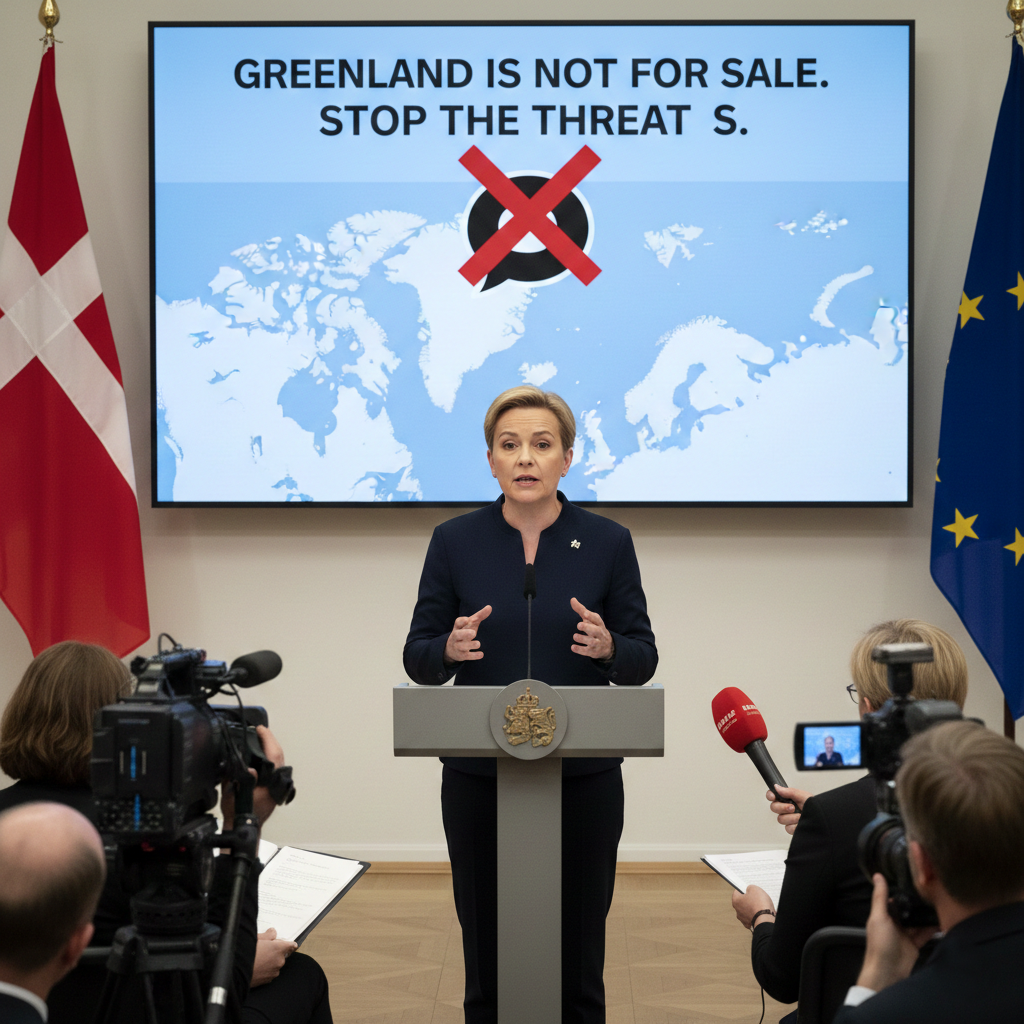
Denmark Pushes Back on U.S. Rhetoric Over Greenland
Denmark’s prime minister has issued a firm and unusually direct message to Washington: stop the public rhetoric about Greenland. According to Copenhagen, the United States has no right to threaten or speak as if it controls Greenland, a semi-autonomous territory within the Kingdom of Denmark.
The statement has quickly drawn global attention, not only because of its sharp tone but also because it touches on sovereignty, Arctic geopolitics, and U.S.–Europe relations. Greenland is not just a vast, icy landmass—it sits at the center of growing strategic competition involving defense, climate change, natural resources, and great-power influence.
This article breaks down what Denmark’s prime minister said, why Greenland matters so much, how the U.S. fits into the picture, and what this dispute means for the future of the Arctic.
For more global political coverage, visit thenews.zone.
Why Greenland Is Suddenly at the Center of Global Politics
Greenland has long been geographically remote but politically significant. In recent years, it has moved from the margins to the center of international debate.
Greenland at a Glance
| Factor | Details |
|---|---|
| Political status | Autonomous territory of Denmark |
| Population | ~56,000 |
| Strategic value | Arctic defense, missile warning systems |
| Resources | Rare earth minerals, oil, gas |
| Key allies involved | Denmark, U.S., NATO |
Despite its small population, Greenland’s location makes it one of the most strategically important territories in the world.
What Exactly Did Denmark’s Prime Minister Say?
Denmark’s prime minister publicly criticized Washington’s language about Greenland, stating that:
- The U.S. has no right to threaten or imply ownership of Greenland
- Public rhetoric about acquiring or controlling the territory is unacceptable
- Greenland’s future must be decided only by Greenlanders themselves
This message was not delivered behind closed doors. It was made openly, signaling Denmark’s intention to draw a clear diplomatic line.
Why the Tone Was So Firm
Denmark rarely uses strong language with close allies like the United States. The unusually direct wording suggests:
- Growing frustration in Copenhagen
- Concern about how public comments affect Greenland’s people
- Fear of setting a dangerous international precedent
Greenland’s Legal and Political Status Explained
Understanding the dispute requires clarity on who controls Greenland.
Is Not for Sale
is:
- Not a U.S. territory
- Not independent, but largely self-governing
- Legally part of the Kingdom of Denmark
manages:
- Natural resources
- Local governance
- Domestic policies
Denmark handles:
- Defense
- Foreign policy
- Currency
This structure makes any foreign threats or claims legally invalid under international law.
For deeper analysis of sovereignty disputes, see coverage on thenews.zone.
Why the United States Is Interested in Greenland
U.S. interest in Greenland is not new. It dates back decades and is rooted in security and strategy rather than symbolism.
Key Reasons Behind U.S. Focus on Greenland
1. Military and Defense Importance
- Home to the U.S. Pituffik Space Base (formerly Thule Air Base)
- Critical for missile early-warning systems
- Part of NATO’s Arctic defense network
2. Arctic Competition
- Melting ice opens new shipping routes
- Increased Russian and Chinese activity in the Arctic
- Strategic positioning matters more than ever
3. Natural Resources
- Rare earth minerals essential for tech and defense
- Potential oil and gas reserves
- Clean energy materials for the future
Outbound reference: Learn more about Arctic security from NATO’s official website.
Why Denmark Is Concerned About Public U.S. Statements
Denmark’s objection is not about cooperation—it is about how that cooperation is discussed publicly.
Diplomacy vs. Public Messaging
Denmark supports:
- Strong U.S.–Danish military ties
- NATO cooperation
- Arctic security collaboration
Denmark opposes:
- Public statements implying ownership or control
- Rhetoric that undermines Greenlandic autonomy
- Language that creates anxiety among Greenland’s population
Impact on Greenland’s People
Public threats or speculative comments can:
- Create political instability
- Fuel independence debates
- Damage trust in international partners
Greenland’s Voice: What Do Greenlanders Want?
One critical aspect often overlooked is Greenland’s own perspective.
Key Sentiments in Greenland
- Strong sense of identity and self-rule
- No interest in becoming U.S. territory
- Mixed views on full independence from Denmark
- Desire for respectful international partnerships
Greenland’s leaders have repeatedly stated that Greenland belongs to Greenlanders—not Denmark alone, and certainly not any foreign power.
How This Dispute Affects U.S.–Europe Relations
Although Denmark and the U.S. remain close allies, public disagreements can leave marks.
Short-Term Impact
- Diplomatic tension
- Careful recalibration of public messaging
- Increased European unity around sovereignty issues
Long-Term Implications
- Stronger emphasis on respecting smaller nations
- Clearer Arctic governance frameworks
- More structured communication among NATO allies
For broader European political context, outbound reference: BBC World News.
The Arctic Is the Real Battleground
This disagreement is less about Greenland itself and more about the future of the Arctic.
Why the Arctic Matters Now
- Ice melt is accelerating
- New trade routes are emerging
- Military presence is expanding
- Global powers are competing quietly—but intensely
Key Arctic Players
- United States
- Denmark (via Greenland)
- Russia
- Canada
- Norway
- China (as a strategic observer)
Any hint of territorial claims risks destabilizing a region that depends on cooperation and restraint.
International Law and Sovereignty: A Clear Line
Under international law:
- Territories cannot be acquired through pressure or rhetoric
- Sovereignty must be respected
- Self-determination is a fundamental principle
Denmark’s statement reinforces these norms at a time when global respect for borders is increasingly under strain.
Outbound reference: United Nations Charter on Self-Determination.
Frequently Asked Questions (FAQs)
Why did Denmark’s prime minister speak out now?
Because repeated public rhetoric risked normalizing the idea that Greenland’s status is negotiable, which Denmark strongly rejects.
Does the U.S. have any legal claim over Greenland?
No. Greenland is legally part of the Kingdom of Denmark with autonomous governance.
Can Greenland become independent?
Yes, but only through a democratic process decided by Greenlanders themselves.
Is this dispute damaging NATO unity?
Not fundamentally. It highlights the need for respectful communication among allies.
Where can I read more balanced global coverage?
You can explore in-depth international reporting at thenews.zone.
What Happens Next?
Most experts expect:
- Quieter diplomatic dialogue
- Continued military cooperation
- More cautious public statements from all sides
This is not a breakdown in relations—but a reminder that words matter in global politics.
Conclusion: A Strong Message About Respect and Sovereignty
Denmark’s prime minister has sent a clear signal to Washington and the world: Greenland is not a bargaining chip, a talking point, or a strategic trophy. It is a land with its own people, rights, and future.
As Arctic competition intensifies, respecting sovereignty and self-determination will be critical to avoiding unnecessary conflict. Strong alliances are built not just on shared interests—but on mutual respect.
👉 Stay informed with trusted global analysis. Visit thenews.zone for the latest international news, insights, and explainers.
