
Why Venezuela Matters More Than Ever
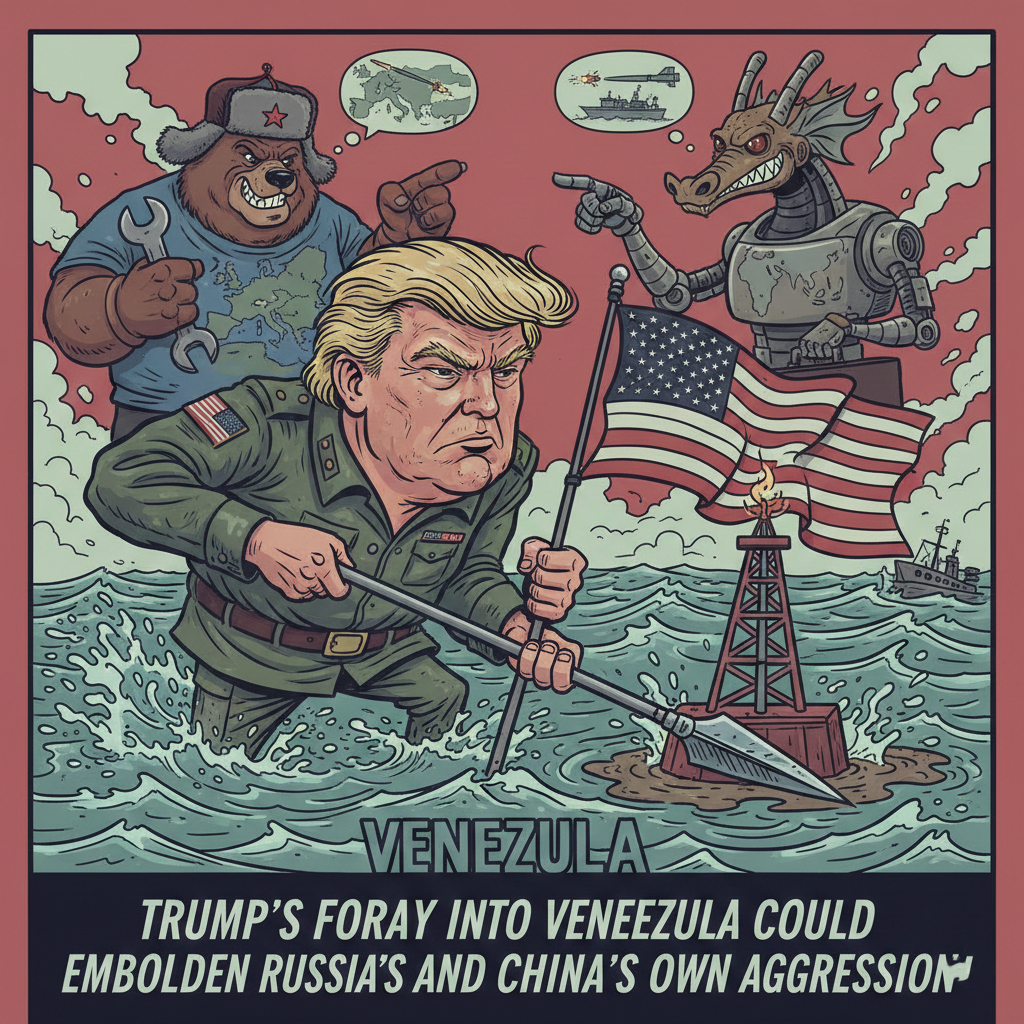
When former U.S. President Donald Trump re-entered the global conversation with renewed rhetoric and political maneuvering around Venezuela, it wasn’t just Latin America paying attention. From Moscow to Beijing, strategic analysts quietly took notes.
Trump’s foray into Venezuela is not happening in a vacuum. It comes at a time when global power balances are fragile, international norms are already under pressure, and authoritarian states are actively testing boundaries. What happens in Venezuela could signal what’s acceptable elsewhere — and that’s exactly why Russia and China are watching closely.
This article explores how U.S. actions in Venezuela could embolden Russian and Chinese aggression, why this matters for global stability, and what lessons history repeatedly teaches us about power vacuums and precedent-setting behavior.
For deeper geopolitical analysis, readers can also explore related global affairs coverage on thenews.zone, which tracks evolving power dynamics worldwide.
Understanding Trump’s Venezuela Strategy in Context
Trump’s Venezuela policy has always been aggressive, unconventional, and headline-driven. During his presidency, the U.S.:
- Recognized Juan Guaidó as Venezuela’s legitimate leader
- Imposed sweeping economic sanctions
- Floated the idea of military intervention
- Used strong rhetoric about regime change
Though these moves were framed as pro-democracy, critics argue they weakened international norms by normalizing unilateral pressure tactics.
Why Venezuela Is Strategically Sensitive
Venezuela is not just another struggling state. It holds:
- The world’s largest proven oil reserves
- Strategic access to the Caribbean Sea
- Long-standing political ties with Russia, China, and Iran
Any forceful U.S. posture there sends a powerful message: big powers can interfere when it suits their interests.
That message doesn’t stop at the Western Hemisphere.
How Russia Interprets U.S. Pressure on Venezuela
The Precedent Problem
Russia has consistently argued that Western interventions — from Iraq to Libya — justify its own actions in neighboring regions. A renewed U.S. push against Venezuela reinforces Moscow’s narrative that:
“Sovereignty is flexible when power demands it.”
This framing has already been used by Russia to justify:
- Its actions in Ukraine
- Military involvement in Georgia
- Political interference in Eastern Europe
When Washington applies pressure without broad international consensus, it weakens its moral authority to oppose similar moves elsewhere.
Russia’s Strategic Takeaway
If the U.S. can pressure Caracas to pursue regime change, Russia may feel further emboldened to:
- Harden its stance in Ukraine
- Expand influence in Africa
- Challenge NATO boundaries more aggressively
According to analysis published by Foreign Affairs, Russia closely studies U.S. foreign policy not for alignment — but for opportunity.
China’s Perspective: Taiwan, South China Sea, and Beyond
China views global politics through a long-term, strategic lens. For Beijing, Venezuela is not the issue — precedent is.
What China Learns From U.S. Moves
A forceful or unilateral U.S. approach toward Venezuela could reinforce China’s belief that:
- Power, not rules, defines global order
- Economic pressure is an acceptable coercive tool
- International backlash fades over time
This has serious implications for flashpoints like:
- Taiwan
- South China Sea
- Hong Kong’s political autonomy
China has already cited Western hypocrisy when responding to criticism of its actions. Venezuela simply adds another data point.
Economic Leverage as a Weapon
China has invested billions of dollars in Venezuela’s infrastructure and oil sector. U.S. pressure threatens those investments, reinforcing Beijing’s resolve to:
- Reduce reliance on the U.S. dollar
- Build alternative global financial systems
- Protect allied regimes more aggressively
The Council on Foreign Relations has repeatedly warned that economic coercion, when overused, accelerates global fragmentation.
A Pattern the World Has Seen Before
History shows that major powers copy each other’s playbooks.
Historical Comparisons That Matter
| U.S. Action | Global Reaction |
|---|---|
| Iraq invasion (2003) | Russia cites it to justify Crimea |
| Libya intervention (2011) | China increases non-interference skepticism |
| Venezuela sanctions | Authoritarian states normalize pressure tactics |
Every time norms are bent, they become easier to break.
As covered in several geopolitical deep dives on thenews.zone, modern power struggles are less about ideology and more about who sets the rules.
Why This Matters for Smaller Nations
The biggest losers in great-power signaling are often smaller, weaker states.
Risks for Developing Countries
- Increased foreign interference
- Reduced respect for sovereignty
- Economic instability driven by sanctions
- Forced alignment with major powers
When global giants act without restraint, smaller nations become chess pieces — not partners.
This reality makes Venezuela a test case, not an isolated crisis.
Can the U.S. Counter Russia and China Without Backfiring?
The challenge for Washington is balance.
Strategies That Avoid Escalation
Instead of unilateral pressure, experts recommend:
- Multilateral diplomacy through the UN
- Targeted sanctions with clear exit paths
- Regional cooperation with Latin American partners
- Consistent application of international law
Selective enforcement weakens credibility. Consistency strengthens it.
As noted by analysts at Brookings Institution, credibility — once lost — is hard to regain.
Key Differences Between Venezuela, Ukraine, and Taiwan
While comparisons are useful, contexts differ.
| Factor | Venezuela | Ukraine | Taiwan |
|---|---|---|---|
| U.S. treaty obligations | No | Partial | Strong |
| Strategic military value | Moderate | High | Critical |
| Economic importance | Oil | Agriculture, transit | Semiconductors |
Still, perception matters more than facts in international politics.
If rivals believe rules are flexible, they will test them.
Trump, Venezuela, and Global Power Politics
Why is Venezuela relevant to U.S. foreign policy?
Venezuela holds massive oil reserves and is located in a sensitive geopolitically area close to the US, making it strategically significant.
How might U.S. actions in Venezuela impact Russia?
Russia may cite U.S. pressure tactics as a reason for its own aggressive moves in Eastern Europe and beyond.
Is China genuinely interested in Venezuela?
Not directly-but China cares deeply about precedents that could apply to Taiwan and other contested regions.
Are sanctions efficient in changing regimes?
Evidence is mixed. Sanctions often hurt civilians more than leaders and can entrench authoritarian rule.
Where can I go to read more geopolitical analysis like this?
You can explore ongoing international affairs coverage and expert insights on thenews.zone, regularly examining the changes in global power.
Conclusion: A Signal Heard Around the World
Trump’s Venezuela strategy appears to be located in the regional context, but its implications are gigantic on a global level. In a globally interlinked world, every big move is a sign, and Russia, in particular, is well-versed in reading signs.
As a way for the U.S. to resist authoritarian aggression – it cannot be the example used to justify it itself.
The future of global stability is dependent, not only on power, but also upon restraint, credibility, and consistency.
For more insight on geopolitics, diplomacy, and changes occurring around the world affecting the balance of power, please go to thenews.zone.
Stay alert. Stay informed. The rules of global order are being re-written, one decision at a time.
follow the thenews.zone
