

When Strong Numbers Hide Weak Signals
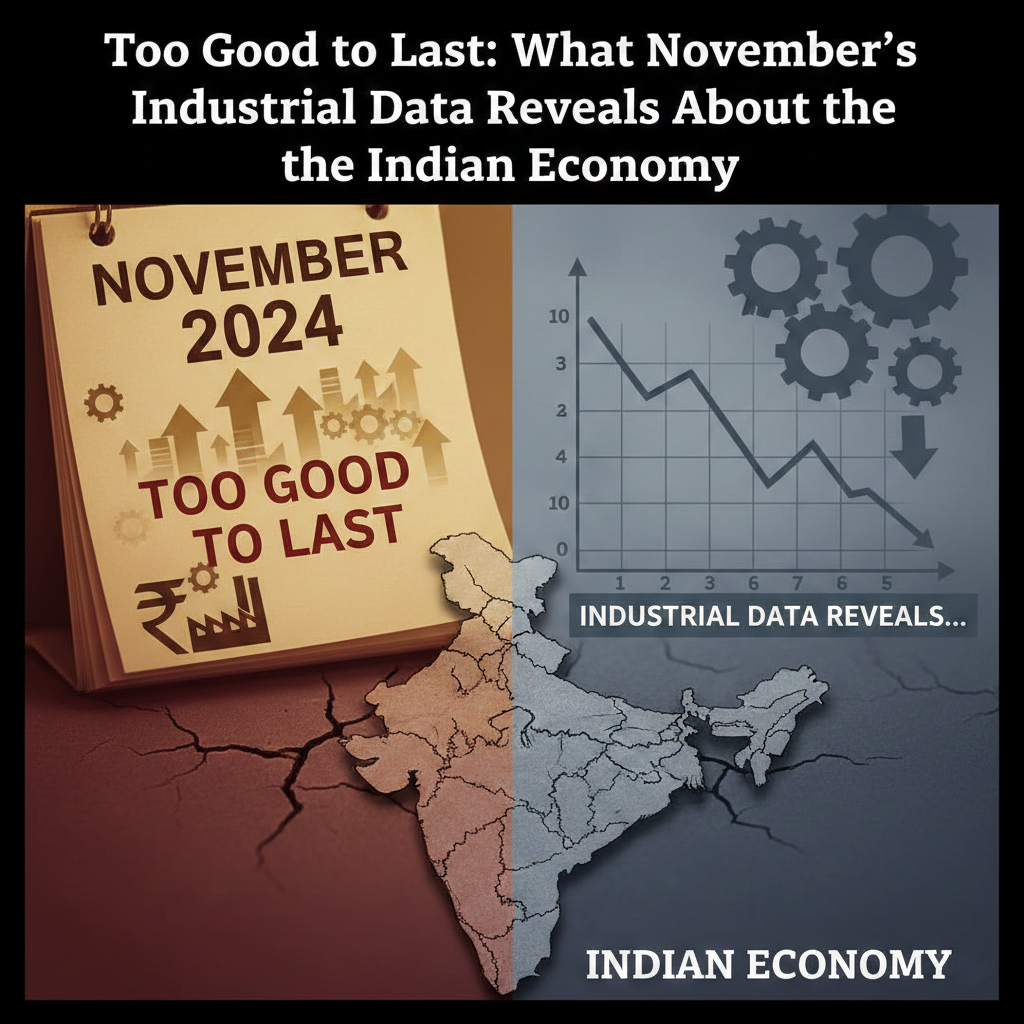
The phrase too good to last perfectly captures the story behind November’s industrial data and the Indian economy. At first glance, the numbers looked encouraging. Industrial output showed growth, manufacturing appeared resilient, and headlines hinted at economic stability. However, when the data is examined carefully, the optimism begins to fade.
November’s industrial performance offered a temporary lift, but underlying structural challenges remain unresolved. Demand softness, uneven sectoral growth, and global uncertainties continue to weigh on India’s economic momentum. Therefore, while the data brought short-term relief, it also raised important questions about sustainability.
This article breaks down November’s industrial data, explains what worked, highlights what didn’t, and explores what it truly means for India’s economy going forward.
Understanding November’s Industrial Data in Context
Industrial data, particularly the Index of Industrial Production (IIP), is one of the most closely watched indicators of economic health. It reflects the performance of manufacturing, mining, and electricity sectors.
What the November IIP Numbers Showed
According to official data released by the Ministry of Statistics and Programme Implementation:
- Overall industrial output registered moderate growth
- Manufacturing contributed the most to the rise
- Electricity output remained stable
- Mining showed marginal improvement
At face value, this signaled resilience. However, context matters.
Why Month-on-Month Comparisons Can Mislead
While year-on-year growth appeared decent, month-on-month trends revealed volatility. Industrial output has been uneven throughout the year, and November’s improvement followed a weaker October base. This means the growth was partly statistical rather than structural.
For reference, historical industrial data from the same period shows similar short-lived spikes followed by corrections, especially during times of demand uncertainty.
Outbound reference: https://www.mospi.gov.in
Manufacturing Growth: A Temporary Bright Spot
Manufacturing accounts for nearly three-fourths of India’s industrial output. Naturally, its performance shaped November’s data.
Sectors That Drove Manufacturing Growth
Some industries recorded notable expansion:
- Pharmaceuticals
- Basic metals
- Chemicals
- Electrical equipment
These sectors benefited from inventory restocking and selective demand recovery.
Why Manufacturing Momentum May Fade
Despite the improvement, several warning signs remain:
- Consumer demand remains weak in rural and semi-urban areas
- High interest rates are discouraging private investment
- Export-oriented units face slowing global demand
Therefore, while manufacturing lifted November’s numbers, it lacks broad-based support to sustain long-term growth.
Mining and Electricity: Limited Support to Industrial Output
Performance
Output showed only modest growth. Coal production helped offset weaker performance in minerals such as iron ore and bauxite. However, regulatory challenges and environmental clearances continue to restrict expansion.
Electricity Output Stability
Electricity generation remained steady rather than strong. This suggests that industrial activity has not accelerated significantly, as power demand often correlates directly with factory output.
Together, mining and electricity failed to provide strong backup to manufacturing, reinforcing the idea that November’s data may not signal a lasting trend.
Demand Conditions: The Core Weakness Beneath the Data
Urban Demand Shows Fatigue
Urban consumption, once a strong pillar, is showing signs of stress:
- Slower discretionary spending
- Reduced automobile sales growth
- Higher household debt
Although festive demand provided a seasonal push, it lacked depth.
Rural Demand Remains Fragile
Rural demand continues to struggle due to:
- Uneven monsoon impact
- Stagnant real wage growth
- Rising input costs for agriculture
Without a revival in mass consumption, industrial growth remains vulnerable.
Global Headwinds and Their Impact on Indian Industry
Export Slowdown Pressures
India’s industrial sector is increasingly connected to global markets. However:
- The US and Europe are witnessing economic slowdown
- Global trade volumes are moderating
- Geopolitical tensions are disrupting supply chains
Export-oriented industries such as textiles, gems, and engineering goods felt the pressure even in November.
Outbound reference: https://www.worldbank.org
Inflation, Interest Rates, and Industrial Investment
Cost Pressures Remain Elevated
Although inflation has eased from peak levels, input costs remain higher than pre-pandemic norms. This affects profit margins and discourages capacity expansion.
Impact of High Interest Rates
Tight monetary policy continues to affect borrowing:
- MSMEs face higher financing costs
- Capital expenditure decisions are being delayed
- Credit growth is selective rather than broad-based
As a result, industrial investment lacks momentum.
Outbound reference: https://www.rbi.org.in
Government Spending: Supportive but Not Sufficient
Public Capex Provides Cushion
Government-led capital expenditure in infrastructure has helped stabilize industrial activity. Roads, railways, and defense manufacturing benefited directly.
Why Public Spending Cannot Do It Alone
However, public capex has limitations:
- It cannot fully replace private investment
- Spillover effects take time
- Fiscal constraints limit expansion
Sustainable industrial growth requires stronger private sector participation.
Comparing November Data with Previous Trends
| Indicator | October | November | Trend Insight |
|---|---|---|---|
| IIP Growth | Lower | Moderate | Base effect driven |
| Manufacturing | Weak | Improved | Inventory-led |
| Mining | Flat | Marginal | Structural limits |
| Electricity | Stable | Stable | Demand-neutral |
The table highlights how November’s improvement was more corrective than transformational.
Why the Optimism May Be Too Good to Last
Several factors explain why November’s industrial data may not mark a turning point:
- Lack of demand-driven growth
- Dependence on selective sectors
- Global economic uncertainty
- Weak private investment cycle
Unless these challenges are addressed, industrial output could soften again in the coming months.
What Policymakers and Businesses Should Watch Next
Key Indicators to Monitor
- Core inflation trends
- Rural wage growth
- Export order books
- Bank credit growth
These metrics will provide clearer signals than headline IIP numbers alone.
Strategic Focus Areas
- Boosting consumption through income support
- Encouraging MSME credit access
- Enhancing export competitiveness
- Reducing regulatory bottlenecks
FAQs on November’s Industrial Data and the Indian Economy
Why did November’s industrial data look stronger than previous months?
November benefited from a low base, festive demand, and inventory restocking, rather than a broad-based economic revival.
Is India’s manufacturing sector recovering sustainably?
Not yet. While selective sectors improved, overall manufacturing lacks strong demand and investment support.
How does global slowdown affect India’s industrial output?
Slower global growth reduces export demand, impacts capacity utilization, and weakens industrial confidence.
Can government spending offset weak private demand?
Government capex helps stabilize growth but cannot fully compensate for weak consumption and private investment.
Where can I find reliable analysis on India’s economy?
You can follow independent economic coverage and insights on thenews.zone for detailed updates and expert opinions.
Conclusion: Reading Between the Numbers
November’s industrial data offered a moment of relief for the Indian economy. However, beneath the surface, the fundamentals remain fragile. Growth driven by base effects and temporary factors cannot substitute for strong demand, robust investment, and global stability.
The lesson is clear. Headline numbers should be interpreted with caution. Without structural reforms and demand revival, optimism may fade as quickly as it appeared.
For in-depth analysis, credible economic reporting, and timely updates on India’s growth story, stay connected with thenews.zone and make informed decisions backed by facts, not just figures.
