

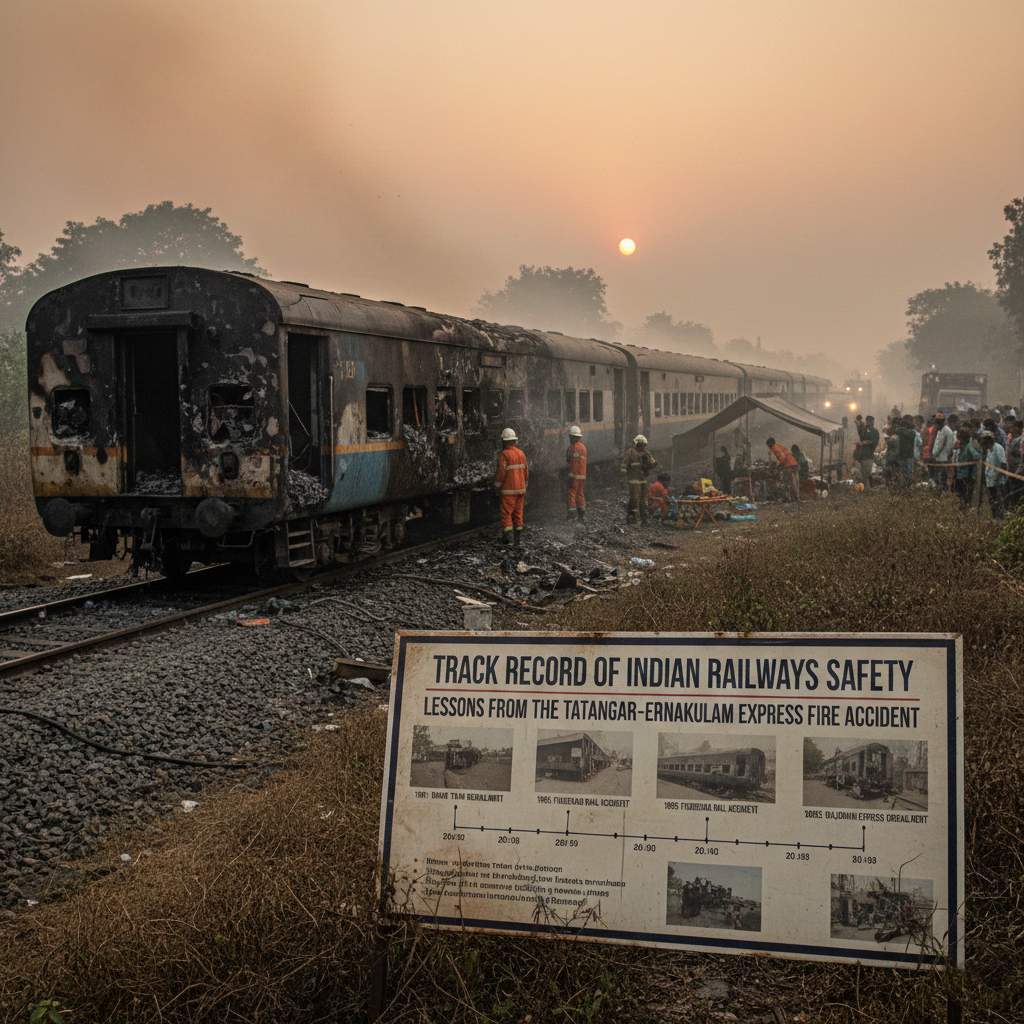
The Tatanagar–Ernakulam Express fire accident once again brought railway safety into the national spotlight. As millions of passengers depend on Indian Railways every day, even a single fire incident raises serious questions about preparedness, infrastructure, and long-term safety reforms. While Indian Railways has improved its safety record over the years, fire accidents remain among the most feared emergencies due to their sudden nature and potential for heavy casualties.
This article offers a complete, fact-based, and SEO-optimised analysis of the Tatanagar–Ernakulam Express fire incident. Moreover, it evaluates the broader track record of Indian Railways in handling fire accidents, compares past data, and explains what has changed, what still needs improvement, and how passengers can stay safe.
Understanding the Tatanagar–Ernakulam Express Fire Accident
What Happened During the Incident
The Tatanagar–Ernakulam Express, connecting Jharkhand to Kerala, was involved in a coach fire incident that triggered panic among passengers. According to preliminary reports, the fire broke out in one of the coaches during the journey, forcing emergency evacuation.
Although the incident did not lead to large-scale casualties, it highlighted how fire-related risks still persist in long-distance train operations.
Immediate Response and Rescue Measures
Indian Railways activated standard emergency protocols:
- Train halted immediately after smoke detection
- Passengers evacuated from affected coaches
- Fire brigade and railway officials rushed to the site
- Power supply isolated to prevent escalation
Thanks to prompt action, the fire was contained quickly. However, experts argue that prevention is as critical as response.
For real-time railway incident updates and in-depth reporting, readers can also follow trusted platforms such as thenews.zone.
Causes of Train Fire Accidents in India
Common Technical and Human Factors
Fire accidents in Indian trains generally occur due to a combination of technical failures and human negligence.
Key causes include:
- Electrical short circuits in wiring systems
- Overheating of pantry car equipment
- Illegal carrying of inflammable materials
- Poor maintenance of old coaches
- Unauthorized cooking or smoking
According to Indian Railways safety audits, electrical faults account for more than 60 percent of onboard fires.
Indian Railways Fire Safety Track Record
Historical Overview of Fire Incidents
Over the past two decades, Indian Railways has significantly reduced major accidents. However, fire-related incidents remain a sensitive area.
| Year Range | Average Fire Incidents per Year | Fatal Incidents |
|---|---|---|
| 2000–2009 | 20–25 | High |
| 2010–2019 | 10–15 | Moderate |
| 2020–2024 | Below 10 | Low |
Source: Ministry of Railways annual safety reports
Outbound reference: https://indianrailways.gov.in
The data clearly shows improvement. Nevertheless, even a single incident like the Tatanagar–Ernakulam Express fire demands accountability.
Safety Reforms Introduced by Indian Railways
Coach Design and Material Upgrades
In recent years, Indian Railways has shifted toward fire-retardant materials in coaches.
Key improvements include:
- LHB coaches with anti-flame interiors
- Smoke detection systems
- Fire extinguishers in every coach
- Improved electrical insulation
These upgrades have already reduced fire spread incidents by a significant margin.
Role of Technology in Fire Prevention
Advanced Monitoring and Detection Systems
Technology now plays a central role in accident prevention.
Major technological measures:
- Automatic fire and smoke sensors
- Real-time coach monitoring
- Thermal scanning in pantry cars
- AI-based predictive maintenance
According to railway safety experts, predictive maintenance alone can reduce fire risk by up to 40 percent.
Outbound reference: https://pib.gov.in
Comparing Indian Railways With Global Rail Safety Standards
How India Stands Internationally
When compared globally, Indian Railways performs better than many developing rail networks but still trails behind top-tier systems.
| Country | Fire Incidents per Billion Passenger Km |
|---|---|
| Japan | Very Low |
| Germany | Low |
| India | Moderate |
| Brazil | Moderate to High |
Despite operating the world’s fourth-largest rail network, India has managed to keep fatalities relatively controlled through scale-based safety planning.
Passenger Safety Protocols During Fire Emergencies
What Passengers Should Do
Passengers play an important role during emergencies.
Safety tips include:
- Immediately pull the alarm chain if smoke is noticed
- Move away from the affected coach calmly
- Cover nose and mouth with cloth
- Avoid jumping from moving trains
- Follow railway staff instructions
Educational safety campaigns on platforms like thenews.zone help spread awareness among daily travelers.
Accountability and Investigation Process
How Railway Fire Incidents Are Investigated
After any fire accident, Indian Railways initiates a multi-level inquiry.
The process includes:
- Preliminary inspection by railway officials
- Electrical and forensic examination
- Commissioner of Railway Safety inquiry
- Public disclosure of findings
These investigations help shape policy corrections and safety upgrades.
Media Coverage and Public Trust
Why Transparency Matters
Incidents like the Tatanagar–Ernakulam Express fire often lead to public anxiety. Transparent communication plays a vital role in maintaining trust.
Digital news platforms such as thenews.zone contribute by providing verified updates without sensationalism.
FAQs on the Tatanagar–Ernakulam Express Fire Accident
What caused the fire in the Tatanagar–Ernakulam Express?
Preliminary findings suggest an electrical fault, although a final report is awaited from railway authorities.
Were there any casualties?
No major casualties were reported due to quick evacuation and emergency response.
Are Indian trains safe after this incident?
Yes, statistically Indian Railways remains safe, and fire incidents have declined significantly over the years.
What safety measures are in place to prevent such fires?
Fire-retardant coaches, smoke detectors, extinguishers, and regular inspections are now mandatory.
Where can I find reliable railway safety news?
You can follow official updates from Indian Railways and independent reporting on platforms like thenews.zone.
Conclusion
The Tatanagar–Ernakulam Express fire accident serves as a reminder that railway safety is an ongoing responsibility, not a one-time achievement. While Indian Railways has made measurable progress in reducing fire incidents, continuous investment in technology, maintenance, and passenger awareness remains essential.
By learning from every incident, strengthening accountability, and maintaining transparency, Indian Railways can move closer to a zero-accident future.
For regular updates, deep analysis, and credible reporting on national safety issues, stay connected with thenews.zone and remain informed.
