

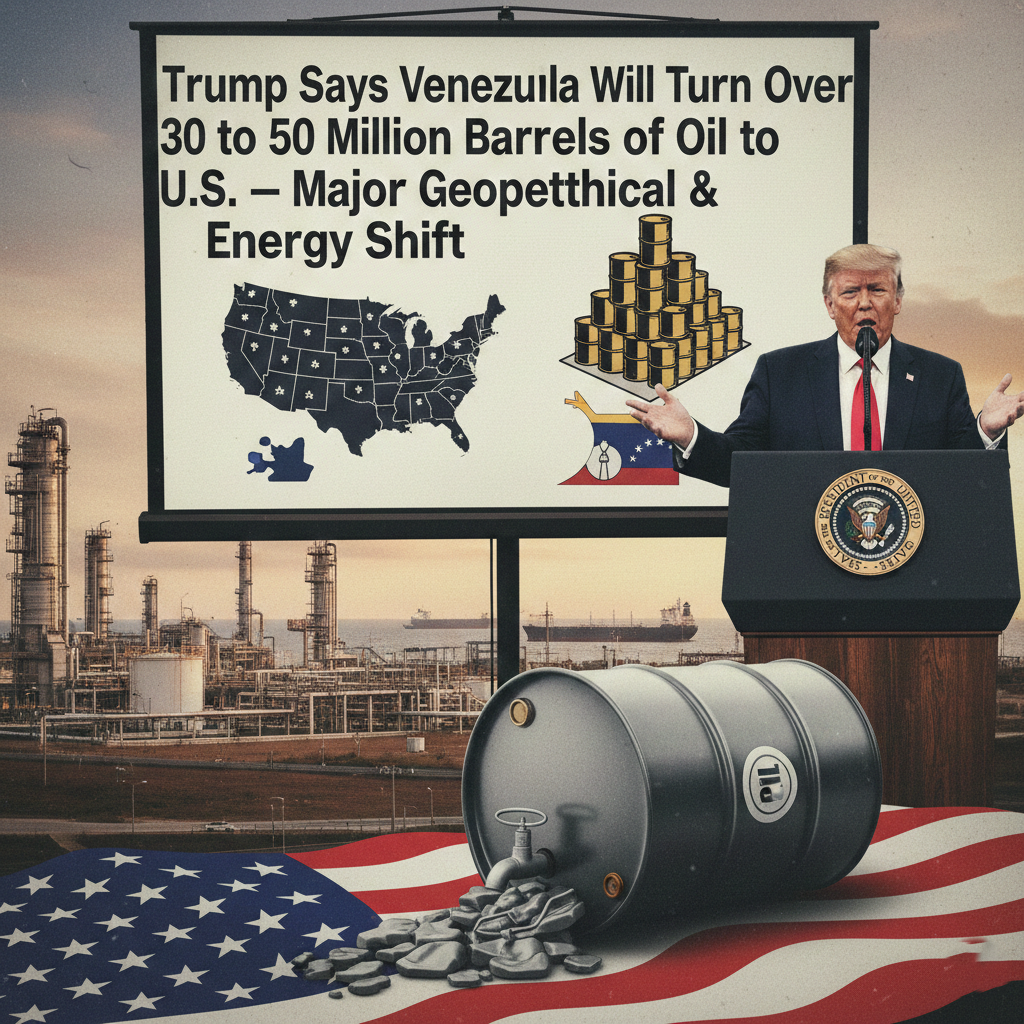
In a major geopolitical and energy announcement, U.S. President Donald Trump declared that Venezuela will transfer between 30 million and 50 million barrels of oil to the United States — a development that could reshape global oil dynamics. This declaration, confirmed by multiple leading news outlets, comes on the heels of a dramatic U.S. military intervention that resulted in the removal of Venezuelan President Nicolás Maduro and significant regional reactions. The move signals a pivotal moment in U.S.–Venezuela relations and global energy markets.
This article provides an in-depth analysis of the implications, context, and questions arising from this high-impact announcement.
Why Trump’s Oil Announcement Matters
Strategic Importance of Venezuelan Oil
Venezuela is widely recognized as one of the world’s richest nations in terms of proven oil reserves, with hundreds of billions of barrels of crude waiting to be tapped. Though actual daily output has declined in recent years due to sanctions and economic turmoil, the sheer volume of oil involved represents a significant strategic asset.
By asserting that Venezuela will transfer up to 50 million barrels of oil to the United States, Trump is pursuing both geopolitical leverage and economic opportunity.
What the Announcement Actually Says
According to U.S. government statements:
- Venezuela’s interim authorities will transfer 30–50 million barrels of sanctioned oil to the United States.
- The oil will be sold at market price, and Trump says the proceeds will be controlled by the U.S. administration to benefit citizens in both countries.
- Energy Secretary Chris Wright has been tasked with implementing the plan “immediately,” involving transport to U.S. ports and unloading directly at American facilities.
This description appears in Trump’s Truth Social post announcing the deal.
Key Background: Political and Military Context
This oil move did not occur in isolation. It follows a U.S. military operation in Venezuela that resulted in the capture of Nicolás Maduro, which has sparked significant controversy and international debate.
Official Venezuelan responses have been mixed, with some leaders denouncing U.S. interference and others navigating the new political landscape. The fact that an interim authority agreed to the oil transfer signals a dramatic shift in Venezuelan governance and global diplomacy.
Possible Global Energy Impacts
Effects on Oil Prices
The U.S. announcement has already had measurable effects on global oil markets. For example:
| Benchmark | Reaction After Announcement |
|---|---|
| WTI Crude | Prices dipped as markets priced in increased supply |
| Brent Crude | Slight downward adjustment amid oversupply concerns |
Reports indicate that oil futures fell around 1–1.5% shortly after Trump’s statement, reflecting global market sensitivity to supply changes.
Political Reactions and Criticism
Critics of the announcement raise several concerns:
- International law and sovereignty: Many world leaders and international organizations have questioned the legitimacy of U.S. military and economic actions in Venezuela.
- Humanitarian implications: Opponents argue that seizing control of another country’s oil raises ethical and legal questions about exploitation and national sovereignty.
- Domestic politics: Inside the U.S., reactions vary across political factions, with debates in Congress about constitutional authority and war powers.
Economic and Strategic Benefits (as Claimed by the U.S.)
Supporters of Trump’s plan argue the oil transfer could:
- Boost U.S. energy security by increasing access to heavy crude that U.S. refineries can process efficiently.
- Stabilize global supply at a time when tensions in the Middle East and OPEC decisions influence markets.
- Economic advantage to the U.S. through revenue controlled by the government, which may be used for domestic programs.
Supporters cite these points as major motivations behind the initiative.
FAQ: Trump Oil Deal with Venezuela Explained
Q1: How much oil is Venezuela giving to the U.S.?
A: President Trump said Venezuela’s interim authorities will transfer 30 to 50 million barrels of oil to the United States, to be sold at market prices.
Q2: Why is this decision significant?
A: The transfer represents both a geopolitical shift and a potential boost in U.S. energy supply, with possible effects on global markets.
Q3: Are there legal concerns about the oil transfer?
A: Yes. Many international legal scholars and world leaders have questioned the legitimacy of U.S. actions in Venezuela and the implications for sovereignty.
Q4: Will this reduce gasoline prices in the U.S.?
A: Not necessarily. While increased supply can put downward pressure on prices, refinery cycles, logistical factors, and taxes also play major roles.
Q5: Where can readers find more updates on this topic?
A: For ongoing coverage, follow credible news sources such as Reuters, Al Jazeera, and Associated Press. For related updates, visit thenews.zone — your centralized source for global energy and geopolitical reporting. (internal link)
External Resources for Further Reading
- Detailed coverage on this development: Reuters – Trump says Venezuela to turn over 30–50 million barrels of oil to US. Reuters
- Context on the evolving crisis: Al Jazeera – Trump says Venezuela to hand over up to 50 million barrels of oil to US. Al Jazeera
Conclusion
President Trump’s announcement that Venezuela will transfer 30–50 million barrels of sanctioned oil to the United States marks a rare and controversial moment in global energy politics. Whether this move ultimately stabilizes energy markets, alters diplomatic relationships, or stokes further geopolitical tensions, it remains a defining story of 2026.
As developments continue to unfold, staying informed is essential. Keep up with updates at thenews.zone and trusted international outlets to understand how this oil deal reshapes economics, energy, and world affairs.
