

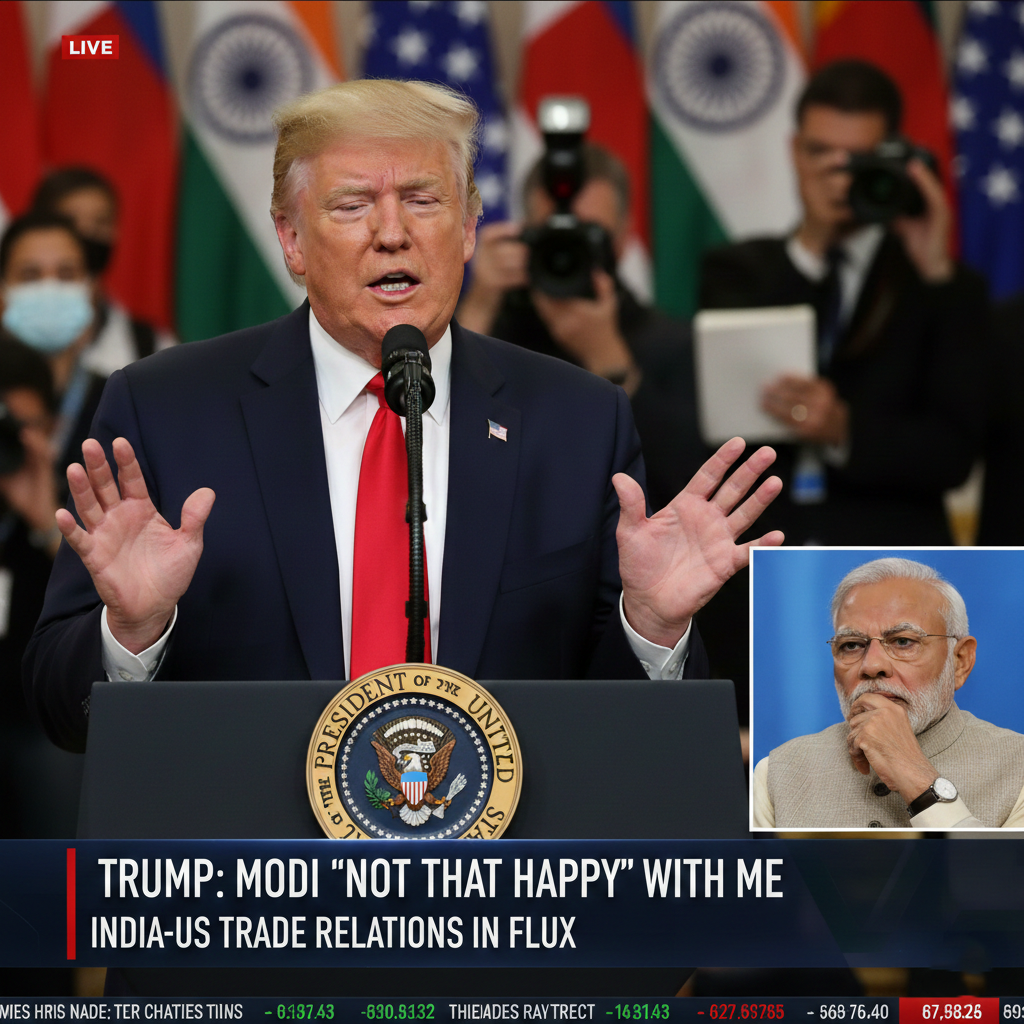
Former US President Donald Trump’s statement that Prime Minister Narendra Modi is “not that happy with me” because India is paying “a lot of tariffs” has once again brought India-US trade relations into the global spotlight. The remark, made during a recent campaign-style interaction, highlights long-standing trade friction between the world’s two largest democracies.
Although Trump is known for blunt diplomacy, his comments reveal deeper structural issues in bilateral trade, especially around tariffs, market access, and protectionism. Moreover, with Trump positioning himself strongly ahead of future US elections, such statements are not just personal opinions but also political signals.
This article breaks down the context, facts, economic impact, and strategic consequences of Trump’s remarks, while also exploring what lies ahead for India-US trade ties.
Understanding Trump’s Statement on PM Modi and Tariffs
Donald Trump has repeatedly accused India of being a “tariff king.” His latest comment reinforces a familiar narrative.
What Trump Said and Why It Matters
Trump claimed that India imposes heavy tariffs on American products, adding that PM Modi is unhappy with him because the US pushed back strongly during his presidency.
This matters because:
- It revives trade tensions that cooled slightly under President Joe Biden
- It signals Trump’s potential return to aggressive trade negotiations
- It impacts investor sentiment and geopolitical alignments
Trump’s remarks were not accidental. Instead, they align with his broader America First trade policy, which prioritizes domestic manufacturing and reciprocal tariffs.
India-US Trade Relations: A Brief Background
Before analyzing the controversy, it is important to understand the foundation of India-US trade ties.
Growth of Bilateral Trade
India and the US share one of the fastest-growing trade relationships globally.
| Indicator | Value |
|---|---|
| Total bilateral trade | Over 190 billion dollars |
| India exports to US | IT services, pharma, textiles |
| US exports to India | Defense, energy, aircraft |
| Strategic status | Comprehensive Global Strategic Partnership |
According to data from the US Trade Representative, India remains a key partner despite disagreements.
Outbound reference: https://ustr.gov
Why Tariffs Became a Flashpoint Between India and the US
Tariffs are central to Trump’s criticism. However, the issue is more complex than it appears.
India’s Perspective on Tariffs
India argues that:
- Tariffs protect domestic industries and MSMEs
- Developing economies need policy space
- The US also subsidizes its own sectors
Furthermore, India maintains higher tariffs mainly on agriculture, dairy, and certain manufactured goods to safeguard farmers and local businesses.
The US Viewpoint Under Trump
On the other hand, Trump’s administration believed:
- India’s tariffs were unfairly high
- American companies faced market access barriers
- Trade deficits harmed US manufacturing
As a result, the US withdrew India’s GSP benefits in 2019, affecting nearly 6 billion dollars worth of Indian exports.
Outbound reference: https://www.brookings.edu
Key Sectors Affected by India-US Tariff Disputes
The tariff conflict did not impact all sectors equally. Some industries felt the pressure more intensely.
Agriculture and Dairy
- The US sought access for dairy products
- India resisted due to cultural and religious sensitivities
- Farmers’ protection remained a political priority
Steel and Aluminum
- The US imposed tariffs under national security grounds
- India retaliated with counter-tariffs
- This escalated trade tensions temporarily
Technology and Digital Trade
- India’s data localization policies worried US tech firms
- Visa restrictions impacted Indian IT companies
- However, cooperation continued in emerging technologies
Comparing India’s Tariffs With Global Standards
Trump often portrayed India as an outlier. But is that entirely accurate?
| Country | Average Tariff Rate |
|---|---|
| India | Higher in agriculture |
| United States | Low average but high subsidies |
| China | Strategic tariffs |
| EU | Complex non-tariff barriers |
While India’s tariffs are higher in certain sectors, experts argue that non-tariff barriers in developed economies often offset lower tariffs.
Outbound reference: https://www.wto.org
Political Messaging Behind Trump’s Remark
Trump’s statement should also be viewed through a political lens.
Domestic Audience Strategy
Trump’s messaging aims to:
- Appeal to US manufacturers
- Reinforce his tough trade image
- Contrast himself with Biden’s diplomacy
By mentioning PM Modi, Trump indirectly signals that even strong leaders had to adjust under his presidency.
Impact on India-US Diplomatic Tone
Despite strong personal rapport between Modi and Trump, trade disagreements never fully disappeared. However, diplomatic channels remained open, preventing escalation.
How the Modi Government Responded to Tariff Pressure
India adopted a calibrated response rather than confrontation.
Strategic Adjustments
- Reduced tariffs on select US goods
- Increased energy imports from the US
- Strengthened defense and strategic cooperation
These moves helped maintain balance while protecting core economic interests.
Internal reference: thenews.zone
Biden Era Versus Trump Era Trade Approach
There is a clear difference between the two administrations.
Biden’s Multilateral Approach
- Focus on supply chain resilience
- Less public criticism of India
- Emphasis on strategic alignment against China
Trump’s Transactional Style
- Public pressure through statements
- Immediate tariff threats
- Focus on trade deficits
If Trump returns to power, India may again face a tougher negotiating environment.
Global Implications of Renewed Trade Tensions
India-US trade relations influence global markets.
Impact on Indo-Pacific Strategy
Both nations collaborate closely to counter China’s influence. Trade friction could complicate this alignment, although strategic interests still outweigh disagreements.
Investor Confidence and Markets
Uncertainty around tariffs can:
- Affect stock markets
- Delay investment decisions
- Impact currency stability
Therefore, clarity in trade policy remains crucial.
Outbound reference: https://www.worldbank.org
What Experts Are Saying
Trade experts believe Trump’s remarks are more rhetorical than immediate policy signals.
Key Expert Opinions
- India remains indispensable to US strategy
- Tariffs are negotiation tools, not end goals
- Long-term cooperation will continue
However, they also warn that protectionist rhetoric can quickly translate into real policy shifts.
Frequently Asked Questions
Why did Trump say PM Modi is unhappy with him?
Trump referred to trade disagreements, particularly India’s high tariffs on US goods, which he criticized during his presidency.
Outbound reference: https://www.reuters.com
Did India really pay high tariffs to the US?
India imposed tariffs on specific American products, mainly in retaliation to US measures. However, overall trade remained strong.
Internal reference: thenews.zone
Will India-US trade relations worsen if Trump returns?
While rhetoric may intensify, strategic and economic ties are likely to continue due to mutual interests.
Outbound reference: https://www.cfr.org
How important is the US to India’s economy?
The US is India’s largest trading partner and a key destination for exports, investments, and technology collaboration.
Internal reference: thenews.zone
Conclusion: What Lies Ahead for India-US Trade
Donald Trump’s statement that PM Modi is unhappy due to tariffs is more than just political commentary. It reflects unresolved trade tensions that could resurface depending on future leadership in Washington.
However, India-US relations are no longer limited to trade alone. Strategic cooperation, defense partnerships, and shared geopolitical goals ensure that disagreements are managed rather than allowed to derail ties.
As global economics become increasingly interconnected, both nations will need pragmatic solutions rather than public posturing.
For more in-depth global political and economic analysis, stay updated with thenews.zone and explore our expert coverage on international affairs.
