

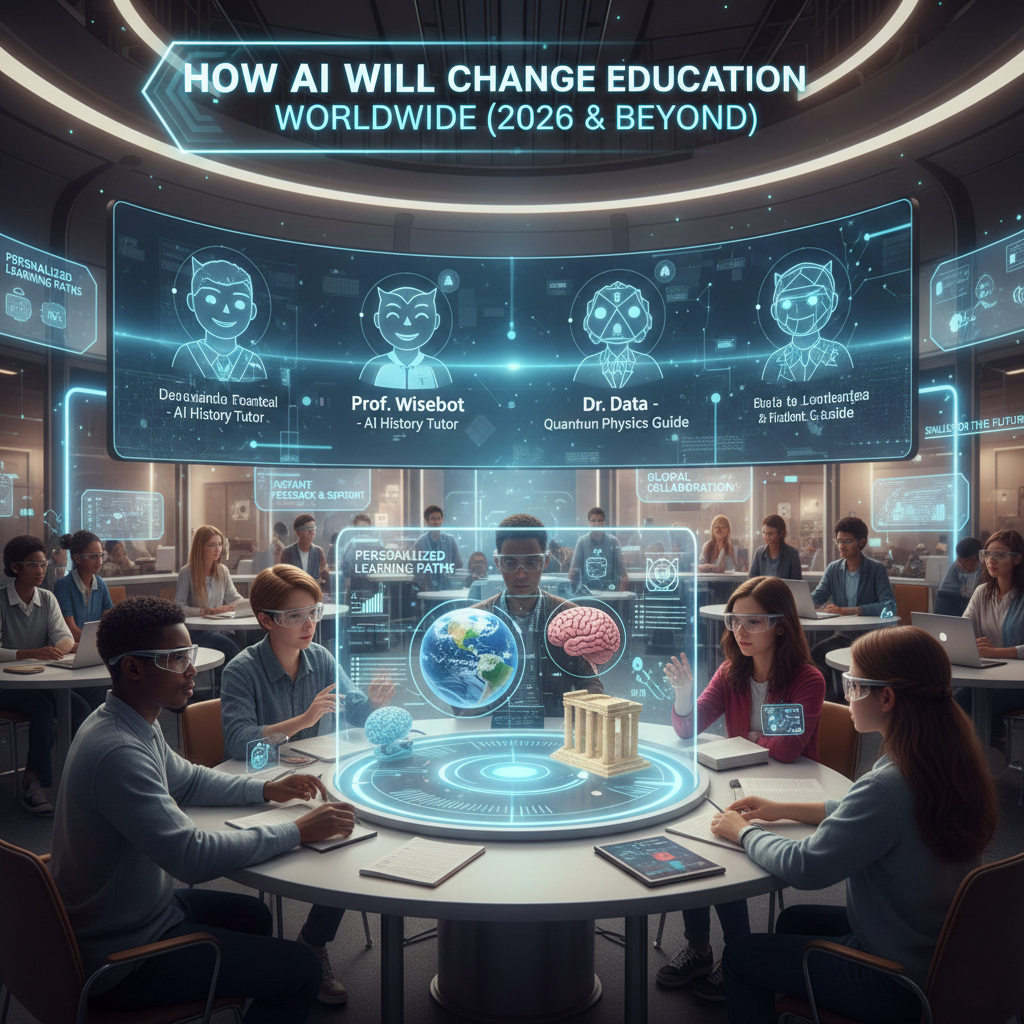
Education is standing at the edge of its biggest transformation in history — and the driving force behind it is Artificial Intelligence. What the internet did in 20 years, AI is doing in five. Classrooms are changing, teachers are evolving into digital facilitators, and students are beginning to learn in ways that were impossible just a decade ago.
From creating personalized study plans to turning textbooks into interactive lessons, from AI tutors helping students 24/7 to predictive analytics identifying learning gaps before they turn into failures — the future of education is becoming smarter, faster, and more global.
Let’s dive deep into how AI will change education worldwide, what the future classroom looks like, and how students, teachers, schools, and global learning systems will adapt in the next decade.
1. Personalized Learning for Every Student
One of the biggest problems in traditional education is that every student learns differently, but most classrooms teach everyone the same way. AI flips that model completely.
How AI Personalization Works:
- AI studies a student’s behavior, speed, understanding, and mistakes
- It adjusts the learning path automatically
- Strong areas move quickly, weak areas slow down
- Students get custom practice questions, notes, and examples
This means no more one-size-fits-all learning.
Real Impact:
- A student struggling in math gets simplified explanations
- A fast learner in science jumps ahead without being held back
- Language learners get speech feedback instantly
- Special-needs students get tailored learning routines
This alone could improve global learning outcomes by 40–60% according to many educational researchers.
2. AI Tutors That Teach 24/7
Imagine having a private tutor available anytime — for free.
That’s exactly what AI tutors are becoming in 2026.
Tools like ChatGPT, Khanmigo, Google NotebookLM, and other AI assistants are already helping students worldwide:
What AI Tutors Can Do:
- Explain complex topics in simple words
- Solve math problems step-by-step
- Help with homework
- Generate notes, summaries, flashcards
- Provide quizzes and tests
- Help with essays and creative writing
- Translate and teach languages
This gives students instant help, something teachers could never provide outside school hours.
For millions of children in rural areas or low-income countries, AI tutors may become the first high-quality learning support they ever receive.
3. AI-Powered Smart Classrooms
Schools are adopting AI-driven smart boards, voice assistants, and automated systems that help teachers run classes more efficiently.
What a Smart Classroom Looks Like:
- AI screens track attendance automatically
- Cameras evaluate student engagement
- Voice-enabled systems answer questions
- AI projectors turn lessons into 3D simulations
- Teachers get real-time dashboards showing which students are confused
The classroom of the future won’t just be digital — it’ll be intelligent.
4. Automated Grading and Assessment
Teachers spend up to 40% of their time on grading, checking homework, and administrative tasks.
AI completely eliminates this burden.
AI Can Grade:
- Objective tests
- Long essays
- Written assignments
- Coding tasks
- Presentations
- Handwritten sheets (via OCR)
This means teachers can spend more time on teaching and less on paperwork.
Even advanced AI can detect:
- plagiarism
- AI-generated text
- writing patterns
- conceptual understanding
- mistakes in logic
Smarter grading → Faster feedback → Better learning.
5. Predictive Analytics: Spot Problems Before They Happen
This is where AI becomes truly revolutionary.
AI systems can analyze years of student data and predict:
- Who is likely to struggle in the next exam
- Who needs extra support in a subject
- Who is losing interest
- Who is at risk of dropout
- Which teaching methods work best
This allows schools to intervene before the problem grows.
Example:
If a student’s homework accuracy drops from 80% to 50% for 2 weeks, the AI alerts the teacher automatically.
Early intervention can save thousands of struggling students.
6. AI Will Teach Skills for Future Jobs
The future economy will need skills very different from today — and AI will help teach them.
Future-Focused Skills AI Will Train Students In:
- Coding & automation
- Data literacy
- AI tool usage
- Critical thinking
- Problem-solving
- Digital communication
- Virtual collaboration
- Cybersecurity basics
- Robotics
School curriculums will shift from memorizing facts to applying knowledge — with AI guiding the process.
7. AI Will Break Language Barriers Globally
One of the most beautiful impacts of AI in education will be its ability to connect the world.
What AI Will Enable:
- Real-time translation in virtual classrooms
- Students from different countries studying together
- Teachers speaking any language through AI voice systems
- Worldwide access to top educators
A child in India can learn from a French teacher.
A child in Brazil can attend a global math class.
A child in Africa can do a course from MIT with real-time translation.
This creates true global learning access.
8. VR, AR & Virtual AI Classrooms
AI combined with Virtual Reality (VR) and Augmented Reality (AR) will create the most immersive learning experiences ever.
Students Can:
- Explore the solar system in 3D
- Walk inside the human body
- Practice chemistry without real chemicals
- Visit historical events like a time traveler
- Train in engineering simulations
No more passive learning — education will become experiential.
9. AI Will Reduce Educational Inequality
Millions of children globally don’t have access to good schools or teachers.
AI can bridge this massive gap.
How AI Helps:
- Free learning apps
- AI textbooks
- Local-language content
- Offline AI tools
- Remote digital classes
Even one mobile phone becomes a “school in your pocket.”
For remote villages, refugee regions, low-income areas — AI may be the biggest equalizer in human history.
10. Teachers Won’t Be Replaced — They’ll Become Super-Teachers
AI is not here to replace teachers.
It’s here to help them.
Teachers will have:
- AI lesson planners
- AI content generators
- AI grading assistants
- AI analytics dashboards
- AI behavior tracking tools
- AI-powered teaching materials
Instead of doing administrative tasks, teachers will focus on:
- creativity
- emotional support
- mentoring
- critical thinking
- values & character development
AI handles the data.
Teachers handle the human side.
11. Exams Will Become Smarter & More Accurate
Traditional exams are flawed — memorization, fear, short-term cramming, one-day pressure.
AI introduces:
- adaptive exams
- open-book AI-supported testing
- skill-based assessments
- real-world performance evaluation
- continuous learning tracking
- AI viva and oral tests
Education shifts from learning facts to solving problems.
12. AI Will Change Universities Forever
Universities worldwide will enter a hybrid-AI model:
Trends Coming by 2026–2030:
- AI professors for basic subjects
- Shorter 1-year degree formats
- Micro-certifications
- Skill-based AI learning paths
- Global virtual classrooms
- Personalized university timelines
Degrees will matter less.
Skills will matter more.
AI makes learning continuous and borderless.
13. Education Will Become Cheaper, Faster & More Accessible
Thanks to automation, AI tutors, and smart content generators:
- Tuition costs drop
- Learning becomes self-paced
- Students finish degrees faster
- Schools save money on operations
- Global courses become free
- Textbooks become digital & interactive
AI democratizes education — the same way smartphones democratized information.
14. The Future Classroom: What It Will Look Like in 2030
A classroom in 2030 might look like this:
- Smart boards analyzing learning metrics
- AI assistants answering student questions
- VR labs for science & history
- Students wearing AR glasses
- Robots helping with teaching
- Cloud-based homework
- Global group assignments
- Real-time translation
- Personalized AI dashboards for every student
Education won’t be limited by walls, teachers, countries, or language.
The entire world becomes a learning platform.
15. Challenges & Concerns We Must Prepare For
AI in education is powerful — but not without risks.
Challenges to Solve:
- Data privacy for children
- Over-dependence on technology
- Digital divide between rich & poor
- Quality control of AI-generated content
- Ethical use of student data
- Need for teacher retraining
- AI bias & fairness in assessment
Countries must build strong policies to balance innovation with safety.
Conclusion: AI Will Create the Smartest Generation in Human History
Artificial Intelligence will not just improve education —
it will redefine what it means to learn.
Students will learn faster, deeper, and more personally than ever before.
Teachers will become empowered professionals with super tools.
Schools will transform into global digital learning hubs.
A child in any corner of the world will have access to world-class education.
The next decade will witness a revolution — not just in technology, but in opportunity, equality, and human potential.
And AI will be the engine driving it.
