

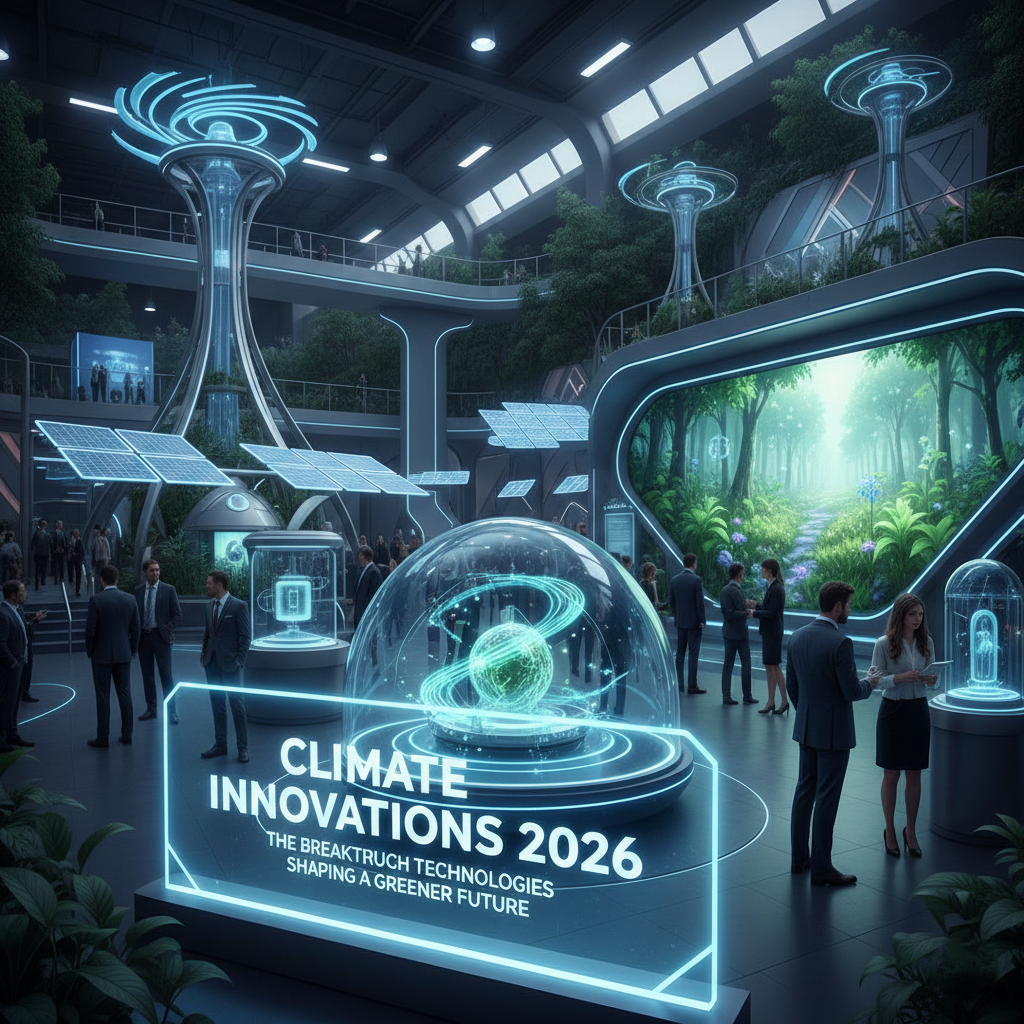
Climate change is no longer a distant worry — it is shaping the world we live in right now. Rising temperatures, unpredictable rainfall, melting ice, food insecurity, and extreme weather patterns have made one thing clear: humanity needs innovation at a massive scale. The good news? Scientists, startups, governments, and global tech giants are accelerating climate innovation like never before.
2026 is shaping up to be a historic year for climate technology. From carbon-removal machines to AI-powered agriculture, from next-gen renewable energy to climate-friendly construction, the world is entering a new era where technology can actually reverse some of the damage done to the planet.
🔥 Why 2026 Is a Breakthrough Year for Climate Innovation
The climate tech boom didn’t happen overnight. But 2026 marks an inflection point because of three major global shifts:
1. Governments Are No Longer Just “Talking” — They Are Funding Big
Multiple countries have rolled out billion-dollar climate tech funds, tax credits, and incentives. The U.S., EU, India, Japan, Korea, Australia, Canada, and Middle-East nations have all launched programs to accelerate renewable energy, EVs, hydrogen, carbon removal, and climate-positive agriculture.
2. AI Is Boosting Climate Solutions
Artificial intelligence is now deeply embedded in climate science – predicting weather, optimizing energy, increasing crop yields, reducing waste, and accelerating discovery of new materials.
3. Climate Startups Are Exploding Worldwide
2025 saw record funding for climate startups. In 2026, over 2,000 new companies worldwide are working on energy storage, carbon capture, micro-nuclear reactors, EV batteries, bio-materials, and regenerative farming.
🌞 1. Ultra-Efficient Renewable Energy Systems
Renewables were already rising globally, but 2026 brings next-generation improvements that make them cheaper, more efficient, and more reliable.
Solar 4.0 – The New Standard
New solar technologies launching in 2026 include:
- Perovskite Solar Cells (PSC) with up to 40% efficiency
- Transparent solar panels for windows, car roofs, and skyscrapers
- Self-healing solar coatings that repair micro-cracks automatically
- Off-grid solar micro-units for homes in rural areas
Solar energy is becoming so cheap that many countries expect solar to be their primary energy source by 2030.
Wind Energy 2026: Bigger, Smarter, Autonomous
Wind farms are now adopting:
- AI-controlled turbines that adjust blades automatically
- Floating offshore wind that generates twice the output
- Carbon-fiber blades that last 40% longer
Countries like Denmark, UK, China, and India are leading the massive deployment of floating wind farms in 2026.
⚡ 2. Next-Gen Energy Storage & The 100% Renewable World
The biggest challenge of renewable energy has been storage — but 2026 changes the game.
New Battery Technologies Transforming the Grid
Several breakthroughs are now commercially viable:
- Solid-state batteries (safer, no liquid electrolyte, longer life)
- Sodium-ion batteries (cheaper than lithium)
- Sand batteries (store heat for months)
- Gravity batteries (use weights to store and release energy)
These new systems allow countries to store renewable power for hours, days, and even months, making blackouts less likely and renewable power more stable.
Home Storage Going Mainstream
Just like smart TVs, home batteries are becoming common consumer products.
Tesla Powerwall, Panasonic, LG, BYD, and new Indian startups are launching modular home energy storage systems at prices 40–60% cheaper than previous generations.
🌱 3. Carbon Removal: Cleaning the Air Like Never Before
Carbon removal is one of the most exciting climate innovations of 2026.
These technologies don’t just reduce emissions — they capture CO₂ already in the atmosphere.
Direct Air Capture (DAC) Machines
Companies in Switzerland, Iceland, UAE, India, Japan, and the USA are building massive air-cleaning plants that suck out CO₂ and store it underground or turn it into useful materials.
Ocean Carbon Removal
New 2026 methods include:
- Ocean alkalinity enhancement
- Kelp farming + sinking
- Wave-powered carbon extractors
Oceans absorb 30% of Earth’s CO₂, and these methods accelerate natural carbon removal cycles.
Biochar & Soil Carbon Storage
Farmers worldwide are adopting biochar — a charcoal-like material mixed into soil — improving soil quality while locking carbon for centuries.
🚗 4. Transportation Revolution: EVs, Hydrogen & Clean Mobility
Transportation is one of the biggest pollution sources. In 2026, mobility innovation is exploding.
Electric Vehicles Are Becoming the Default
2026 is the year EVs become cheaper than petrol cars in many countries.
Breakthroughs include:
- EVs with 1,000 km range
- 5-minute charging batteries
- Cheaper EVs under $10,000 from India and China
- Wireless road charging trials
Hydrogen Vehicles Strengthen Heavy Transport
Hydrogen trucks, buses, and ships are expanding rapidly.
Countries investing heavily include:
- Japan
- Germany
- South Korea
- Saudi Arabia
- India
Hydrogen is especially promising for aviation and heavy freight, areas where batteries fall short.
Smart Mobility: AI Traffic Management
Cities now use AI to:
- Reduce traffic congestion
- Optimize bus routes
- Manage EV charging
- Reduce fuel waste
- Predict transport demand
🌿 5. Agriculture & Food: AI-Powered Farming & Climate-Resilient Crops
Feeding 8+ billion people during climate change requires a revolution in farming — and 2026 is delivering it.
AI-Driven Precision Agriculture
Farmers now use AI to:
- Predict rainfall and pest outbreaks
- Optimize fertilizers and water use
- Monitor plant health via drones
- Reduce crop failure
- Increase yield by 20–40%
Climate-Resilient Crops
Scientists have developed new crop varieties:
- Heat-resistant wheat and rice
- Drought-tolerant maize
- Saltwater-tolerant rice for coastal areas
This is critical as rising temperatures threaten food security worldwide.
Vertical Farming & Hydroponics
Cities like Singapore, Dubai, London, Delhi, and Tokyo are scaling:
- Soil-less farming
- LED-powered indoor crops
- Automated farms using robots
They use 95% less water and grow crops 3–5× faster.
🏗️ 6. Climate-Smart Construction & Green Materials
The construction industry contributes nearly 40% of global carbon emissions — but 2026 innovations are changing that.
Carbon-Neutral Buildings
New construction regulations in many countries now require:
- Solar rooftops
- Rainwater systems
- Green insulation
- Energy-efficient materials
- Smart energy management
Green Cement & Recycled Steel
New materials reduce emissions by 30–70%:
- Bio-cement made from bacteria
- Recycled steel with no coal used
- Hempcrete & mycelium bricks
- 3D-printed eco homes
These innovations make buildings cheaper, stronger, and climate-friendly.
Cool Roof Technology
Reflective roofs reduce city heat, lowering AC usage by up to 40%.
🧠 7. AI & Big Data: The Brains Behind Climate Solutions
AI is one of the biggest climate technologies of 2026.
AI Predicts Climate Disasters
AI now predicts:
- Flood risks
- Heatwaves
- Storm intensities
- Wildfire paths
- Rainfall patterns
This helps governments plan evacuations, prepare resources, and save lives.
AI Optimizes Energy Systems
AI balances:
- Grid supply
- EV charging
- Renewable power output
- Industrial energy demand
This prevents blackouts and reduces wastage.
🌊 8. Water Innovation: Desalination, Recycling & Smart Distribution
As water scarcity increases, 2026 brings powerful new solutions.
Solar-Powered Desalination
New plants convert seawater to fresh water at 60% lower cost.
AI-Smart Water Networks
Cities use sensors and AI to:
- Detect leaks instantly
- Reduce water loss
- Monitor quality in real time
Wastewater Recycling for Drinking
Countries like Singapore, Israel, UAE, USA, and India are leading safe, advanced recycling systems.
♻️ 9. Circular Economy 2026: Waste-to-Energy & Eco-Recycling
Instead of landfills, 2026 industries are focusing on circularity.
Waste-to-Energy Plants
Modern plants convert:
- Plastic into fuel
- Waste into electricity
- Food waste into biogas
Advanced Plastic Recycling
2026 tech breaks down plastics into:
- Oils
- Chemicals
- Building materials
This helps fight pollution and reduce landfill dependency.
💰 10. Climate Finance & Green Investment Explosion
Climate investment has become one of the fastest-growing financial sectors.
Rising trends:
- Green bonds
- Climate mutual funds
- Sustainable real estate investments
- Carbon credit markets
- ESG-backed startup funding
Investors are moving money toward companies that contribute to net-zero goals.
🔮 The Future: What Climate Tech Looks Like in 2030
Based on 2026 innovations, the next decade will likely bring:
- Cities powered 80–100% by renewables
- Fully autonomous EV fleets
- Carbon-negative buildings
- AI-managed global climate networks
- Large-scale hydrogen aviation
- CO₂-free cement and steel industries
- Reforestation using drones at massive scale
Climate technology is no longer just a possibility — it is becoming a global reality.
