

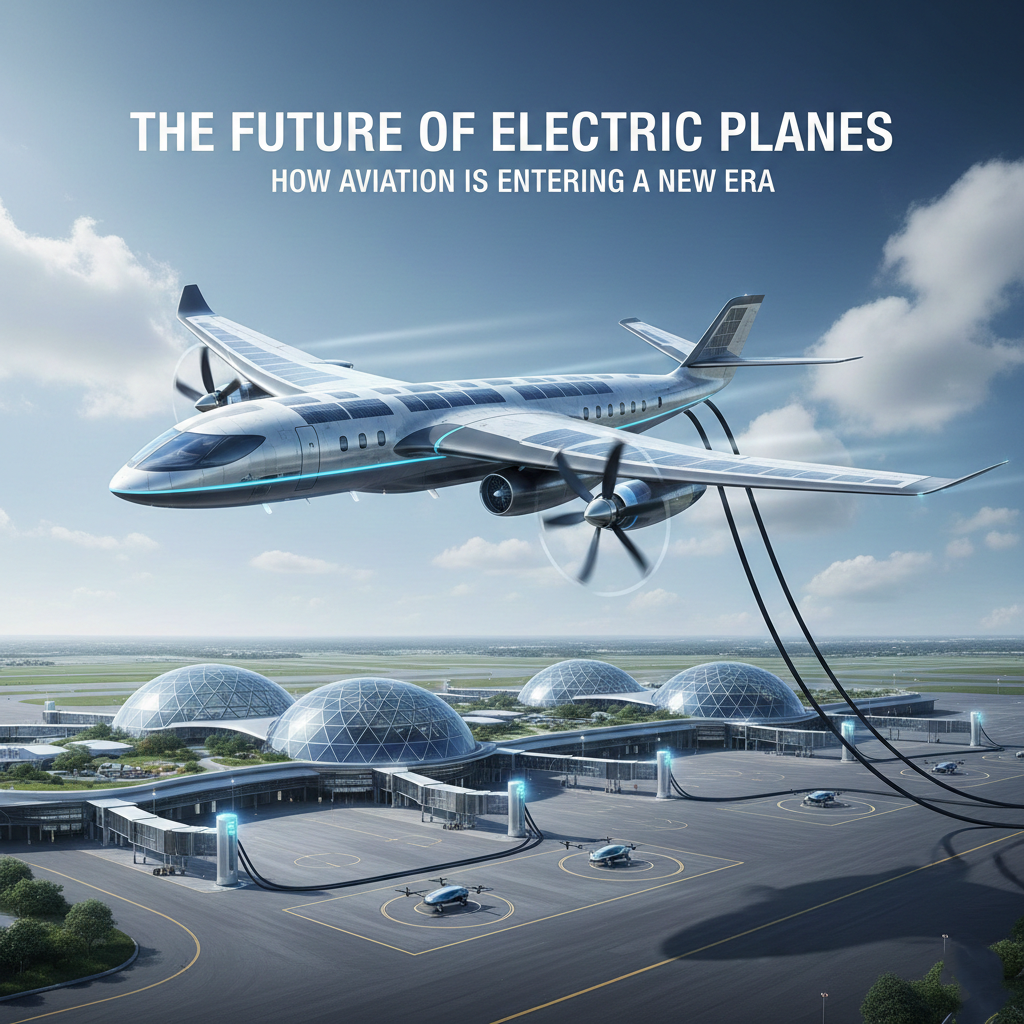
The dream of flying on purely electric aircraft — quieter, greener, and far more efficient than today’s jet-fuel giants — is no longer science fiction. As the world seeks to decarbonize transportation, electric and hybrid-electric aviation has transitioned from concept to fast-moving development, with prototypes, regional aircraft programs, and vertical take-off and landing (eVTOL) designs emerging globally.
In this deep-dive, we’ll explore:
- Why electric planes matter
- Where the technology stands today
- Key innovation categories (electric, hybrid, and hydrogen)
- Leading companies and projects
- Real-world challenges
- When electric passenger flights might become mainstream
- What it means for future travel, the environment, and society
🌱 Why Electric Planes Are the Next Big Leap in Aviation
The aviation industry contributes a significant portion of global CO₂ emissions. Unlike road transport — where electric cars and buses are already widespread — aircraft are much harder to electrify due to energy-density challenges and safety requirements. Still, cleaner aviation is critical to hitting global climate goals.
Electric planes promise:
- Lower carbon emissions, helping aviation decarbonize
- Reduced noise pollution, ideal for urban air mobility
- Lower operating costs, with electric motors cheaper to maintain
- New forms of flight, like distributed propulsion and urban air taxis
These drivers are pushing governments, startups, and legacy aerospace players to invest billions in new designs.
✈️ Types of Electric and Electrified Aircraft
Electric aviation isn’t one thing — it’s a spectrum of technologies from short-range electric flyers to hybrid airliners.
1. Fully Electric Planes
These airplanes use only onboard batteries to power electric motors. They have no combustion engines. Fully electric designs are currently best suited for:
- Short regional routes (20–200 km)
- Training aircraft
- Urban air mobility (eVTOL)
Battery energy-density is the limiting factor — electric batteries still store far less energy per kilogram than jet fuel — but continuous advances in battery chemistry are improving range step by step.
2. Hybrid-Electric Aircraft
These combine batteries with a small turbine or generator. A hybrid design lets aircraft use electric propulsion during take-off and landing (where fuel burn and noise are highest), and supplemental power for cruise.
Hybrid systems promise a near-term stepping stone to full electrification with better range than pure electric.
3. eVTOL (Electric Vertical Take-Off and Landing) Aircraft
Often what people first imagine when thinking of electric flight, eVTOLs are designed for urban air travel — air taxis, cargo drones, and short-haul personal aircraft. They don’t need runways and leverage distributed electric propulsion to enhance safety and performance.
eVTOLs may debut commercially before large electric regional planes.
4. Hydrogen-Electric and Fuel Cell Aircraft
Some future aircraft could use hydrogen fuel cells to generate electricity, combining zero emissions (water is the only exhaust) with greater energy density than batteries alone. Hydrogen systems require new infrastructure and safety protocols but hold huge potential for medium-range electric flight.
🛠️ How Electric Planes Work: The Key Technologies
To understand the future of electric aviation, we need to look at the core technologies that make it possible.
🔋 Electric Motors
Electric motors provide high torque at low RPM with efficiency often above 95 %. Electric propulsion is simpler than combustion engines — fewer moving parts, less vibration, and lower maintenance.
🔌 Advanced Batteries
The biggest constraint for electric aviation is energy storage. Modern lithium-ion chemistries are improving rapidly, and emerging solid-state batteries promise higher capacities.
Even so, batteries today store far less energy per kilogram than jet fuel, so long-range electric flight remains challenging without hybrid or alternative energy sources.
🌬️ Distributed Electric Propulsion
Instead of one or two big engines, many electric designs use several smaller electric motors distributed across wings or fuselage. This improves efficiency, control, and safety — a key advantage for future eVTOL aircraft.
💻 AI and Smart Control Systems
Electric aviation benefits from advanced flight control software that optimizes power use, battery management, and safety redundancies. Intelligent systems help with energy recovery during descent and real-time monitoring to prevent failures.
✈️ Current Progress: Where Electric Aviation Stands
Electric aviation is no longer theoretical. Several types of electric aircraft are already flying in prototype form:
✅ Trainer and Light Aircraft
Electric small aircraft designed for pilot training are among the first to reach the skies. Their limited range is ideal for short flights and training missions.
✅ Short-Range Regional Aircraft
Several aerospace firms are building electric regional aircraft intended for routes up to 200–300 km, serving remote communities and reducing noise and emissions.
✅ eVTOL and Urban Air Mobility
Electric air taxi designs have proliferated, with many companies completing test flights. Some are targeting commercial service launches within this decade, initially focusing on urban routes where noise reduction and zero local emissions are huge benefits.
🚁 Cargo Drones and Delivery Systems
Electric unmanned aircraft for cargo delivery have demonstrated reliable operations in niche markets, signaling new logistics possibilities.
🏢 Leading Companies and Projects Driving Electric Aviation
The future of electric planes isn’t owned by a single company — it’s a global movement with contributions from startups, major aerospace corporations, and research institutions.
✈️ Startups and Innovators
- Pipistrel (now part of Textron): One of the early pioneers with fully electric small aircraft.
- Joby Aviation, Lilium, Archer Aviation, and Vertical Aerospace: eVTOL developers with advanced prototypes and planned commercial operations.
- Ampaire, magniX, and Heart Aerospace: Companies working on hybrid-electric regional aircraft and electric powertrains.
These firms are pushing boundaries on battery systems, electric motors, and aircraft architecture.
🛩️ Legacy Aerospace Players
Traditional manufacturers like Airbus, Boeing, Rolls-Royce, and Embraer are investing in electric and hybrid propulsion research. They bring decades of flight safety expertise and massive engineering resources.
🌍 Research Institutions and Government Labs
Universities and space agencies are contributing breakthroughs in battery tech, lightweight materials, and systems integration — critical building blocks for future electric aircraft.
📈 When Will Electric Planes Become Mainstream?
Full electrification of passenger aircraft will likely occur in phases:
🚪 Phase 1: Short Urban Routes and Air Taxis (2025–2030)
The first widespread electric aircraft will be:
- eVTOL air taxis in select cities
- Electric trainer aircraft
- Small commercial freight drones
These are the most achievable applications due to limited range requirements and regulatory support.
🚀 Phase 2: Short Regional Flights (2030–2035)
As batteries improve and hybrid systems mature, electric planes could serve short commuter routes — for example, hops between cities within 200–500 km.
Regional airlines may adopt hybrid-electric models first to reduce fuel dependency and noise.
✈️ Phase 3: Wider Commercial Adoption (Mid-2030s and Beyond)
True long-range electric passenger flights may not become widely viable until:
- Next-gen batteries or hydrogen systems reach high energy densities
- Infrastructure for charging or hydrogen refueling is widespread
- Certification and safety regulations evolve
Electric propulsion could eventually become mainstream for many flights under ~1000 km, with hydrogen or hybrid systems bridging the gap to long-haul.
🌍 Benefits of Electric Aviation
🌱 Environmental Gains
Electric planes have the potential to drastically reduce aviation emissions — especially if the electricity used comes from renewable sources.
🔇 Noise Reduction
Electric motors are quieter than combustion engines, making airport operations less disruptive for nearby communities.
🛩️ Lower Operating Costs
Electric propulsion systems have:
- Fewer moving parts
- Lower maintenance needs
- No jet fuel costs
This can make regional air travel more affordable and reliable.
🚗 New Air Mobility Models
Urban air taxis and short-haul electric flights could transform commuting — much like ride-hailing did for ground transport.
🛠️ Challenges Facing Electric Aviation
Despite rapid progress, several major hurdles remain:
🔋 Energy Storage Limitations
Current batteries have far lower energy density than aviation fuel. This limits range and payload for fully electric aircraft compared to conventional planes.
🏗️ Infrastructure Needs
Airports need charging or hydrogen refueling infrastructure. Remote regions require standardized systems for consistent operations.
🔧 Safety and Certification
Aircraft certification is a rigorous, multi-year process. New propulsion systems, energy storage, and control software must meet strict safety standards before commercial deployment.
⚡ Grid and Power Considerations
Widespread electric aviation will increase electricity demand. Airports and regions must invest in grid upgrades and renewable generation to support sustainable operations.
🌐 Regulatory and Policy Landscape
Governments and aviation authorities are actively developing:
- Certification pathways for electric and hybrid aircraft
- Noise and emissions standards
- Funding for research and infrastructure
- Air traffic integration for low-altitude electric aircraft
Public policy will play an important role in how quickly electric aviation becomes mainstream.
🛫 Impact on Society and Global Travel
Electric planes could revolutionize how we move between cities and countries:
✈️ Regional Connectivity
Smaller electric aircraft can make service to remote communities economically viable, connecting areas underserved by current airlines.
🚁 Urban Air Mobility
Imagine short air taxi hops across congested cities — reducing road traffic and offering new commuting patterns.
📦 Cargo and Logistics
Electric aircraft can efficiently handle cargo on short routes, lowering delivery times and emissions from freight transport.
🔮 What the Future Holds (2030 and Beyond)
The next decade will likely see:
- Commercial eVTOL fleets serving urban corridors
- Hybrid-electric regional airlines connecting medium-distance routes
- Hydrogen-electric aircraft demonstrations
- Battery innovations pushing toward longer range
- New business models for air taxi, cargo, and commuter flights
Electric aviation may also intersect with automated systems, AI pilots, and connected air traffic management — shaping a future where the sky becomes a flexible, efficient transportation network.
📝 Conclusion: A New Chapter in Flight
Electric planes are not a distant dream — they are under construction, taking test flights, and approaching real-world deployment. While full electrification of long-haul flights won’t happen overnight, short-range electric aircraft, urban air mobility systems, and hybrid solutions will likely transform aviation first. These changes promise quieter flights, lower emissions, reduced costs, and entirely new ways to move people and cargo.
As technology continues to evolve and regulatory frameworks adapt, the future of electric aviation is bright — and closer than most people imagine.
