

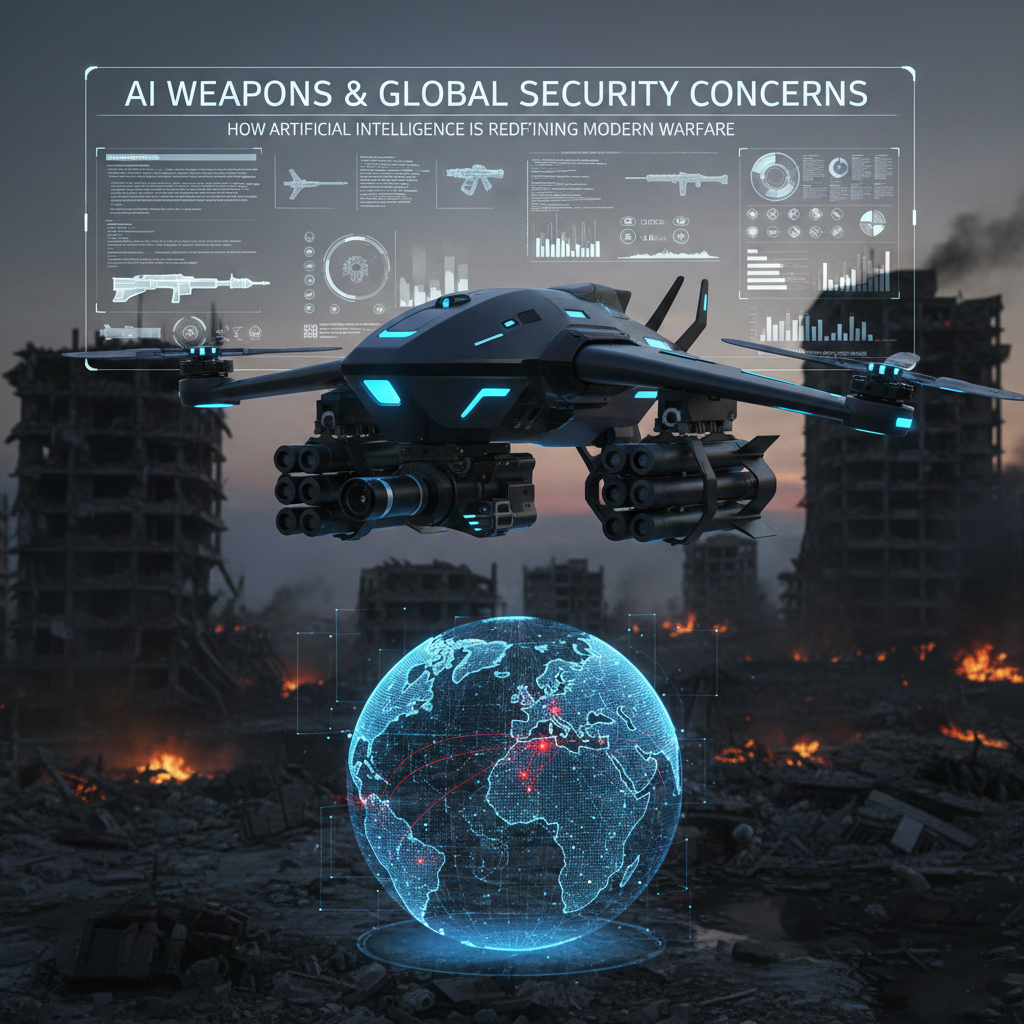
Why AI Weapons Are a Global Security Wake-Up Call
Artificial intelligence is no longer limited to smartphones, chatbots, or business automation. Today, AI-powered weapons systems are rapidly transforming global defense strategies, military operations, and international security policies. From autonomous drones to AI-driven cyber warfare tools, nations are entering a new era of warfare—one where machines can identify, decide, and strike with minimal human involvement.
The rise of AI weapons and global security concerns has triggered urgent debates among governments, defense experts, and human rights organizations. While AI promises faster decision-making, precision targeting, and reduced military casualties, it also introduces unprecedented risks, including accidental wars, loss of human control, ethical dilemmas, and global arms races.
This article provides a deep, human-centered analysis of AI weapons, their impact on global security, real-world applications, risks, regulations, and what the future may hold. If you want a clear, professional, and SEO-friendly guide to this critical global issue, you’re in the right place.
Understanding AI Weapons in Modern Warfare
What Are AI Weapons?
AI weapons, often referred to as autonomous weapons systems (AWS) or lethal autonomous weapons, are military technologies that use artificial intelligence to:
- Detect targets
- Analyze data in real time
- Make operational decisions
- Execute attacks with limited or no human intervention
These systems rely on machine learning, computer vision, predictive analytics, and sensor fusion to function effectively in complex combat environments.
Key Types of AI-Powered Military Weapons
AI in warfare is not limited to robots or drones. It spans multiple domains:
- Autonomous drones and UAVs for surveillance and strikes
- AI-guided missile defense systems
- Robotic ground vehicles for combat and logistics
- AI-enabled cyber weapons for hacking and digital sabotage
- Decision-support systems for battlefield strategy
- Facial recognition and target identification tools
These technologies are already being deployed by major military powers, raising serious global security implications.
Why AI Weapons Are a Major Global Security Concern
Speed of Warfare Beyond Human Control
AI systems operate at machine speed. Decisions that once took minutes or hours can now occur in milliseconds. While this may offer tactical advantages, it also increases the risk of:
- Accidental escalation
- Misinterpretation of data
- Unintended military conflicts
A small algorithmic error could potentially trigger large-scale military responses.
Reduced Human Accountability
One of the biggest ethical and legal challenges is accountability. If an AI weapon commits a war crime, who is responsible?
- The programmer?
- The military commander?
- The government?
This lack of clear responsibility weakens international humanitarian law and raises moral concerns worldwide.
Autonomous Weapons vs Human-Controlled Weapons
| Aspect | Human-Controlled Weapons | AI Autonomous Weapons |
|---|---|---|
| Decision-making | Human judgment | Algorithm-based |
| Reaction speed | Slower | Extremely fast |
| Emotional control | Moral reasoning possible | No emotions or ethics |
| Accountability | Clear chain of command | Legally unclear |
| Risk of error | Human mistakes | Algorithmic bias & data flaws |
This comparison highlights why many experts argue for keeping humans in the loop for all lethal decisions.
The Global AI Arms Race: Who Is Leading?
Countries Investing Heavily in AI Weapons
Several nations are aggressively developing AI military technologies:
- United States – AI-driven drones, predictive warfare, autonomous defense systems
- China – AI surveillance, smart missiles, military robotics
- Russia – Autonomous tanks, AI-powered electronic warfare
- Israel – Advanced drone swarms and AI targeting systems
- United Kingdom & NATO allies – Defensive AI and decision-support tools
This rapid development has triggered what many analysts call a global AI arms race, increasing geopolitical tensions.
Risks of an Unregulated AI Arms Race
- Lower barriers to warfare
- Proliferation of weapons to non-state actors
- Increased cyber and proxy conflicts
- Destabilization of international peace
Without global regulation, AI weapons could become as dangerous as nuclear weapons—if not more.
Ethical Challenges of AI Weapons in Warfare
Can Machines Make Moral Decisions?
AI lacks human values, empathy, and moral reasoning. Teaching a machine to distinguish between:
- Combatants and civilians
- Surrender and threat
- Proportional force and excessive violence
remains a massive challenge.
Bias and Data Manipulation Risks
AI systems are trained on data. If that data is biased, incomplete, or manipulated, the weapon’s decisions can be flawed. This can result in:
- Wrongful targeting
- Civilian casualties
- Discriminatory outcomes
In warfare, such errors are irreversible.
AI Weapons and International Humanitarian Law
Existing Legal Frameworks Are Outdated
Current international laws, including the Geneva Conventions, were written long before autonomous weapons existed. As a result:
- AI weapons fall into legal gray zones
- Enforcement mechanisms are weak
- Global consensus is lacking
Calls for a Global Ban or Regulation
Many organizations, including the United Nations and human rights groups, are pushing for:
- A complete ban on lethal autonomous weapons
- Mandatory human oversight
- Transparent AI military development
However, major military powers remain divided on these proposals.
Cyber Warfare and AI: A New Digital Battlefield
AI weapons are not only physical. AI-driven cyber warfare is becoming one of the most dangerous security threats.
How AI Is Used in Cyber Attacks
- Automated hacking and malware deployment
- Deepfake-based psychological warfare
- AI-generated disinformation campaigns
- Attacks on critical infrastructure
These tools can destabilize economies, elections, and public trust without firing a single bullet.
AI Weapons and Terrorism Risks
One of the most alarming concerns is AI weapons falling into the wrong hands.
Potential Threats from Non-State Actors
- Autonomous drones used for terrorist attacks
- AI-powered surveillance by extremist groups
- Cheap, scalable weapons with high impact
As AI technology becomes more accessible, preventing misuse becomes increasingly difficult.
The Role of AI in Defensive Military Systems
Not all AI weapons are offensive. AI also plays a crucial role in defense:
- Missile interception systems
- Early threat detection
- Border surveillance
- Disaster response and logistics
When used responsibly, AI can enhance national security without increasing global instability.
Future of AI Weapons and Global Security
Possible Scenarios Ahead
- Strict global regulation with human oversight
- Uncontrolled arms race leading to instability
- Balanced adoption focused on defense and deterrence
The path chosen will shape global peace for decades.
Importance of International Cooperation
No single country can address AI weapon risks alone. Global cooperation is essential for:
- Setting ethical standards
- Sharing best practices
- Preventing catastrophic misuse
Frequently Asked Questions About AI Weapons & Global Security
Are AI weapons already being used in real wars?
Yes. AI-assisted drones, surveillance systems, and targeting technologies have already been used in modern conflicts.
Can AI weapons start a war by mistake?
Yes. Algorithmic errors, misinterpretation of data, or cyber manipulation could trigger unintended military escalation.
Are AI weapons illegal under international law?
Currently, they are not fully illegal, but they exist in legal gray areas. Global regulations are still under discussion.
Why are autonomous weapons considered dangerous?
They reduce human control, increase speed of conflict, and raise serious ethical and accountability issues.
Can AI improve global security instead of harming it?
Yes, when used defensively and responsibly, AI can enhance early warning systems, reduce casualties, and prevent conflicts.
Conclusion: The Urgent Need for Responsible AI in Warfare
AI weapons represent one of the most powerful and dangerous technological shifts in human history. While artificial intelligence can enhance defense capabilities and protect nations, its unchecked use threatens global stability, human rights, and international peace.
The real challenge is not whether AI weapons will exist—but how humanity chooses to control them. Transparent policies, international cooperation, ethical standards, and human oversight must be prioritized before AI-driven warfare becomes irreversible.
